









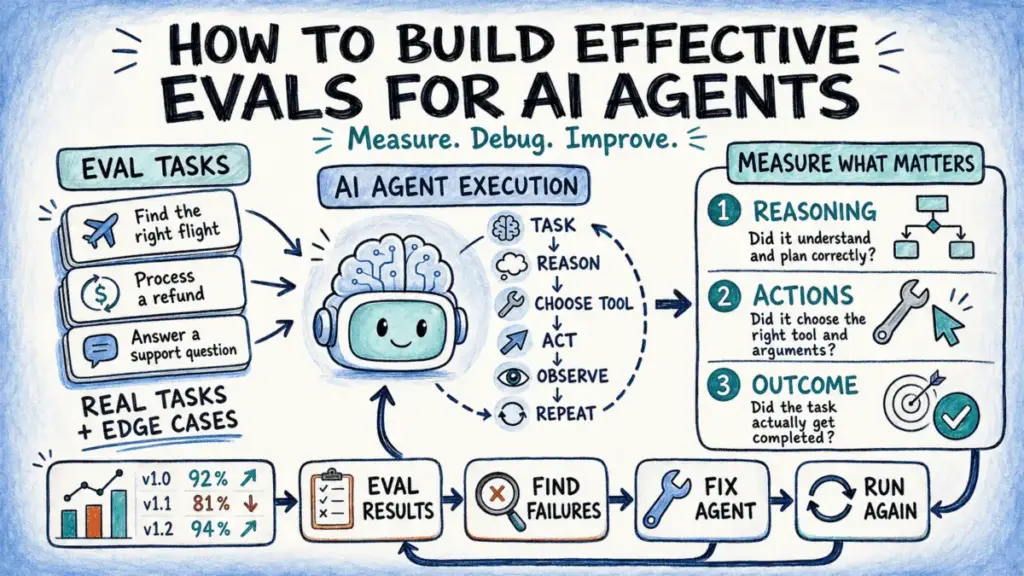
Developing and deploying autonomous artificial intelligence agents has rapidly evolved from an experimental endeavor into a core software engineering discipline. However, engineering teams across the technology sector continue to grapple with a persistent operational challenge: an agent’s performance frequently degrades after seemingly minor updates, leaving developers in the dark regarding the root cause. Whether a failure stems from a subtle tweak to a system prompt, an updated tool description, or an underlying model version migration, the behavioral impacts can be unpredictable. Without a systematic methodology to measure these variances, development cycles easily devolve into costly guesswork and repetitive manual testing.
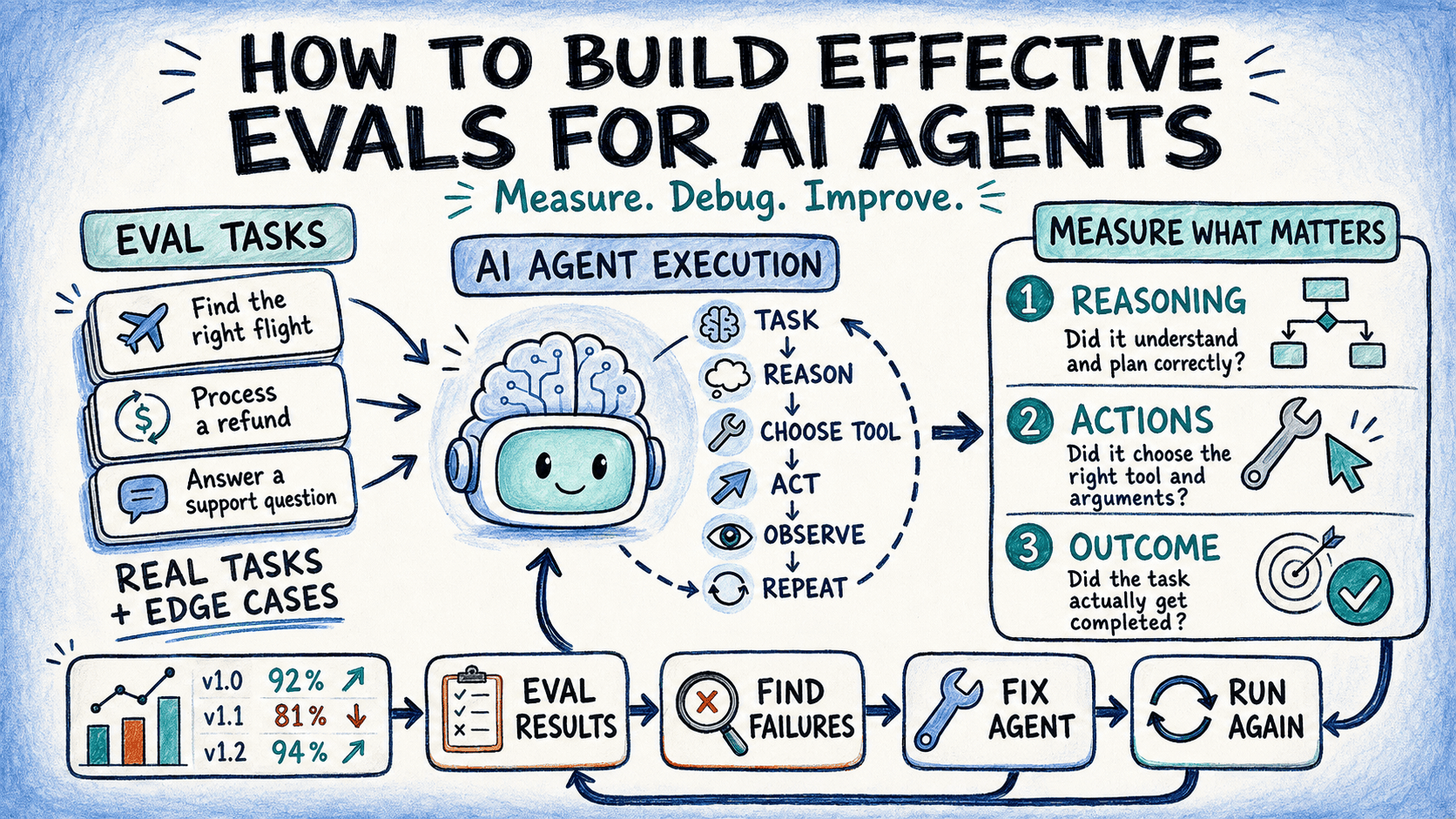
Industry engineers increasingly rely on structured evaluations, commonly known as evals, to measure these behavioral shifts. An evaluation framework provides an agent with a defined task, executes the workflow, and checks the output against pre-established criteria. By running this same validation process across different versions and system modifications, development teams can isolate performance deltas. Instead of relying on broad, subjective claims about an agent’s operational capability, engineers can pinpoint specific, measurable behavioral changes. This transforms a vague production bug into a concrete engineering issue to investigate, providing a reliable benchmark to verify whether a code or prompt change actually improved the final result.
Understanding how to build these evaluation frameworks requires looking closely at what makes agent testing fundamentally distinct from traditional software validation.

Understanding Why Agent Evals Are Different
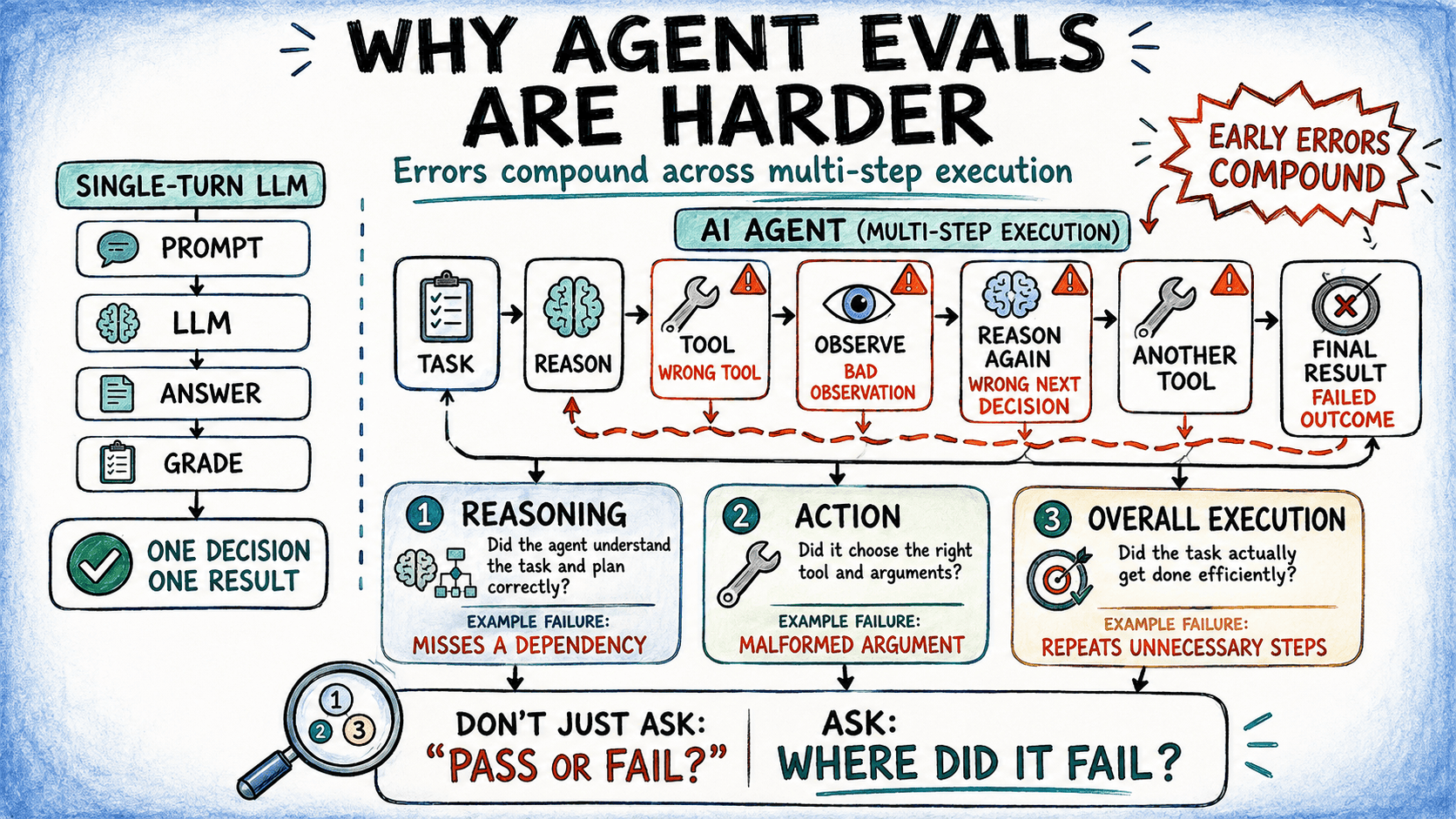
Evaluating traditional software or single-turn large language models is relatively straightforward: a single prompt yields a single response, and an automated grader checks it against an expected output. Autonomous agents fundamentally break this linear model. An agent must reason through a complex task, select an appropriate tool, execute an action, observe the resulting system feedback, and repeat the loop—sometimes for dozens of sequential turns.
In this multi-step paradigm, every single step can fail independently. Furthermore, because subsequent steps rely on the accumulated context of prior actions, an early mistake alters the entire state that later reasoning processes depend upon. Consequently, errors tend to compound rapidly rather than remaining isolated to a single function call. This compounding effect highlights why developers must evaluate agent failures in distinct layers rather than relying on a simplistic pass-or-fail metric.
When assessing an agent’s performance, engineers find it useful to separate failures into three distinct operational layers: reasoning, action, and overall execution. For instance, consider an automated travel-booking agent. A failure in the reasoning layer occurs when the agent attempts to book a return flight before verifying whether the requested outbound flight is actually available. A failure in the action layer happens when the agent correctly identifies the need for a flight-search tool, but passes a city name or airport code that the underlying API does not recognize. Finally, an overall execution failure occurs when the agent eventually completes the booking, but does so inefficiently—such as calling the same search tool multiple times for information it had already retrieved in an earlier turn.
A properly designed evaluation framework should immediately identify which specific layer failed, moving beyond a simple binary indication of task failure. This layered approach is further complicated by the autonomy of modern frontier models. Given sufficient flexibility, an agent may discover a completely valid, highly creative solution that no human anticipated when writing the test case. A rigid, overly dogmatic grader might incorrectly mark this unexpected path as a failure, even though the agent solved the user’s underlying problem more effectively than the prescribed method. Robust evaluation systems must therefore assess the ultimate outcome and the logical reasonableness of the approach, rather than enforcing a rigid, predetermined sequence of steps.
Sourcing Tasks and Writing Testable Criteria
Building a robust evaluation suite does not require hundreds of complex tasks on day one. A small, highly focused set of initial test cases is frequently sufficient to catch meaningful regressions early in the development lifecycle. Establishing clear requirements and turning them into repeatable test cases is significantly easier before an application architecture becomes deeply complex.
The most efficient approach to assembling a first evaluation set is to leverage the manual checks engineering teams already perform: common user workflows, known edge cases, and standard scenarios tested prior to a software release. Transitioning these manual checks into repeatable, automated tasks eliminates the need to test core functionality from scratch during every deployment cycle.
Moreover, engineering teams must maintain a balanced test set that includes scenarios where a specific behavior is strictly required alongside scenarios where it must be avoided. For instance, a search evaluation suite should incorporate queries that explicitly necessitate external web retrieval alongside queries that can be answered directly from the model’s internal parametric knowledge. This balance measures whether the agent is exercising sound judgment regarding tool utilization, rather than blindly repeating the same operational sequence regardless of user intent.
Writing effective evaluation tasks requires clear, objective success criteria. Two independent reviewers examining the exact same agent execution transcript should arrive at the same conclusion regarding whether the test passed. If a task description is vague or leaves critical details open to subjective interpretation, the evaluation grader ends up measuring its own ambiguity rather than the agent’s actual capability. Before integrating any task into the primary test suite, developers must ensure the instructions contain all necessary context. If a grader assumes background information that the task prompt omitted, any resulting failure reflects poor task design rather than a deficiency in the agent.
Selecting Appropriate Graders and Harness Architecture
Different components of an agent’s behavior require distinct measurement strategies, making it essential to match the grader type to the specific operational layer being evaluated.
Deterministic graders, such as standard string matching, unit test suites, and database checks, offer fast, inexpensive, and entirely unambiguous results, though they struggle to recognize valid output variations they were not explicitly programmed to anticipate. Code-based graders, which utilize programmatic assertions, API health checks, and state validation scripts, excel at verifying functional behavior, structured outputs, and database state transitions, provided the test environment remains strictly controlled.
For more subjective or open-ended tasks involving freeform natural language generation, model-based graders—where a separate large language model scores the execution transcript against a detailed rubric—provide scalable evaluation, provided they are regularly calibrated against human judgment. Finally, human review remains indispensable for complex judgment calls that automated scripts or secondary models cannot reliably execute alone, even if it is inherently slower and more expensive to scale.
Beyond selecting the right grader, the underlying evaluation harness must provide a clean, isolated environment for every trial. Leftover temporary files, cached API responses, or shared execution history can easily skew results, artificially inflating or deflating an agent’s true reliability. Furthermore, teams should embrace partial credit scoring rather than defaulting to binary pass-or-fail metrics. An agent that correctly diagnoses a customer’s issue and verifies their identity but ultimately fails to process a refund is performing at a fundamentally higher level than an agent that completely misunderstands the initial request; binary scoring obscures this critical performance distinction.
Because autonomous agents frequently exhibit non-deterministic behavior and rarely produce identical execution paths across multiple runs, a single trial can be highly misleading. To accurately quantify reliability, teams utilize metrics such as pass@k, which measures the probability of achieving at least one successful execution across k attempts—ideal for batch tasks where eventually finding a valid solution is sufficient. Conversely, customer-facing applications often rely on pass^k, which measures the probability that all k attempts succeed consecutively, ensuring strict consistency.
Transcript Inspection and Continuous Integration
Dashboard scores alone cannot guarantee that an evaluation suite is measuring the correct parameters. Engineering teams must regularly inspect raw execution transcripts to review the agent’s step-by-step reasoning, tool invocations, and final state transitions. When a task fails, reviewing the transcript clarifies whether the agent genuinely malfunctioned or whether an overly rigid grader incorrectly rejected a valid, alternative solution. This qualitative review frequently exposes broken grading logic and ambiguous task specifications. In many cases, resolving underlying grading bugs has substantially improved benchmark performance metrics without requiring a single change to the core agent model.
Organizations must also watch for evaluation suites where agents already achieve near-universal success. While a 98% pass rate provides a reliable regression guard for existing functionality, it offers little insight into where the agent can be further optimized. Mature development workflows incorporate continuous testing by wiring evaluation suites directly into the software development lifecycle. By tracing an agent’s core functions and executing the evaluation suite like standard unit tests upon every pull request, engineering teams can automatically block code merges that introduce performance regressions before those changes ever reach production users.
Ultimately, robust evaluation frameworks transform the development of artificial intelligence agents from an exercise in unstructured guesswork into a predictable, measurable engineering discipline. By combining repeatable tasks, layered grading, isolated test harnesses, and continuous transcript monitoring, development teams can systematically identify what improves, what regresses, and why—establishing a reliable feedback loop of testing, measurement, diagnosis, and continuous improvement.