









In the modern digital economy, keeping pace with fast-moving markets requires a continuous flow of up-to-date information. Whether tracking shifting competitor prices, updating product rankings across international marketplaces, or collecting vital supplier details, data-driven organizations rely heavily on web scraping. However, gathering this information traditionally demands tedious manual searching, filtering, and paging through disjointed search results, followed by the complex task of combining data from dozens of different pages. While emerging artificial intelligence tools have simplified initial data exploration, recurring enterprise tasks still require reliable, reusable pathways to prevent overhead costs from spiraling out of control.
Every week that a data collection job repeats, the technical overhead adds up. Traditional custom scripts require constant maintenance to handle broken selectors, while unguided AI agents that attempt to explore a target website afresh consume excessive time and computational tokens. To address these industry-wide bottlenecks, platforms like BrowserAct have emerged, offering no-code AI web scraping solutions designed to balance the exploratory flexibility of artificial intelligence with the structural efficiency needed for large-scale, recurring data collection.
Why Traditional Web Scraping Tools Struggle With Complex Websites
Extracting information from a stable, static HTML page is usually a straightforward engineering challenge. However, traditional web scraping tools encounter significant roadblocks when confronted with modern web applications. Today’s dynamic websites frequently require scrapers to wait for heavy JavaScript rendering to complete, submit interactive search queries, apply complex multi-layer filters, navigate through deep pagination, and visit individual detail pages to capture complete datasets. Furthermore, unexpected pop-ups, regional content variations, and human-verification security checkpoints introduce a multitude of volatile page states that standard scripts struggle to interpret autonomously.
Attempting to solve these complex navigation challenges using custom-built scripts inevitably leads to heavy maintenance burdens. Engineering teams find themselves constantly updating brittle CSS or XPath selectors, managing fragile browser automation environments and proxy pools, and spending valuable hours diagnosing sudden failures whenever a target website undergoes an unannounced design update. As these data collection tasks scale across multiple product categories, geographic regions, and competing platforms, the cumulative maintenance work grows exponentially, diverting developer resources away from core product innovation.
Why AI Web Scrapers Need a Reusable Path for Recurring Tasks
The advent of AI-powered web scrapers promised a paradigm shift by allowing users to articulate their extraction goals directly in natural language. Instead of writing rigid code, an analyst can simply instruct an agent to search for specific items, filter by rating thresholds, and return structured fields such as names, prices, sellers, and inventory availability. Advanced AI models can dynamically explore target websites, bypass interactive filters, and work through pagination structures to locate and extract the required data fields.
Despite their impressive adaptability during ad hoc research, completing a task once does not automatically establish a reliable, reusable collection pipeline. Without a saved, tested execution path, subsequent runs of an AI scraper may interpret the target web pages and plan their navigation actions all over again. While this trial-and-error approach is acceptable for one-off investigations, it becomes highly inefficient for tasks scheduled to run daily or weekly. Repeated reasoning consumes unnecessary tokens and time, making operational expenses unpredictable and delaying the delivery of business-critical insights.
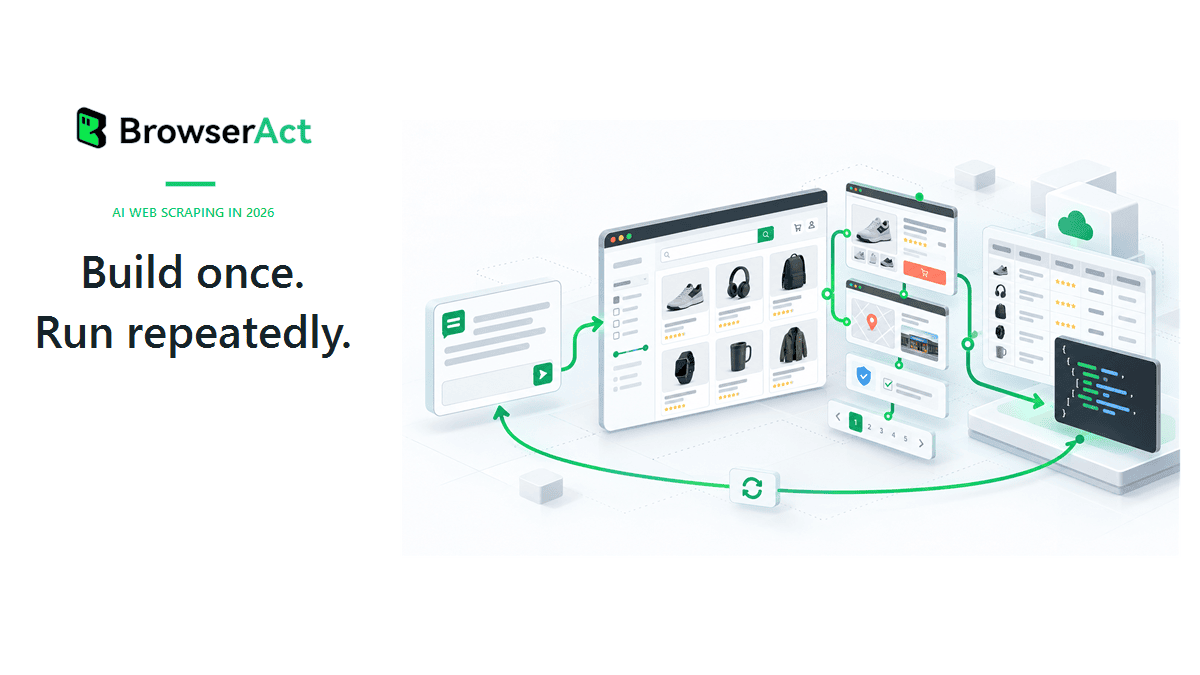
To solve this dilemma, platforms such as BrowserAct convert initial exploratory browsing and testing sessions into a permanent, reusable Bot. Subsequent automated runs leverage this validated logic to consistently deliver structured data without redundant computational overhead.
BrowserAct: Reliably Scraped Structured Data From Complex Websites at Scale
Positioned as a comprehensive no-code AI web scraping platform, BrowserAct is engineered to explore and test live websites, extracting necessary data fields from dynamic pages, active filters, paginated results, and nested detail pages. The platform removes the traditional barriers of entry by eliminating the need to write code, configure complex selectors, or install and manage local browser infrastructure.
For recurring data collection operations, the platform utilizes specialized Bots that preserve verified extraction logic. When running scheduled updates, operators can simply modify parameters such as URLs, keywords, categories, or target regions using the Bot’s supported configuration options to seamlessly harvest fresh market intelligence.
How the BrowserAct AI Web Scraper Works
Organizations looking to deploy automated web scraping can choose between leveraging prebuilt templates or generating customized scrapers from scratch. The platform features an extensive library of more than 400 prebuilt web scraping templates designed for immediate deployment. Users can select an established template, populate the required parameters, and initiate data extraction with a single click. For instance, teams utilizing the Amazon Best Sellers Scraper template can select a specific marketplace and product category, define the desired volume of items, and instantly extract product ranks, names, direct links, pricing, user ratings, and review counts. These templates can be re-run whenever an updated market overview is required.
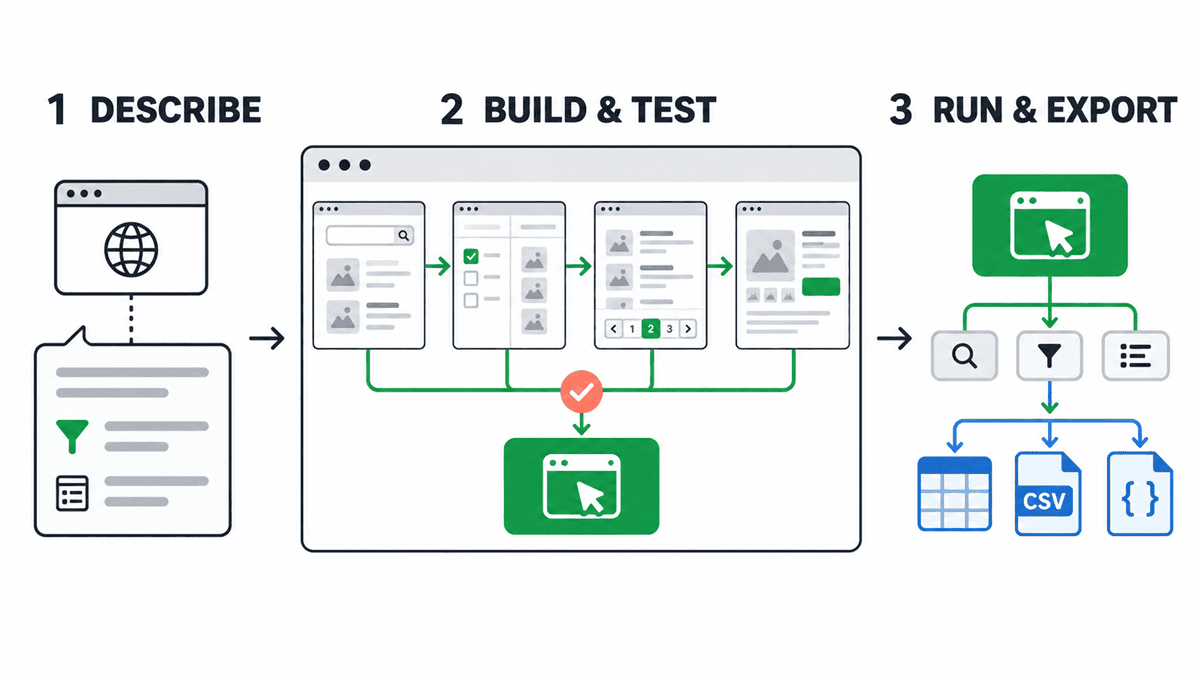
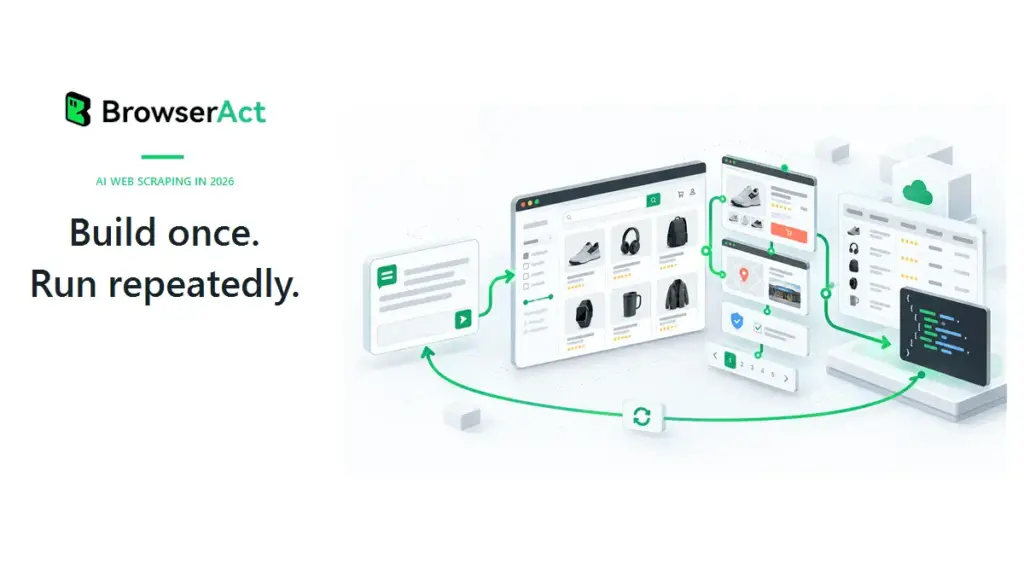
When dealing with niche websites or highly specific filtering criteria, users can bypass templates entirely by describing their data collection objectives in plain language. The platform translates these natural language instructions into a customized AI web scraper through an automated discovery workflow. The system initially evaluates the user’s instructions regarding target websites, filters, and required data fields, then dispatches intelligent agents to explore the live web pages, test the navigation path, and construct a stable, reusable Bot. Once finalized, operators can execute the Bot repeatedly, feeding structured output directly into downstream business applications and analytical reports.
Automated Web Scraping for Complex, Recurring Data Collection
Modern enterprise data pipelines demand robust architectures capable of handling complex, recurring collection tasks without prohibitive costs. BrowserAct addresses these requirements by combining automated AI discovery with persistent, reusable execution paths. By allowing artificial intelligence to handle initial site exploration and path validation while routing routine runs primarily through saved scripts, the platform successfully minimizes repeated reasoning, token consumption, and execution delays. While initial custom Bot creation utilizes system credits, subsequent runs of published Bots operate at a fraction of the cost, typically consuming only thirty to fifty credits per execution.
To ensure uninterrupted data flows, the platform relies on managed cloud browsers equipped with advanced stealth fingerprinting, residential and dynamic proxies, and regional IP selection. These capabilities empower the system to interact smoothly with highly dynamic web pages and execute multi-step extractions without triggering immediate blocks. Furthermore, the infrastructure provides built-in mechanisms to handle supported CAPTCHA and human-verification workflows, significantly reducing the engineering overhead that internal teams would otherwise need to shoulder.
When target websites undergo structural updates that disrupt existing extraction pathways, operators can utilize detailed failure records to optimize the Bot, test the revised logic, and publish an updated version. The platform’s ongoing support depends heavily on the specific access conditions and structural volatility of the target web domain.
Once harvested, structured data can be exported immediately in standard CSV or JSON file formats. Alternatively, organizations can leverage built-in APIs, webhooks, and native integrations with workflow automation platforms like Make, n8n, and Zapier to feed fresh data directly into enterprise reporting dashboards and operational workflows. Additionally, published Bots can be configured as Model Context Protocol tools, allowing compatible AI clients connected to the corresponding server to access live web data seamlessly.

E-commerce organizations utilize these automated capabilities to monitor competitor pricing strategies, product availability, and category rankings across multiple international markets in real time. Meanwhile, corporate research and data-science teams rely on continuous scraping to keep industry directories, job boards, and supplier databases synchronized. By integrating structured results directly into internal databases and automated workflows, businesses maintain a distinct operational advantage in fast-paced digital environments.
Choosing the Right Web Scraping Tool for Recurring Data Collection
When evaluating web scraping solutions for complex and recurring data pipelines, decision-makers must carefully weigh the initial setup requirements against the long-term maintenance burden associated with routine website updates. While traditional custom scripts offer maximum flexibility, they demand continuous engineering oversight to maintain codebases and browser environments. Conversely, rigid web scraping APIs simplify data retrieval but often falter when encountering complex, multi-step navigation paths that require custom development. Visual scrapers offer a user-friendly entry point via point-and-click element selection, yet they remain vulnerable to minor layout changes that break saved configurations. While one-off AI agents excel at ad hoc research through natural language prompts, their failure to preserve execution paths leads to redundant processing overhead during scheduled runs. Modern hybrid solutions like BrowserAct bridge these operational gaps by combining natural language accessibility and template-driven deployment with managed cloud infrastructure and persistent, parameter-driven execution paths.
Start With a Prebuilt AI Web Scraper or Build Your Own
Organizations seeking to modernize their data collection pipelines can begin by exploring ready-made templates or utilizing natural language prompts to construct custom scraping Bots tailored to their exact specifications. New users can access introductory tiers, while paid monthly subscription plans feature a comprehensive seven-day free trial to evaluate platform performance under live operational conditions.
As part of an exclusive partnership for KDnuggets readers, new subscribers can apply the promotional code KDnuggets at checkout to receive a fifty percent discount on their first monthly subscription order, up to a maximum value of two hundred United States dollars.