








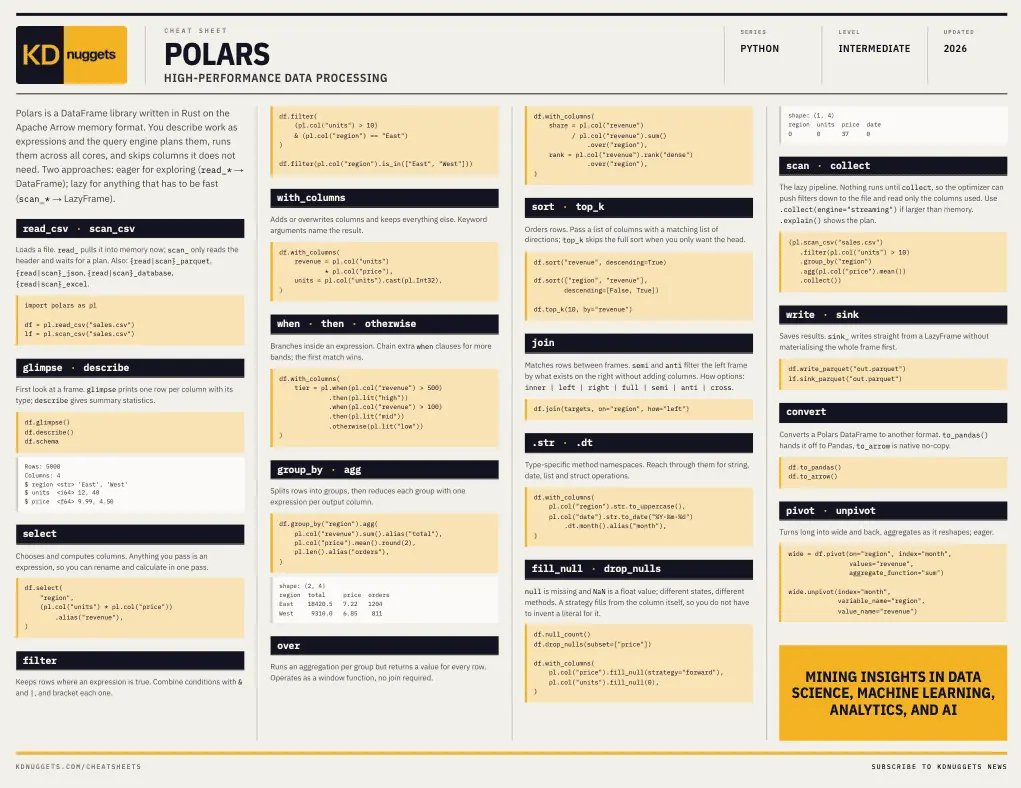
Most data practitioners arrive at Polars after experiencing a very specific, highly relatable kind of frustration: they are handling a dataset that fits comfortably on their hard drive but completely overwhelms their system memory, or they are trying to execute a heavy transformation that stubbornly runs on a single CPU core while the other fifteen cores sit completely idle. Written in Rust and built directly on the Apache Arrow memory format, Polars has rapidly emerged as a transformative DataFrame library. However, as experienced developers quickly realize, the remarkable speed of the library stems less from the underlying programming language itself and much more from its sophisticated execution model. Instead of forcing immediate, imperative execution, Polars asks users to describe their data operations as a series of abstract expressions. The built-in query engine then maps out these expressions, plans the entire sequence of operations, and determines the most efficient execution strategy across all available hardware cores, intelligently bypassing unnecessary columns entirely. To help developers navigate this paradigm shift, KDnuggets has officially released a comprehensive new cheat sheet designed to provide all the foundational functionality necessary to make Polars work at peak efficiency.
The unique mechanics of this execution model are perhaps most clearly observed when comparing immediate data loading with lazy evaluation, specifically through the contrasting behaviors of functions like read_csv and scan_csv. While traditional methods like read_csv immediately pull an entire file into system memory, scan_csv takes a much more cautious approach by reading only the file header and then pausing, waiting for further instructions. Every operation chained after this initial scan is merely a recorded description of intent; nothing actually executes until the user explicitly invokes the collect method. This delayed execution gives the query engine valuable breathing room to optimize the pipeline, pushing data filters directly down to the file level itself so that the system reads only the specific columns required by the pipeline. For massive files that vastly exceed available RAM, utilizing collect(engine="streaming") allows the engine to process data in manageable chunks rather than abruptly failing or throwing memory errors.
Another foundational concept that separates Polars from older tools is the use of window functions through the over expression. Traditionally, calculating a group’s internal share of a total or ranking items within a specific category required complex groupby-and-join procedures that bloated code and slowed down execution. In contrast, the over expression runs an aggregation per defined group while seamlessly returning a calculated value for every single row in the dataset. This powerful window function operates directly as a normal column expression, eliminating the friction of multi-step transformations and keeping data pipelines clean and readable.

Beyond these architectural advantages, practitioners must also navigate subtle design choices that often trip up newcomers during early adoption. A prime example is the distinct treatment of missing values versus undefined numerical states. In the Polars ecosystem, a null value strictly represents a missing entry, whereas NaN represents an actual floating-point mathematical value. These represent completely different states that require entirely different handling methods, and expecting them to behave as a single interchangeable concept is a common stumbling block for developers transitioning from other data analysis environments.
To address these learning curves and provide a ready reference for daily development, the newly published KDnuggets cheat sheet covers the entire working surface of the library. It details the core verb set consisting of select, filter, and with_columns, alongside comprehensive grouping and reshaping capabilities through group_by, agg, pivot, and unpivot. It also outlines conditional logic implementation using when, then, and otherwise, as well as advanced join operations including semi and anti variants that filter datasets without artificially widening the frame. Furthermore, the reference covers the specialized .str and .dt namespaces for type-specific string and datetime operations, and outlines output options such as sink_parquet, which writes data straight from a lazy frame without materializing it in memory first. Recognizing that adopting a new tool does not mean discarding existing infrastructure, the cheat sheet also highlights interoperability methods like to_pandas and to_arrow for seamless integration with legacy Python workflows. Data professionals looking to optimize their daily operations can download the Polars high-performance data processing cheat sheet directly through the KDnuggets platform to immediately enhance their analytical efficiency.