











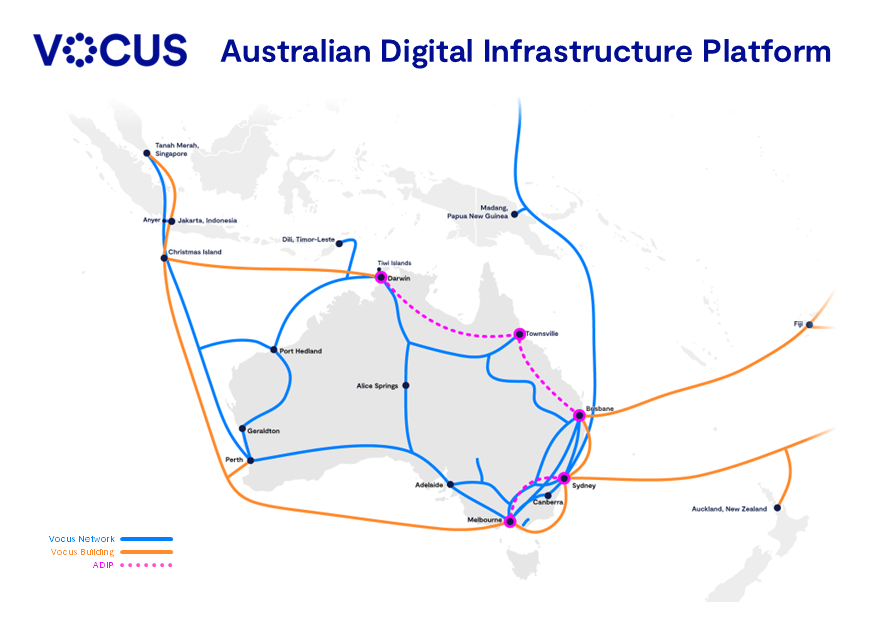
Fiber specialist Vocus has announced plans to build its second major ducted long-haul fiber route, a massive 4,000-kilometer infrastructure project that will connect Brisbane, Townsville, and Darwin across northern Australia.
The ambitious project represents the second major deployment under the company’s Australian Digital Infrastructure Platform (ADIP), a multi-year strategic initiative launched by Vocus to tackle the nation’s rapidly widening fiber capacity gap. As artificial intelligence workloads, cloud computing, and advanced digital services drive unprecedented demands for data transmission, the telecommunications company is reshaping how high-capacity networks are built and maintained in the region.
Designed to accommodate up to 3,456 fiber strands, the new Brisbane-to-Darwin corridor is slated to be fully completed and ready for service by 2030. While Vocus has chosen not to disclose the specific financial details regarding this latest northern expansion, the strategic importance of the route to Australia’s digital future is immense.

"Northern Australia is becoming a critical region for AI, cloud, and digital services, with Queensland and the Northern Territory emerging as important data center precincts and gateways connecting Australia with Asia and the United States," said Vocus CEO Andress Irlando in a statement detailing the project.
Vocus is no stranger to the strategic landscape of northern Australia, where it already operates critical international communications infrastructure. This existing footprint includes the Darwin-Jakarta-Singapore cable system and the North-West cable system. Furthermore, the region has increasingly drawn the attention of global technology giants, with major subsea network initiatives currently underway by players like Google and Meta, both of which maintain strong strategic interests in northern Australia’s connectivity hubs.
The addition of the Brisbane-to-Darwin route is intended to create a robust web of high-speed pathways that tie regional gateways back into the nation’s primary demographic and economic centers.
"The Brisbane-Darwin corridor will strengthen the connection to Australia’s east coast and give customers additional capacity, diversity, and resilience," explained Vocus Chief Technology Officer Nikos Katinakis.
Extending Australia’s Ducted Fiber Deployment
Katinakis emphasized that Vocus’ new long-haul fiber route between Brisbane and Darwin directly builds upon the foundational engineering design of the company’s first ducted inter-capital project, which was unveiled for the Sydney-Melbourne route.
Announced in July as the inaugural project under the broader ADIP initiative, the Sydney-Melbourne route marked a historic milestone as the first Australian inter-capital project to deploy modern ducted infrastructure. That pioneering route is capable of accommodating up to 6,912 fiber cores, representing approximately 3,456 fiber pairs. Backed by a hefty investment of 500 million Australian dollars (approximately $344.5 million US dollars), the Sydney-Melbourne link is scheduled to be ready for service by 2029.
Although ducted fiber architecture has long been standard practice among leading artificial intelligence and cloud infrastructure providers in North America and Europe, it has historically never been utilized on a long-haul route within Australia.
Traditional long-haul fiber deployment methodologies across the Australian continent have long relied on burying direct-lay cables straight into the ground. Under this legacy approach, once a cable’s capacity is completely exhausted, operators must physically dig up the earth along thousands of kilometers of terrain to lay additional cables, a process that is not only costly and time-consuming but also introduces the constant risk of disrupting active customer lines.
In stark contrast, the modern ducted approach utilized by Vocus involves placing fragile glass fiber strands inside protective underground pipes. This innovative architecture empowers Vocus to seamlessly upgrade network capacity over time simply by blowing additional fiber pairs through the existing pre-installed ducts. By eliminating the necessity for repeated excavation work, the company can expand bandwidth rapidly and safely without disturbing operational networks.
"This creates a scalable foundation for incremental fiber deployments over time," Katinakis noted, highlighting the long-term operational efficiency and flexibility that the ducted model introduces to the Australian telecommunications market.
Market research commissioned by Vocus underscores the urgent necessity for these sweeping infrastructural upgrades. Projections indicate that Australia’s total data center capacity is on track to triple by the year 2030, with artificial intelligence workloads expected to account for the lion’s share of future long-haul fiber demand. As enterprises and hyperscalers rush to adopt advanced computational technologies, legacy fiber corridors across the country are facing mounting pressure and are rapidly approaching saturation points as connectivity demands continue their exponential climb.
The company’s overarching ADIP initiative is strategically targeted at closing this looming capacity deficit. By deploying thousands of new fiber route kilometers, massive counts of fresh fiber pairs, and hundreds of additional terabits of capacity across both terrestrial and subsea networks, Vocus is positioning its infrastructure to support the next generation of digital innovation across the Australian continent.