









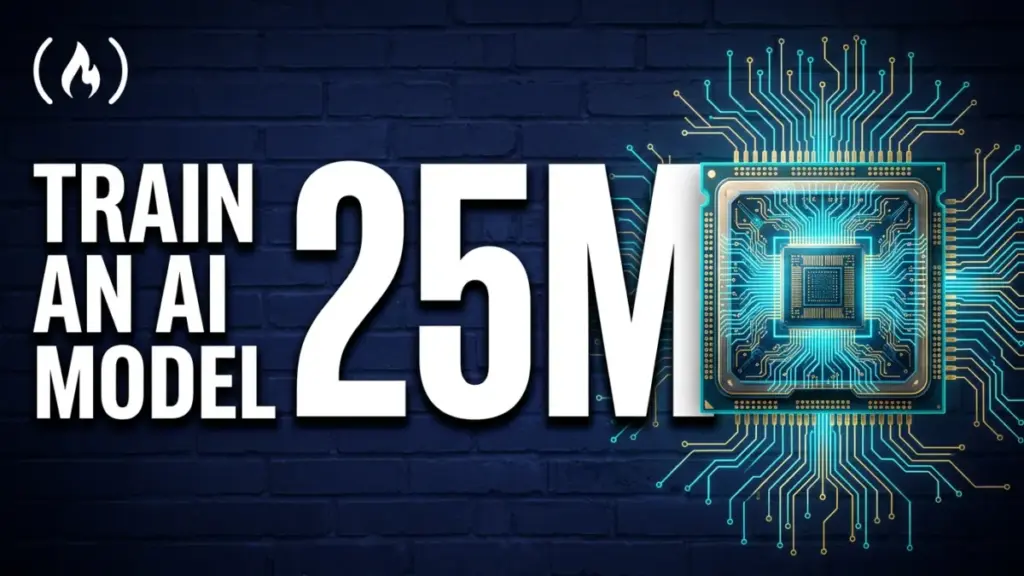
The barrier to entry for understanding modern frontier artificial intelligence has officially dropped, as developers and AI enthusiasts no longer require massive GPU clusters or expensive cloud infrastructure to learn how complex language models operate under the hood. In a newly released educational video published on the freeCodeCamp.org YouTube channel, learners are guided through the comprehensive process of building, pre-training, and fine-tuning a working 25-million parameter language model executed directly on a standard laptop or everyday CPU.
While the artificial intelligence industry is dominated by massive frontier laboratories training colossal systems spanning hundreds of billions or even trillions of parameters, the fundamental underlying architecture, mathematical principles, and operational workflows remain remarkably consistent across scales. By deliberately scaling down a standard transformer architecture to a modest 25 million parameters and implementing a compact byte-level vocabulary, this approach strips away the prohibitive cloud compute costs that typically gatekeep advanced machine learning education. Consequently, training loops can execute locally on consumer-grade hardware in a matter of seconds, transforming what is usually an opaque, hours-long cloud waiting game into an immediate, interactive learning experience.
This rapid iteration cycle provides a distinct pedagogical advantage, enabling developers to directly observe how micro-level modifications to data curricula, loss functions, and reward designs alter model behavior in real time. Rather than treating an expansive language model as a distant black box accessible only via commercial application programming interfaces, local execution allows practitioners to peer directly into the mechanics of tokenization, attention mechanisms, and gradient descent. Because the entire system operates on local hardware, experimentation becomes frictionless, encouraging trial and error without the financial anxiety of runaway cloud computing bills.
The comprehensive one-hour tutorial covers the essential pillars of modern language model construction and optimization. Viewers are taken through the initial conceptualization and coding of the model architecture from scratch, moving past high-level abstractions to write the core components that give neural networks their predictive capabilities. Following the structural setup, the curriculum delves into pre-training methodologies, explaining how raw text corpora are processed and fed into the network to establish foundational linguistic patterns. Finally, the tutorial addresses the critical phase of fine-tuning, demonstrating how a pre-trained model can be adapted and refined for specific tasks or behaviors using specialized training loops.
This educational release arrives at a time of immense public interest in artificial intelligence, coupled with a simultaneous widening of the gap between consumer usage and deep technical comprehension. While millions of people interact with generative artificial intelligence daily, very few understand the mechanical realities of how probabilistic token prediction functions at a code level. By demonstrating that foundational comprehension does not demand enterprise-grade budgets or specialized hardware accelerators, the initiative aims to democratize AI education and empower a broader demographic of programmers to transition from mere consumers of AI tools to active builders of the technology.
The full tutorial is available to watch for free on the official freeCodeCamp.org YouTube channel, providing an accessible pathway for students, hobbyists, and professional developers alike to demystify the technology powering the current wave of artificial intelligence innovation.