










The ongoing evolution of the modern web platform is quietly reshaping how developers manage application codebases, with recent advancements allowing mid-sized JavaScript applications to eliminate between 60KB and 90KB of minified and gzipped dependencies. As browsers rapidly ship native APIs for tasks that once required dedicated external packages, industry experts are urging development teams to re-evaluate their dependency management strategies and audit their package configurations against modern web standards.
For years, installing third-party libraries for routine operations like date manipulation, number formatting, HTTP requests, modal dialogs, and array grouping has been standard practice. Once installed, these dependencies frequently remain untouched for the lifetime of a project, passing automated tests while silently contributing to larger bundle sizes. However, the capabilities of the underlying web platform have advanced significantly, rendering a surprising number of traditional utility libraries redundant.
The persistence of these redundant packages is rarely attributed to negligence. Instead, many engineering teams fail to audit their dependencies on a regular cadence or remain unaware of the rapid pace at which modern browser engines are implementing standardized features. While automated security audits are standard procedure across the industry, asking whether a specific library continues to perform functions that the browser cannot handle independently remains an infrequent practice.

To address this oversight, industry analysts recommend examining dependencies in functional clusters rather than evaluating packages individually, as optimization opportunities frequently emerge in groups. By combining bundle size mathematics with structured compatibility evaluations, development teams can establish repeatable auditing processes to trim unnecessary weight from their production codebases.

Understanding the Role of Baseline in Modern Web Development
Central to this auditing movement is the concept of Baseline, an initiative from the WebDX Community Group that provides clear, standardized guidance on the cross-browser safety of web features across major engines including Chrome, Edge, Firefox, and Safari. Features categorized under this framework typically progress from newly available status to widely available status over time, a transition period that directly influences when a team can safely deprecate a third-party library.
A feature that has achieved widespread availability generally allows developers to remove a corresponding dependency immediately. Conversely, features that are newly available require teams to review their specific audience analytics or rely on feature detection before making substitutions. Public-facing websites catering to diverse device ecosystems demand a more cautious approach than internal enterprise dashboards populated by users on modern, up-to-date browsers.
Before removing any library, engineering teams must evaluate three critical factors: whether the native replacement is safe for their specific user base, whether implementing a polyfill might inadvertently increase bundle size, and whether the platform feature fully covers the application’s actual use cases. Specialized libraries often provide advanced features—such as request interceptors or automatic retries in HTTP clients—that go beyond basic native implementations, requiring careful verification before migration.
Internationalization and HTTP Client Optimization
The internationalization cluster frequently yields the most substantial bundle size reductions, as native browser features under the Internationalization API replace numerous small, popular formatting libraries. Built-in tools such as relative time formatting, number and currency localization, and list formatting allow developers to eliminate packages that previously handled these linguistic transformations. While certain advanced capabilities like humanized durations remain newly available and require careful consideration of user demographics, implementing native internationalization features can easily save typical applications upwards of 14KB of gzipped code.

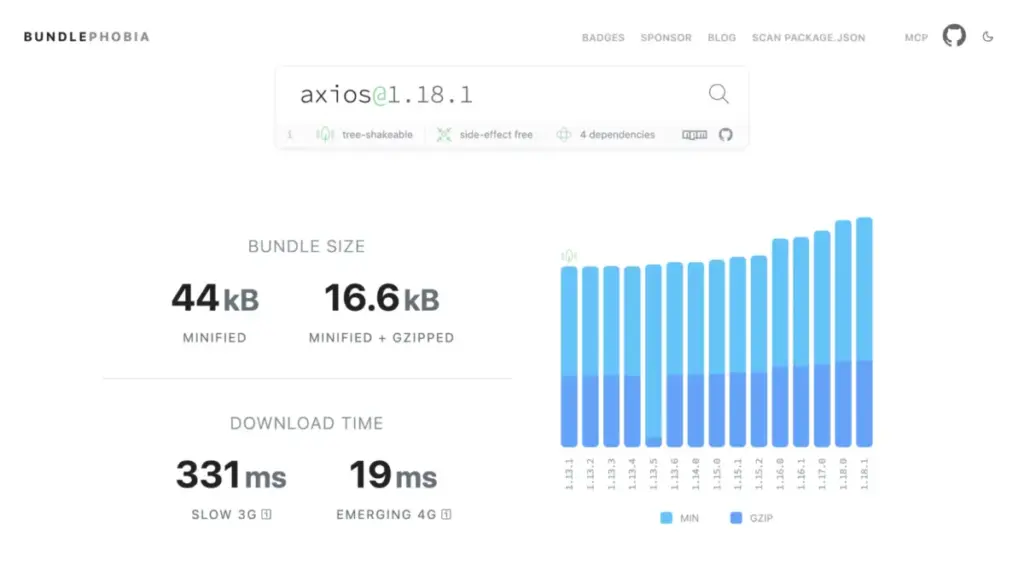
HTTP client management presents a more nuanced challenge for development teams. While heavy networking libraries like Axios and Superagent remain popular for their comprehensive feature sets, the native fetch API combined with modern abort controllers handles standard HTTP operations natively across all major browsers. For applications relying solely on basic GET and POST requests, transitioning to a lightweight native fetch implementation can eliminate approximately 17KB of compressed code, though teams utilizing complex interceptors or automatic retry logic must weigh the effort required to rebuild those utilities natively.
Modern UI Primitives and Native Utility Integration
User interface primitives offer some of the most satisfying optimization wins, as native platform features frequently provide superior accessibility defaults compared to hand-rolled solutions or legacy packages. The native dialog element, the Popover API, and CSS anchor positioning now replace a wide array of specialized libraries dedicated to modal dialogs, focus trapping, background scroll locking, and tooltip positioning. Together, these platform capabilities allow teams to remove roughly 24KB of gzipped dependencies while achieving robust accessibility behavior out of the box.
Utility libraries, particularly subset packages derived from Lodash, represent another prime target for reduction. Modern JavaScript engines now support native array and object grouping via dedicated static methods, deep object cloning through structured cloning algorithms, and comprehensive set operations including intersections and unions. Eliminating redundant cloning and grouping utilities removes approximately 8KB of compressed code, though specialized functions like debouncing and throttling still lack direct platform equivalents and remain practical to retain.
Conversely, some advanced features warrant a deliberate wait-and-see approach. The long-awaited Temporal API for date and time manipulation represents a massive architectural improvement over legacy JavaScript date objects, offering immutable instances and robust time zone support. However, because Temporal has not yet achieved universal cross-browser availability, relying on it today requires heavy polyfills that can significantly increase bundle sizes compared to lightweight date libraries like Day.js. Industry guidance advises teams to maintain their current date dependencies until native support matures across all major stable browser releases.

Practical Implementation and Ongoing Audits
Transitioning away from redundant dependencies involves a systematic approach starting with a comprehensive review of production dependencies using standard package manager commands and bundle visualization tools. By measuring the real-world impact of each package within the final build, developers can identify the heaviest contributors and cross-reference them against current platform support metrics provided by developer resources and web status platforms.
Rather than treating dependency reduction as a one-time project, engineering teams are encouraged to incorporate periodic audits into their quarterly review cycles. As browser vendors continue to close the gap between external libraries and native platform capabilities, regular evaluations empower organizations to reduce bundle sizes, improve application performance, and return core functionality directly to the modern web platform.