










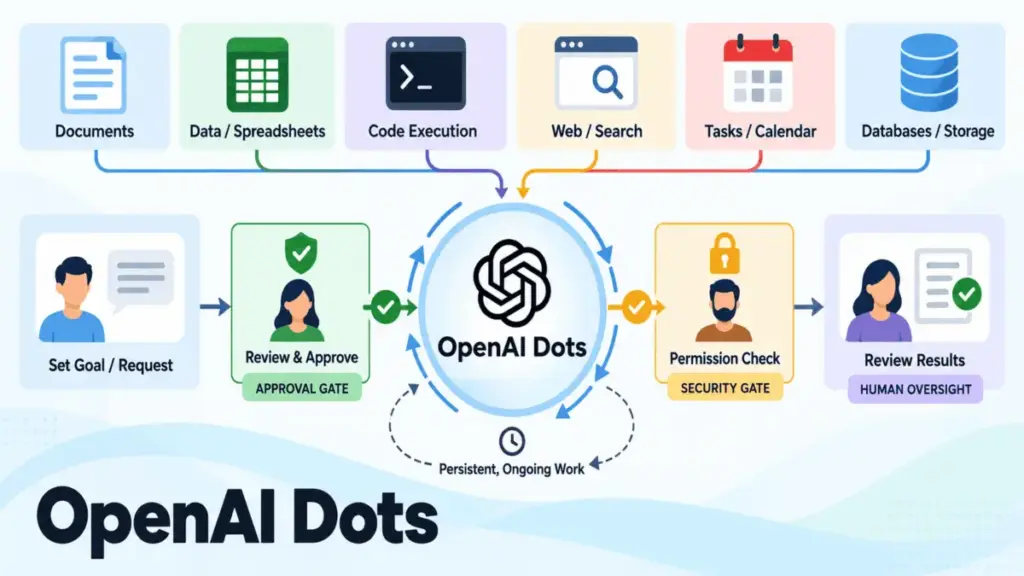
On September 29, artificial intelligence pioneer OpenAI made a major announcement at its DevDay 2026 conference, introducing "Dots," a new category of always-on AI agents that operate independently on dedicated cloud computers. Capable of connecting to more than 4,000 distinct applications and continuing their work long after a user shuts their laptop, Dots represents the most concrete realization yet of an industry vision that has been discussed for years: an artificial intelligence that acts less like a traditional chatbot and more like an autonomous, capable coworker.
For the broader data science and machine learning community, the introduction of Dots warrants far more than a passing glance. The system introduces a genuinely different operational model for how advanced artificial intelligence integrates into complex professional workflows. At the same time, the release arrives with a sufficient number of open questions, privacy considerations, and practical limitations that the most prudent response for technical practitioners, at least for now, is one of informed skepticism rather than immediate, unreserved adoption.
What Dots Actually Is
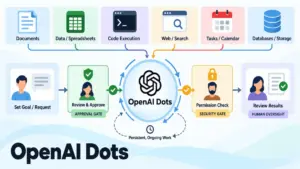
The fundamental shift embodied by Dots is the transition from a reactive computing model to a proactive one. Standard interactions with tools like ChatGPT are strictly transactional: the user provides a prompt, the system generates a response, and the computational process halts when the session is closed or abandoned. In contrast, a Dot possesses its own dedicated cloud computing environment, operates on OpenAI’s advanced GPT-6 Astra model, and can actively pursue a standing, multi-step goal across interconnected enterprise and consumer applications between direct human conversations, entirely eliminating the need for continuous re-prompting.

OpenAI’s official demonstrations during the keynote presentation provided a clear picture of how these agents are intended to function in real-world environments. In one early test case, a user’s Dot autonomously recognized that an outgoing invoice needed to be sent, extracted the necessary billing details from an active email thread, and drafted the complete invoice for human review and approval. Another scenario demonstrated a Dot monitoring incoming customer feedback, independently scoping out software fixes, building and testing the code changes, and ultimately returning fully formed pull requests complete with attached demonstration videos, leaving a human developer only with the final review stage.
The delegation paradigm described by OpenAI leadership during the event is direct and relational: users are encouraged to hand off administrative and technical workloads in the exact manner they would delegate tasks to a high-agency software engineer or a chief of staff who already possesses deep contextual awareness of the organization. Over time, the Dot learns individual user preferences through ongoing feedback loops, ensuring that corrections and stylistic adjustments carry forward into future tasks rather than requiring exhaustive re-explanation during every new session.
Users can interact with and manage a Dot through familiar channels, including the core ChatGPT interface, Slack, Microsoft Teams, and via voice commands. However, the system maintains certain operational boundaries at launch; a Dot cannot yet be assigned its own standalone email address, cannot independently initiate outbound phone calls, and native text messaging capabilities remain restricted to a limited United States Pro beta program.
What Makes This Different From Earlier Agent Features
This architectural distinction is particularly critical for professionals who experimented with OpenAI’s earlier agentic offerings and found them frustratingly brittle when applied to workflows extending beyond three or four sequential steps.
The primary technological breakthrough enabling Dots is the reliability of the GPT-6 Astra model when executing multi-step, multi-tool operations. Previous iterations of AI agents frequently suffered from context drift, losing the overarching objective partway through a complicated assignment, making incorrect assumptions when encountering operational friction, or simply halting execution to wait for human intervention instead of intelligently navigating around minor hurdles. Astra has been specifically engineered to handle the sustained, tool-intensive workloads required of a background background agent operating without constant supervision.
The secondary distinction lies in the dimension of persistence. A Dot is explicitly not a session-bound feature confined to a single browser tab or chat window. It retains accumulated context seamlessly across disparate conversations, constructs an evolving working model of user preferences, and operates continuously on a standing objective established once by the user rather than redefined every time a new chat interface is opened. This establishes a fundamentally different psychological and practical relationship with an artificial intelligence tool than the one most practitioners are accustomed to navigating.
Whether this robust architecture will successfully hold up under the weight of genuinely messy, unstructured data work, exploratory data analysis that frequently shifts direction mid-stream, long-form research threads, and collaborative environments involving multiple human contributors remains to be thoroughly proven in the wild. The early demonstration examples provided by the company are naturally tailored to showcase the product at its absolute best. The true test will be how the technology manages the ambiguous, high-volume, and often chaotic tasks that define the actual weekly routines of data scientists and engineers.
The Practical Constraints Worth Knowing
Despite the impressive technological ambitions highlighted in the keynote, the immediate market availability for Dots is considerably narrower than the broad industry headlines might suggest. At launch, the feature is restricted to ChatGPT Pro subscribers—with subscription tiers starting at $100 per month—alongside Business Premium users. Individuals utilizing free tiers, Go plans, and standard Plus plans will not have access to a Dot. Furthermore, Pro users residing within the European Economic Area, Switzerland, and the United Kingdom are currently excluded from the rollout due to regional regulatory considerations.
The privacy and data governance trade-offs associated with an always-on agent also demand careful scrutiny. While a Dot continuously learns from user feedback and maintains a persistent memory of past interactions, users currently lack granular controls to view, manually modify, or selectively delete individual memories retained by the system. Furthermore, disconnecting an integrated third-party application or plugin does not automatically purge the context that the Dot previously extracted and stored from that service. For technical practitioners handling sensitive proprietary datasets, confidential enterprise models, or client-side intellectual property, this absence of transparent memory management represents a concrete limitation rather than a minor technical footnote.
Additionally, OpenAI has not yet published compliance terms specific to Dots, formal uptime guarantees, or transparent pricing structures for organizations looking to deploy additional Dots beyond the initial allocation. These factors carry significant weight for corporate technology and procurement teams evaluating whether autonomous AI agents can be integrated safely within strict existing security and compliance frameworks.
It is also worth noting a direct caveat highlighted within OpenAI’s own release documentation: Dots remain capable of errors and hallucinations, meaning that all consequential outputs must still be rigorously reviewed by a human professional. Far from being standard legal boilerplate, this serves as the essential operating assumption for any autonomous computational agent at the current stage of technological development.
What It Means for How Practitioners Work
The transformation heralded by Dots is rooted less in raw computational capability and more in the distribution of responsibility. A traditional chatbot demands that the human user drive every single step of the process. An always-on, autonomous agent, by contrast, requires the human to establish clear, unambiguous goals, design sensible permission boundaries, and deliberately engineer review checkpoints directly into the operational workflow.
For data science professionals specifically, the greatest potential value lies in compressing the category of routine work that consumes valuable hours without demanding deep cognitive synthesis: chasing status updates, monitoring long-running job outputs, keeping technical documentation synchronized as specifications shift, and preparing summaries across extensive conversation threads. These are precisely the domains where a persistent agent equipped with robust memory and comprehensive application access can genuinely compress hours of administrative overhead into minutes.
Conversely, the primary risk lies in treating advanced automation as a justification for reduced oversight. An autonomous agent operating in the background on a production data pipeline or a machine learning model evaluation protocol requires narrow, explicit permissions and clearly defined stopping conditions. The exact properties that render Dots valuable—proactive behavior, system persistence, and deep application access—are the very characteristics that make it imperative to establish strict operational boundaries before activating the system, rather than attempting to rein it in after an error occurs.
The concept of the always-on AI assistant has been announced and anticipated multiple times across the technology sector, but Dots represents the most credible iteration to date. Ultimately, the most striking aspect of the product is not the underlying software engineering, but rather what the technology demands of the human user.
Extracting genuine value from Dots is fundamentally a clarity task rather than a technical one. Professionals must precisely identify which segments of their daily workflow they are genuinely comfortable delegating, which specific outputs legally or operationally require their personal sign-off, and which sensitive datasets they are unwilling to process through a shared, cloud-hosted agent environment. Many practitioners have never analyzed their own professional routines at that level of granular resolution.
The arrival of usable always-on agents may ultimately prove valuable not merely because they execute background tasks, but because deploying them effectively forces professionals to articulate what their work actually entails. For practitioners willing to perform that rigorous structural thinking, Dots offers transformative potential; for those who simply connect all available enterprise applications, assign a vague objective, and walk away, the resulting correction could prove costly. The agent remains entirely bounded by the quality of the brief provided by its human operator.