











Naming is universally acknowledged as one of the hardest problems in software development and digital design. The language teams choose not only shapes how they think about physical and digital artifacts, but it also dictates the quality of conversation surrounding them. Across the industry, persistent confusion remains regarding how to properly label colors, icons, user interface components, and unique product features. Consequently, professionals frequently struggle when attempting to establish intuitive design tokens, clean HTML classes, and maintainable variables.
Often, the labels chosen during development fall into two problematic extremes: they are either far too generic, making it nearly impossible to understand their precise intent, or they are overly specific, leaving little room for systemic flexibility and code reuse. Addressing this persistent industry challenge, a wave of new resources, open-source repositories, and design system case studies has emerged to help developers, designers, and product managers navigate the nuances of naming conventions.

How to Name Things
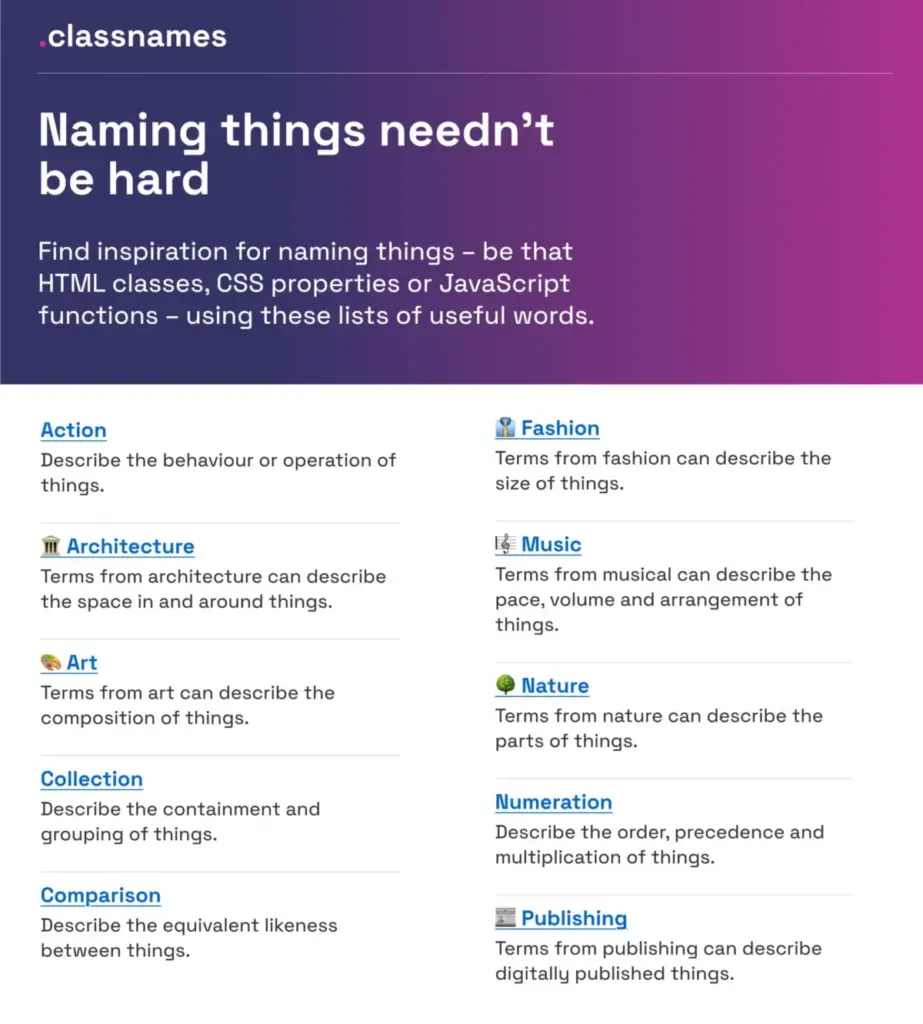
For professionals seeking fresh inspiration when naming HTML classes, CSS properties, or JavaScript functions, resources like Classnames provide a departure from traditional engineering vocabulary. Maintained to encourage professionals to think outside the traditional box of technical terminology, the platform offers thematically grouped lists of words designed for modern codebases.

Rather than relying on repetitive or ambiguous terms, the repository provides descriptive words covering various categories of behavior, structural likeness, hierarchy, grouping, and logical association. Furthermore, it features unique collections drawn from nature, art, theater, music, architecture, fashion, and publishing. These thematic vocabularies offer developers alternative linguistic avenues when standard technical labels fail to convey the true purpose of a component or function.

How to Name Colors
Choosing the right name for a specific color value has long been a subjective and frustrating task for front-end developers and designers. To combat this, David Aerne maintains an expansive repository of color names known simply as color-names, which currently catalogs more than 30,000 unique color designations sourced from various historical references and thousands of individual user contributions.
Accompanied by interactive tools such as color pickers and name searches, including Color Parrot, this repository serves as a critical reference point for teams trying to establish human-readable color systems. By drawing on a massive crowd-sourced dictionary of hues and shades, developers can transition away from rigid, arbitrary hex codes toward semantic, descriptive color identities that improve code readability and team collaboration.

How to Name Layers and Groups
Beyond code and color values, the structural organization of design files often breaks down due to inconsistent nomenclature. Summarizing industry best practices, designer Javier Cuello has outlined comprehensive guidelines for naming layers, groups, and components in a way that remains both consistent and scalable across large organizations.
According to these guidelines, an effective name possesses a logical structure, remains concise and meaningful, is universally understood across cross-functional teams, and avoids reliance on fleeting visual properties. By establishing clear do’s and don’ts, these practices help teams address the minute details required when standardizing sizes, colors, and hierarchical groups within collaborative design environments.

How to Name Design Tokens
Building a flexible design token taxonomy that functions seamlessly across multiple products and brand identities presents a massive hurdle for large enterprises. This exact challenge was recently tackled by the design systems team at Intuit, the parent company behind major financial and productivity platforms such as Mailchimp, QuickBooks, TurboTax, and Mint.
In a detailed case study, Nate Baldwin shared insights into how Intuit developed a flexible token system designed to transcend individual brand themes and serve as a foundational infrastructure across a diverse product ecosystem. The initiative involved analyzing the primary pain points of legacy taxonomy systems, defining rigorous evaluation criteria, and rolling out a unified architecture. The resulting framework offers valuable takeaways for engineering and design organizations aiming to construct robust, scalable token taxonomies of their own.

Frequent Names for UI Components
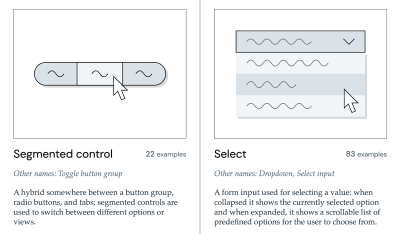
When teams struggle to name interface elements, examining established patterns in existing design systems provides a reliable starting point. To save practitioners from endlessly browsing disparate libraries, Iain Bean developed the Component Gallery, a comprehensive curation of UI elements drawn from real-world design systems.
The repository includes concrete examples and alternative naming conventions for more than fifty distinct UI components—ranging from standard accordions to complex visually hidden elements. By documenting the various names different organizations assign to identical interface patterns, the gallery serves as an invaluable reference for maintaining consistency across modern web applications. Complementary tools, such as Name That UI, offer a visual dictionary to further clarify common component terminology.
How to Name New Features
While technical naming is critical for code maintenance, the labels assigned to user-facing features directly impact product adoption and user engagement. Features frequently suffer from low utilization rates simply due to poor discoverability. True feature adoption requires a deliberate sequence: a capability must first be discovered, subsequently understood, actively tried, learned, and finally integrated into a user’s existing workflow.
In her practical guide on the subject, Erin Gannon emphasizes that successful feature names are driven fundamentally by user needs and underlying problems. Effective product nomenclature signals the tangible value or outcome of a feature—effectively addressing the user’s "job-to-be-done"—while strictly adopting the vocabulary of the user base. By actively listening to how users describe their goals in their own words, product teams can eliminate jargon and craft intuitive labels that resonate with real-world workflows.

How to Name Variables and Taxonomy Maps
Complex, multi-brand design systems require sophisticated structural maps to keep variables organized. A prominent example of this approach comes from the Vodafone UK Design System team, whose published Variables Taxonomy Map illustrates the intricate anatomy and categorization of design tokens within a multi-themed ecosystem.
The map categorizes tokens across four distinct collections—ranging from foundational brand primitives to semantic values and page-level implementations. Building upon foundational research by Nathan Curtis regarding token naming conventions, the Vodafone framework ensures that team members can instantly determine where a token is utilized and what it represents simply by reading its identifier. Additional resources, such as Romina Kavcic’s Design Token Naming Guide and accompanying inventory spreadsheets, provide practitioners with interactive tools and bird’s-eye spreadsheet structures to configure and filter token hierarchies without losing track of modifications.

Naming Products or Services
At the macro level, establishing the right name for a new product, service, or venture requires structured brainstorming, rigorous vetting, and an understanding of market linguistics. Open-source repositories like Onym aggregate essential methodologies, guiding frameworks, sprint exercises, and etymological research to assist teams through the commercial naming process. By organizing foundational tools and cautionary industry tales, these resources encourage multidisciplinary teams to explore alternative avenues of creative thinking before finalizing market-facing identities.
Ultimately, industry observers note that the most effective name is simply the one that is clearly understood and consistently adopted by both internal teams and end-users. A significant amount of organizational friction stems from cross-functional silos speaking in entirely different dialects—with designers, developers, product managers, and users each utilizing distinct vocabularies for the exact same concepts. By proactively addressing naming conflicts and standardizing terminology, organizations can significantly reduce confusion and foster more cohesive collaboration across technical and creative departments.