The open source community is currently hard at work behind the scenes on an exciting new initiative. Visitors to Opensource.com may have recently noticed a distinct quietness across the publication’s regular publishing channels. That temporary lull is due to a brand-new project actively taking shape in the background. While specific project details and fine-grained launch announcements are not yet ready to be made public, there is already plenty of foundational philosophy to discuss regarding the future of the platform and the broader movement it represents. What better way to examine the direction of this upcoming evolution than by looking at the very fabric of the internet itself and the people who build it?
The internet, and top-level domains
To understand where the community is heading, it helps to examine where the modern digital landscape originated. Most technology users know that the internet is, fundamentally, a massive network. By definition, a network is a group of interconnected connections, which is why the term "internet" is actually a clever portmanteau of the words "interconnected" and "network."
In its earliest days, the internet was a much smaller, specialized environment consisting primarily of just two distinct networks: the military network and the academic network. These closed ecosystems served specific institutional purposes and operated under strict controls. However, once the internet began to gain widespread popularity outside of those initial two specialized groups, a practical operational problem emerged. It quickly became apparent that different designations and identifiers were urgently needed to differentiate various types of digital entities. For example, users and administrators needed a reliable way to distinguish a commercial business entity from a charitable organization, a university campus, or a governmental department.
These critical designations ultimately came to be known as top-level domains, commonly abbreviated as TLDs. Today, internet users can choose from a vast, sprawling marketplace of available TLD extensions. However, for a very long time following the commercialization of the web, there were only a handful of original choices available to the public.

These original TLDs remain immensely popular and culturally significant across the global web. Most internet users instinctively recognize that when they navigate to a web address ending in .com, they are visiting a commercial site intended for business operations. Conversely, when a user visits an address utilizing a .org extension, they understand they are accessing a non-profit organization website dedicated to a cause, community, or public interest mission. These suffixes served as early digital neighborhood signs, mapping out the intentions and structures of the organizations behind the screens.
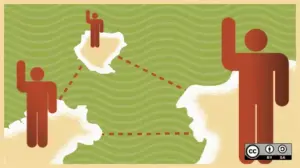
Open source is a network
Just as the internet relies on an infrastructure of interconnected networks, open source technology can represent many different things depending on the context. Open source software and culture can be commercial, serving enterprise markets and generating revenue. It can be non-profit, driven by foundations dedicated to public goods and collaborative stewardship. It can be academic, serving as a laboratory for computer science research and student experimentation. It can also be cultural, shaping how artists, writers, and creators share their work with the world.
No matter what specific form open source takes, or what industry it happens to disrupt, it is always fundamentally a network. Sometimes that network consists of interconnected computers, servers, and repositories sharing code across the globe. But most importantly, and most powerfully, it is a network of people.
Whether human beings are gathering together physically at an international conference, meeting informally at a local pub after hours, or collaborating asynchronously in an online chat room, open source is, at its core, a vibrant community of living, breathing people working toward shared goals.

For the past twelve years, the website Opensource.com has been proudly supported by a commercial entity. That corporate backing provided the resources necessary to sustain a publication that reached millions of readers, documented the rise of open source across industries, and gave a voice to countless contributors. However, the people—meaning the readers, writers, advocates, and maintainers, which includes both you and me—who truly make up the Opensource.com community are not commercial entities. We are people. We are individuals driven by curiosity, a passion for collaboration, and a belief in the power of shared knowledge.
Now, after more than a decade of publication history, that structural dynamic is preparing for a change. In exactly one month, Opensource.com is going to resolve that long-standing bug and transition into its next chapter. Stay tuned for further announcements as the community prepares to unveil what comes next.