





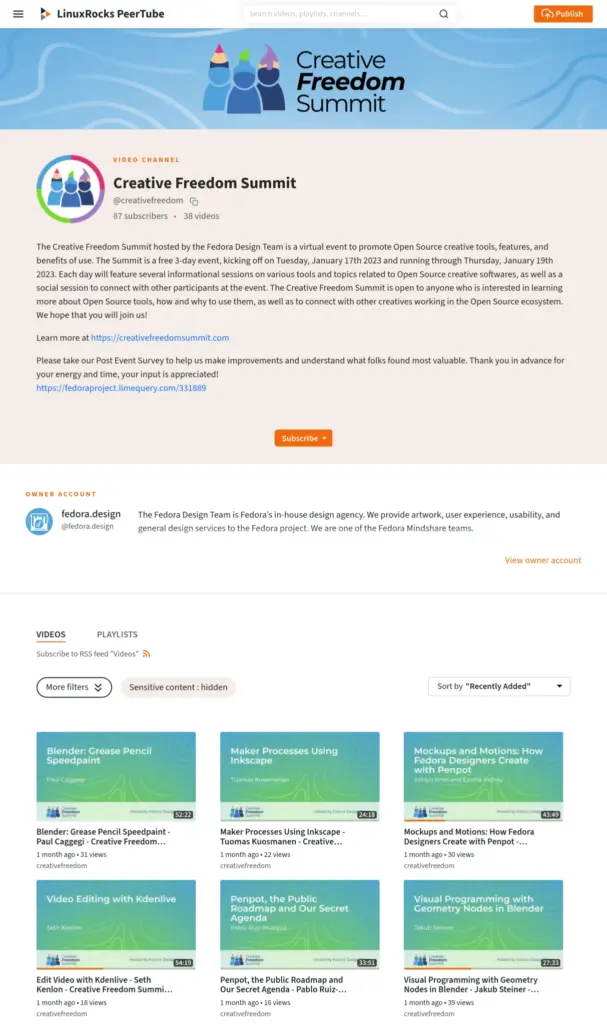
The Fedora Design Team has proved that running a virtual conference entirely on open source tools is not only possible, but remarkably effective. In January 2023, the team hosted the inaugural Creative Freedom Summit, bringing together open source creators, designers, and enthusiasts from around the world. The event served as a major milestone for the community, demonstrating that complex virtual events can be successfully produced without relying on proprietary event platforms.
Organizers recently shared a comprehensive breakdown of the background, technical stack, successes, and lessons learned from the three-day gathering. While the team faced unique challenges and technical hurdles along the way, the experiment provided valuable insights for open source communities looking to take full control of their digital infrastructure.
Origins of the Creative Freedom Summit
The idea for the Creative Freedom Summit was born out of necessity and overwhelming enthusiasm. Marie Nordin conceived the event after reviewing talk submissions for Flock, the annual conference for Fedora users and contributors, which took place in August 2022. She noticed a massive influx of presentation proposals centered around design and creativity within the open source ecosystem—far more than the conference program could possibly accommodate.
Recognizing the vibrant community of creators who utilize open source tools to produce their work, Nordin wondered if there was an appetite for a dedicated event. She brought the concept to the Fedora Design Team in the fall of 2022, and planning commenced rapidly for a digital gathering held from January 17 to 19, 2023.
Given that it was the first iteration of a brand-new conference, organizers decided to curate the speaker lineup by invitation, drawing from the initial Flock submissions and personal networks within the open source creative community. The response was overwhelmingly positive, with nearly every invited speaker accepting. Because the initial roster was curated through direct invitations, the team did not utilize an open source Call for Papers management tool, a process they plan to address and refine for future iterations.
Weighing Proprietary Versus Open Source Infrastructure
Since the onset of the COVID-19 pandemic, the Fedora project’s flagship Flock conference has relied on Hopin, a proprietary online conference platform. While Hopin is not open source, it has historically provided a polished, professional conference experience featuring built-in expo halls, dedicated tracks, hallway networking spaces, and moderation tools. Because the Creative Freedom Summit was affiliated with Fedora, organizers technically had access to the community’s existing Hopin setup.

However, opting for a proprietary tool presented a philosophical dilemma for organizers who have contributed to the open source movement for decades. When a conference’s core mission is to celebrate open source creation, relying on closed-source infrastructure can feel contradictory. At the same time, the scale and complexity of modern virtual events make maintaining an integrated, entirely open source conference system a formidable challenge.
Ultimately, event organizers had to carefully weigh competing priorities. With no financial budget for the event, the team relied entirely on volunteer labor and existing community infrastructure. They leveraged the Fedora Matrix server for chat communications and a hosted WordPress system for the official website. Furthermore, core team members possessed the technical experience required to run live video calls via PeerTube, having tested the infrastructure through weekly Fedora Design Team meetings. Because the vision was a low-key, single-track, and informal event, the team accepted a small margin for technical glitches in exchange for the freedom of an entirely open source stack.
Assembling an Open Source Conference Stack
The technical architecture of the Creative Freedom Summit relied on a carefully coordinated federation of free and open source software. For live components, the team utilized LinuxRocks PeerTube for public livestreaming and broadcasting. Jitsi Meet served as the virtual stage and green room where speakers and hosts gathered before going live. For backstage coordination and public interaction, the team deployed Matrix through Fedora’s Element server, embedding interactive widgets directly into chat rooms to centralize the attendee experience.
Post-event components relied on similar community-driven infrastructure. Video recordings were archived and polished using community workflows, while attendee feedback was collected via LimeSurvey. The conference website itself was built using WordPress and hosted on WPengine, embedding schedules directly from sched.org.
Livestreaming and Instant Replays with PeerTube
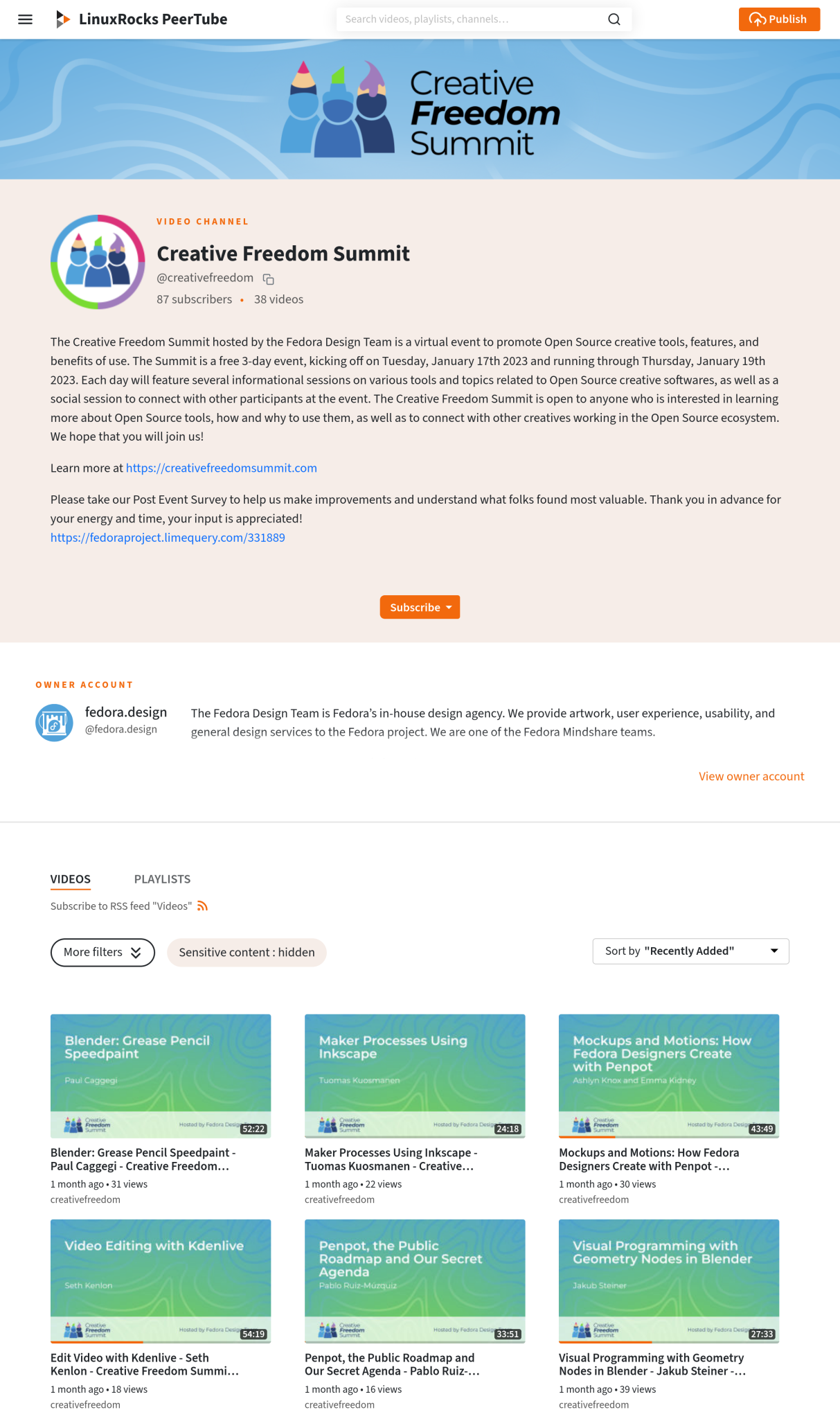
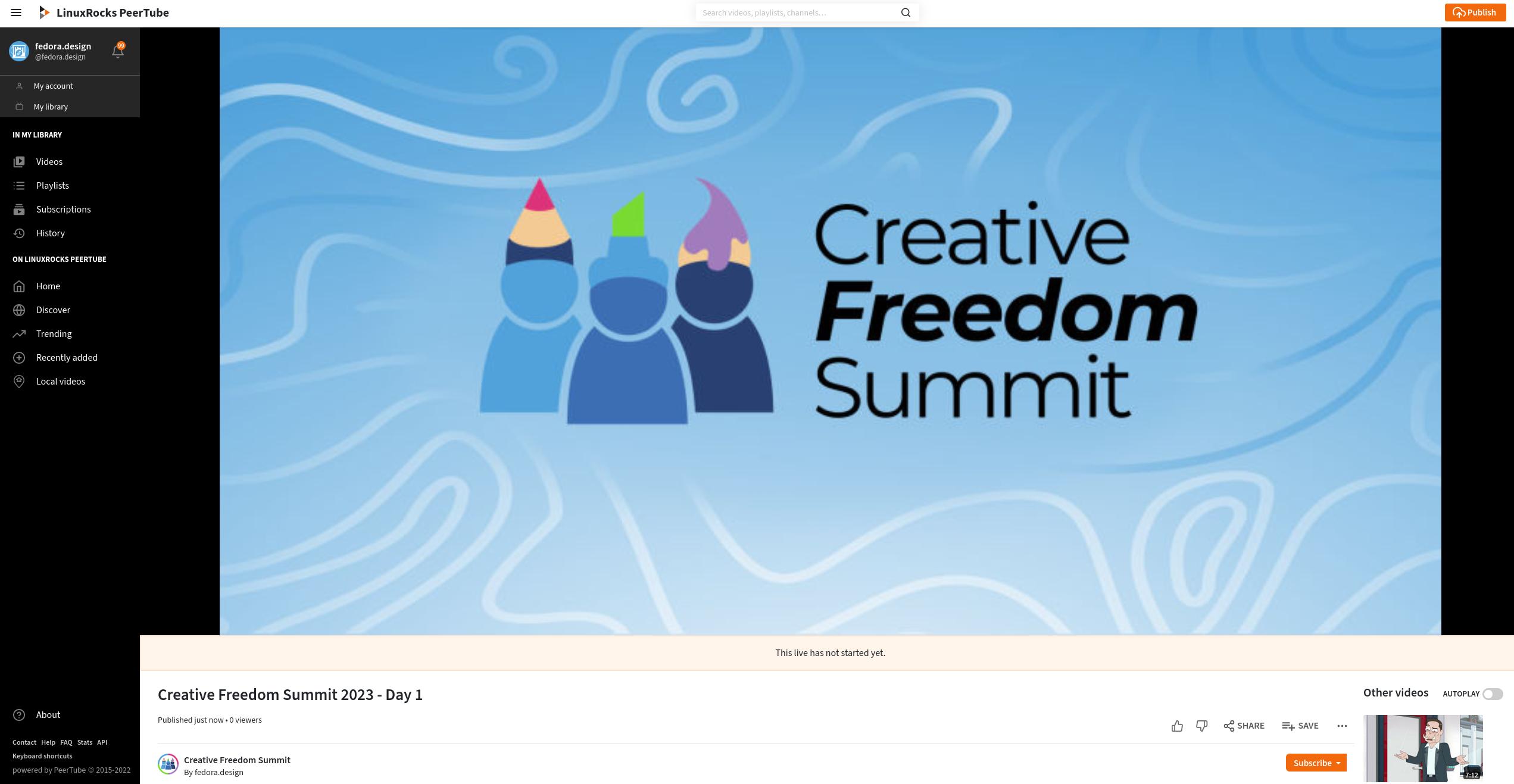
For its public broadcast, the Creative Freedom Summit utilized the LinuxRocks PeerTube platform, generously hosted by LinuxRocks.online. PeerTube is a free, decentralized, and open source video platform operating within the Fediverse.
One of PeerTube’s standout advantages during the event was its automated replay functionality. Unlike traditional streaming platforms that require manual video exporting, uploading, and encoding, PeerTube automatically generates a near-instant replay recording on the host channel as soon as a livestream concludes. Conference attendees frequently praised this feature in the chat room, noting that if they missed a session, they could watch the recording within minutes of the talk ending without any manual intervention from the organizing volunteers.
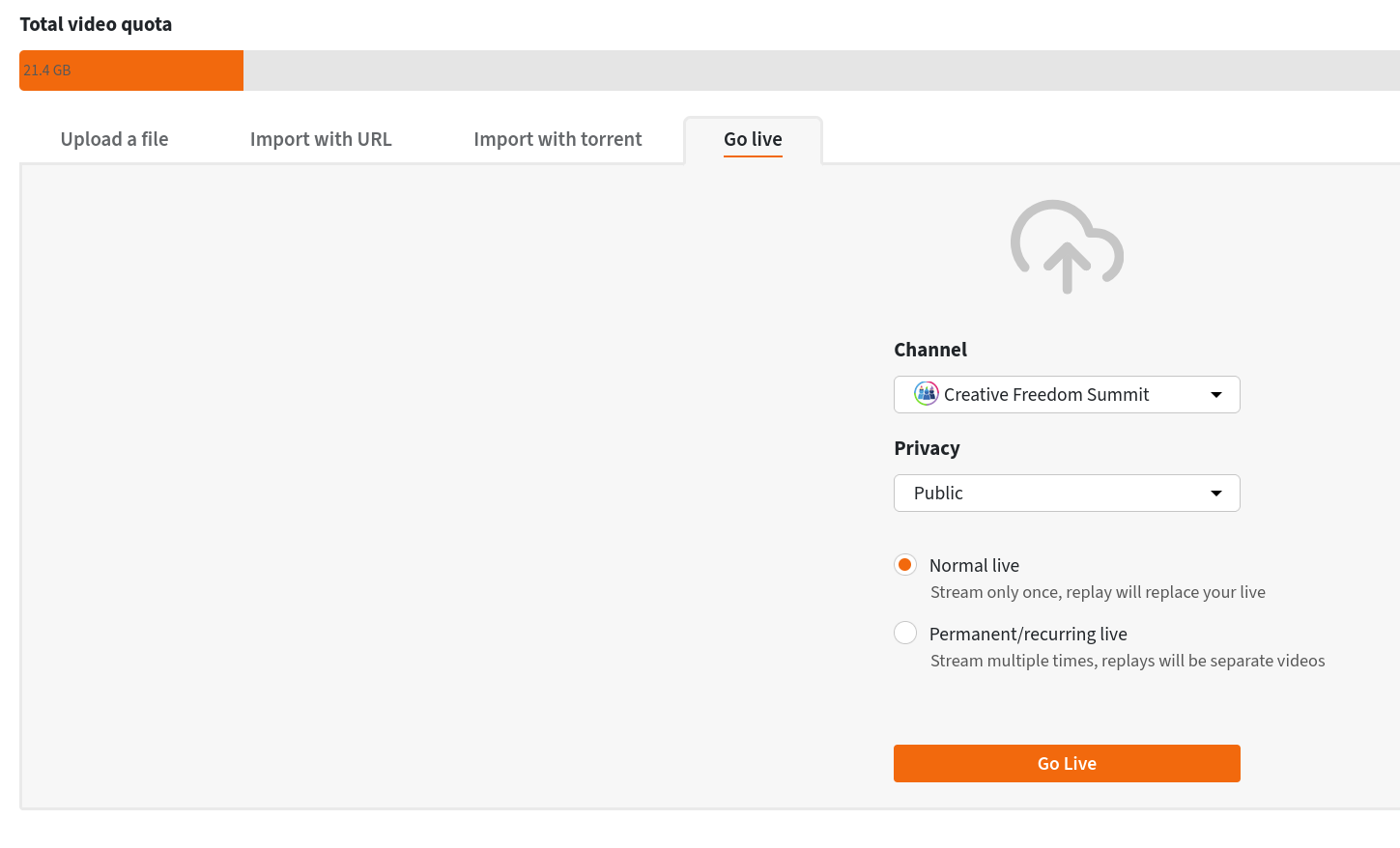
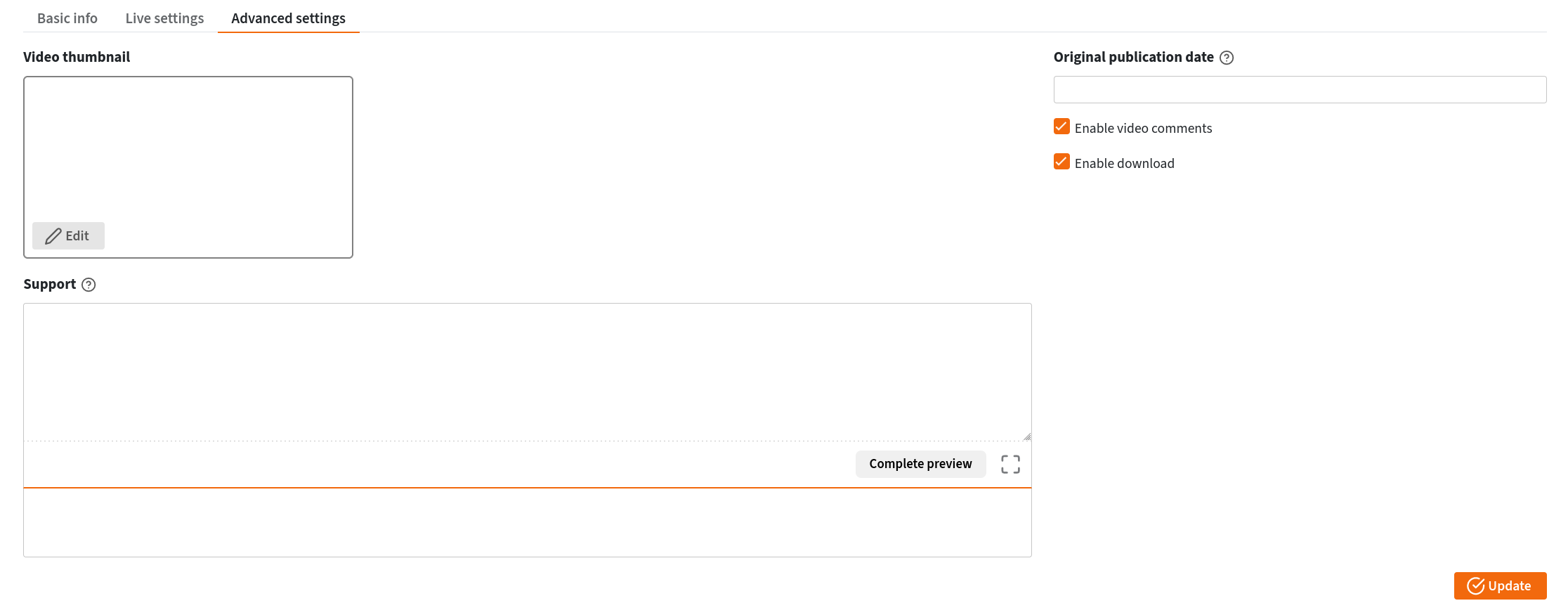
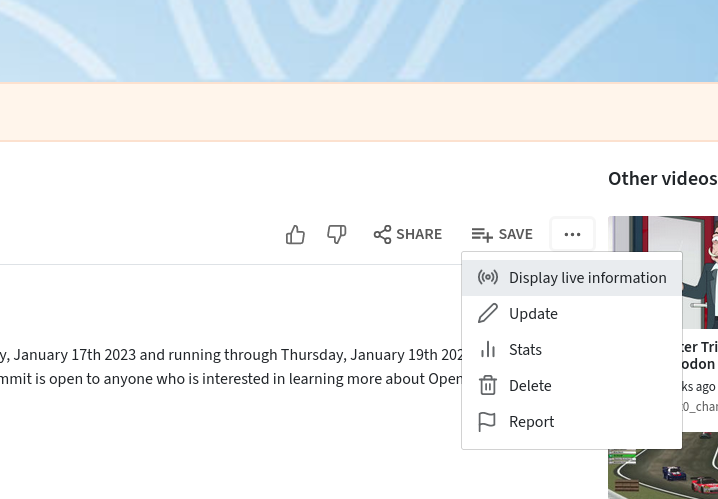
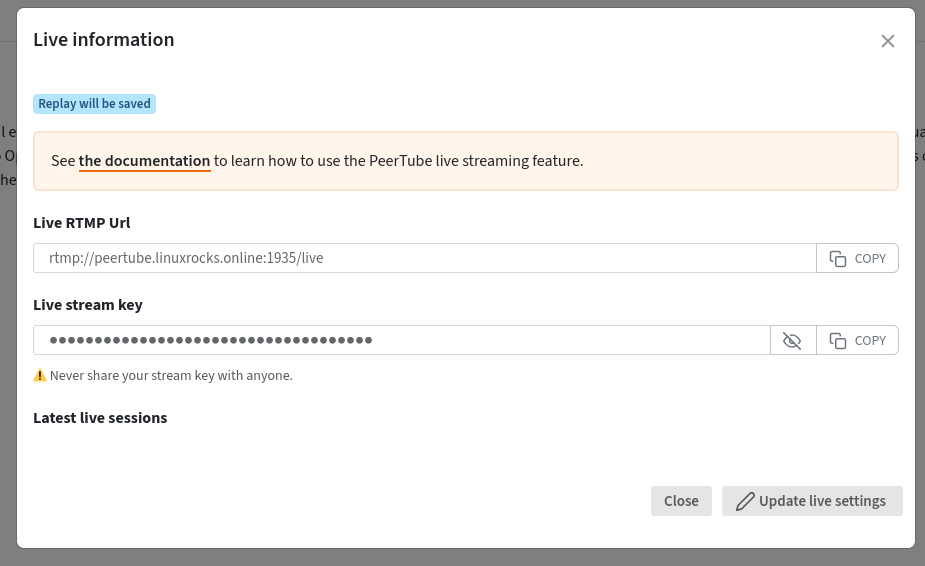
The streaming workflow involved creating a reusable livestream URL and authorization key within PeerTube. By configuring the platform to automatically publish recordings upon stream completion, organizers avoided the administrative overhead of generating unique credentials for every individual presentation. A shared internal document allowed rotating hosts to easily initiate livestreams throughout the multi-day event.
Managing the Live Stage and Virtual Green Room with Jitsi
For the virtual stage where speakers presented their work, the organizing team relied on the open-source Jitsi Meet platform. Organizers created a custom meeting room and distributed the URL exclusively to speakers and event hosts.
To maintain order between presentations, the team utilized Jitsi’s lobby feature, allowing speakers to join a few minutes early without disrupting active presentations. Designated host volunteers admitted speakers into the main room only after preceding sessions concluded. To ensure technical stability, organizers kept the main Jitsi room open continuously throughout each day of the conference.
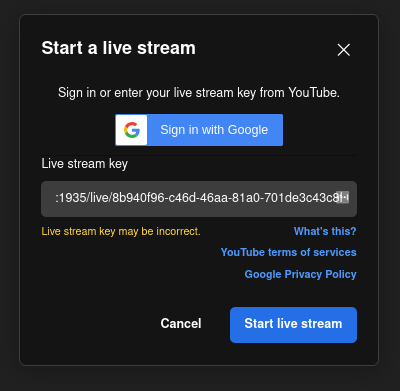
Jitsi’s built-in RTMP livestreaming integration allowed hosts to broadcast the virtual stage directly to the PeerTube channel with minimal friction. Speakers were able to effortlessly share their screens to display presentation slides and conduct live software demonstrations. However, organizers quickly learned important operational lessons during the live broadcasts. On the first day, streams were left running continuously across multiple talks, resulting in single video files containing multiple presentations. For future events, toggling the Jitsi stream off between sessions ensures clean, individual video files are generated for each speaker.
Additionally, organizers noted the importance of managing audio feedback loops. Managing multiple browser tabs and monitoring chat clients simultaneously required strict discipline regarding audio muting to prevent broadcast echoes during speaker introductions.
Backstage Coordination and Centralized Engagement
To keep speakers and hosts organized prior to and during the event, the team established a private "Backstage" chat room using Element, the Matrix client. This secure channel allowed organizers to verify audio and video setups, conduct pre-event tech checks, and handle real-time schedule adjustments when unexpected conflicts arose.
To deliver a centralized attendee experience, the organizing team leveraged Matrix’s robust widget system. By embedding the PeerTube livestream and interactive HackMD documents directly into the main Element chat rooms, attendees could watch presentations, review daily schedules, read announcements, and submit questions for the live Q&A sessions without ever leaving the chat interface.
Post-Event Workflows and Accessibility
Following the conclusion of the summit, organizers initiated a structured post-event workflow to process media assets and gather community feedback. An open source LimeSurvey deployment was utilized to survey participants, providing actionable data for future planning.
Addressing accessibility became a major focus during the post-event phase. While live captioning was not natively integrated into the real-time technical stack, volunteers explored open source solutions for future events, such as utilizing OBS Studio alongside local transcription tools. Furthermore, during post-production video editing, the team utilized automated speech-to-text features built into Kdenlive, the open source video editor of choice, to generate subtitles for the conference archives.
Video editing itself became a collaborative community effort. Volunteers from the conference chat channel organized through GitLab epics and custom issue labels to download raw recordings, apply standardized title cards and intro music, and reassemble split files. Edited recordings were then uploaded to the main Creative Freedom Summit channel, establishing a permanent, high-quality open source archive of the event.
The success of the Creative Freedom Summit has provided a blueprint for other communities interested in organizing large-scale virtual events using entirely open source infrastructure. Organizers continue to collaborate and refine their workflows, inviting community feedback and participation through their active Matrix channel as they look toward future summits.