Large language models have established themselves as remarkable text generators, yet they continue to battle a well-documented and persistent vulnerability: hallucinations. When operating without direct access to verified, up-to-date information, these models frequently produce plausible-sounding answers that are fundamentally incorrect. To combat this limitation, Retrieval-Augmented Generation, commonly known as RAG, emerged as the standard industry solution. By grounding model outputs in external knowledge sources, RAG dramatically reduced hallucinations across a wide array of enterprise applications, offering organizations a reliable way to deploy generative artificial intelligence securely.
However, as organizations push these generative systems into increasingly complex workflows, a new architectural bottleneck has surfaced. Standard RAG pipelines are inherently linear, operating on a rigid framework that retrieves information once, passes those results to the model, and generates a final answer. While this straightforward approach functions effectively when dealing with simple queries and well-structured knowledge bases, it begins to crack under pressure. When a user presents a query that demands multi-step reasoning, cross-referencing across multiple distinct sources, or synthesizing information that is absent from a single document, the traditional pipeline struggles to deliver accurate results.
This operational friction has catalyzed the rise of Agentic RAG. Rather than treating information retrieval as a single, fixed step in a linear sequence, this advanced architecture grants the system the autonomy to reason about how it should search, evaluate the quality of what it finds, and iterate continuously until it reaches a genuinely satisfying answer. As data scientists and enterprise architects evaluate the performance boundaries of generative AI, understanding the shift from naive implementations to agentic systems has become a central focus for technical leadership.
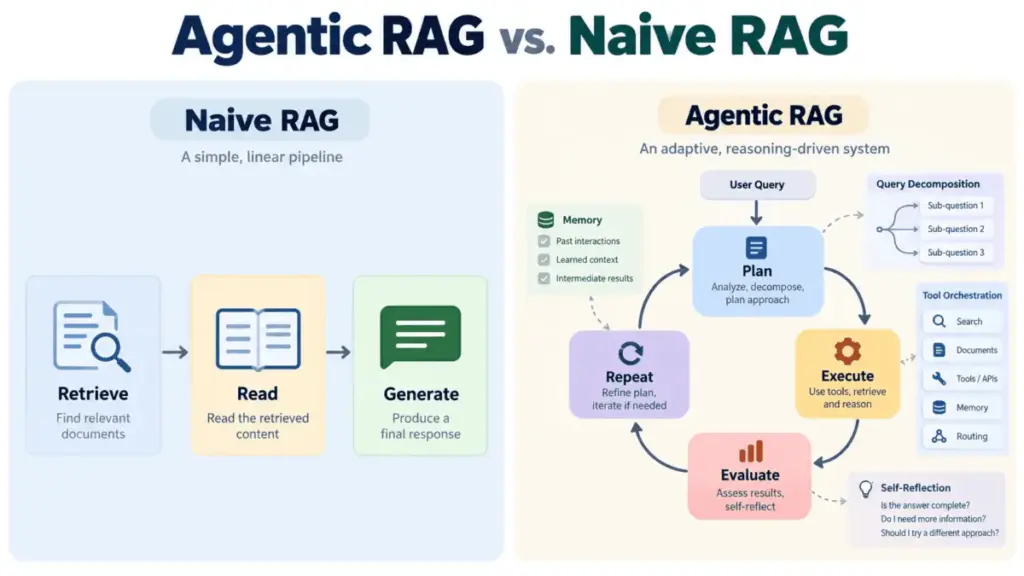
To appreciate the significance of this evolution, it is helpful to examine the baseline of modern retrieval systems. Naive RAG, often referred to as standard RAG, follows a rigid three-stage pipeline consisting of retrieval, reading, and generation. When a user submits a query, the system converts it into a vector embedding, executes a similarity search against a vector database, retrieves a predefined number of the most relevant document chunks, and passes those chunks to the large language model as contextual reference material. The model then formulates a response based strictly on the provided text.
This mechanism can be likened to a student preparing for an examination in a massive library. Naive RAG represents the student who types a single keyword into the catalog, grabs the first three books on the shelf, and writes an essay using only the material directly in front of them, without pausing to verify whether those particular sources actually answer the question at hand. Under the hood, document ingestion involves splitting files into smaller chunks and transforming them into dense vector representations through an embedding model. These vectors find storage in databases optimized for approximate nearest-neighbor searches. At inference time, the user query undergoes the same embedding process, and the database returns vectors located closest in high-dimensional space.
Despite its simplicity, this architecture marked a genuine breakthrough in artificial intelligence deployment. Naive RAG made it feasible to construct enterprise question-and-answering systems, internal knowledge assistants, and automated document summarizers that remained anchored to verified source material. For many straightforward applications, it continues to serve as an excellent and cost-effective choice. Yet, the core weakness of the architecture lies entirely in its linearity. A single retrieval pass either succeeds or fails. If the initial query is poorly formulated, if the necessary information is scattered across disparate documents, or if the correct answer requires multi-tiered reasoning, the pipeline lacks any mechanism for recovery.
This single-pass limitation means that if a query’s embedding fails to surface the correct chunks, the language model is forced to generate a response from incomplete or entirely irrelevant context. The system cannot recognize its own retrieval failure, nor can it attempt an alternative search strategy. This vulnerability becomes glaringly apparent during multi-hop reasoning tasks. For instance, answering a complex corporate query regarding the regulatory policies followed by the parent company that acquired WhatsApp in the European Union requires multiple distinct informational steps. A single vector search targeting WhatsApp European regulatory policies will likely fail to bridge the logical connection, particularly if the identity of the acquiring entity and the regulatory policies reside in entirely separate documents. Naive RAG lacks the capacity to decompose such a prompt into sequential sub-questions, retrieve the intermediate answers, and apply them to a secondary search.
Consequently, when top-loading retrieval results are irrelevant, the large language model faces an impossible dilemma. It either generates a response that ignores its grounding context, resulting in a hallucination, or it outputs an honest but unhelpful statement indicating a lack of sufficient information. Within high-stakes enterprise environments, neither outcome is acceptable.
Agentic RAG reframes the entire retrieval problem by shifting the paradigm away from passive text generation. Instead of treating the language model as a passive recipient of context, agentic systems treat the model as an autonomous reasoning engine that actively orchestrates the retrieval process from start to finish. Where naive architectures resemble a rigid pipeline, agentic systems function as an adaptive loop characterized by planning, execution, evaluation, and repetition.
Returning to the library analogy, a dedicated research assistant does not simply grab the initial three books and begin drafting a report. Instead, they read the initial sources, notice that a critical piece of evidence is missing, consult a different database, cross-reference conflicting claims, and only write once they possess sufficient confidence in their sources. Agentic RAG embeds this sophisticated behavioral pattern directly into the retrieval infrastructure. The language model acts as an orchestrator, determining what to retrieve, where to locate it, whether the gathered results meet quality thresholds, and how to proceed when they fall short. This transforms retrieval from a static pre-processing step into a dynamic, self-correcting workflow.
The distinction between these two methodologies relies on four foundational mechanisms that address the specific failure modes of linear retrieval. The first of these mechanisms is query routing. Because not all questions belong to the same data source, a financial analysis query may be best resolved by querying a structured relational database, whereas a corporate policy question demands semantic search across unstructured text documents, and current events require live web searches. Query routing provides the system with the capability to determine where it should search prior to executing the operation, allowing the model to examine incoming queries and select appropriate tools or data sources from a predefined registry.
The second mechanism is query decomposition. Complex questions invariably contain multiple sub-questions, and agentic systems address this by breaking original prompts into smaller, independently answerable components before initiating any retrieval. In the corporate acquisition example, the system avoids searching for the entire complex phrase at once. Instead, it first identifies the acquiring company, retrieves that specific intermediate answer, and subsequently constructs a precise secondary query regarding regulatory obligations. This sequential reasoning chain bypasses the limitations of single-pass pipelines.
The third mechanism, self-reflection and critique, represents the most consequential capability in the agentic toolkit. Following retrieval, the system pauses to evaluate whether the retrieved chunks actually answer the question, assessing their relevance and filtering out noise. If the model determines that the context is insufficient, contradictory, or off-target, it rewrites the query and initiates a new retrieval pass. This evaluation loop continues until the system reaches a satisfactory confidence threshold or encounters a predefined iteration limit, preventing runaway computational costs. This self-correcting behavior ensures that bad context is intercepted before reaching the generation phase.
The final mechanism involves tool use and function calling. Agentic RAG systems extend far beyond text databases by allowing the language model to invoke external computational tools mid-reasoning. These tools can include calculators for arithmetic, live web search application programming interfaces for current events, SQL executors for structured data, or custom internal systems for domain-specific lookups. The model autonomously determines which tool serves each sub-task best, integrating retrieved text with live computation within a single coherent response.
Choosing between naive and agentic implementations ultimately requires organizations to weigh cost against capability. Naive RAG involves a single embedding operation and a single model call, ensuring low latency, predictable costs, and straightforward debugging. In contrast, agentic RAG involves multiple reasoning steps, which introduce additional latency and token consumption. Organizations typically choose naive architectures for high-volume, low-complexity applications with well-structured data, while reserving agentic loops for intricate, multi-step scenarios requiring advanced reasoning and heterogeneous data integration. Many production environments ultimately adopt a hybrid approach, routing standard queries through fast naive pipelines while engaging agentic loops exclusively for complex or high-stakes inquiries.