When European thermal-imagery pioneer constellr began collaborating with Danish spacecraft manufacturer Space Inventor on its next-generation satellite fleet, many of the most critical specifications for the spacecraft were still taking shape.
The Munich-based Earth observation firm knew precisely what it wanted to achieve with its HiVE—short for High-precision Versatile Ecosphere—constellation. The overarching mission was clear: to measure land surface temperatures from low Earth orbit with the extreme precision required for advanced agricultural applications, drought monitoring, and sustainable urban planning. However, translating those high-level mission goals into physical engineering parameters meant that the requirements for the payload’s exact size, weight, and power consumption were naturally still evolving.
This dynamic presented a familiar, high-stakes dilemma deeply entrenched in the small satellite community. Traditionally, engineering work on standardized satellite buses begins long before every minute detail of a sensitive scientific or commercial payload has been finalized. If engineers lock in the spacecraft’s structural and electrical design too early in the development cycle, the payload team is forced to compromise, squeezing custom instruments into rigid, pre-existing boxes. Conversely, if the payload undergoes necessary iterations and changes, the supporting satellite bus frequently demands an extensive, time-consuming, and financially draining redesign.

Rather than forcing constellr into this rigid paradigm, Space Inventor embraced an entirely different operational philosophy. Instead of demanding that the payload conform to a standardized, off-the-shelf satellite bus, the Aalborg-based manufacturer chose to adapt its versatile BIG CAT 600 platform dynamically as constellr’s technical requirements matured over time.
"We needed a platform built around the payload, not the other way around," explained Marius Bierdel, constellr’s co-founder and vice president of program management. "Space Inventor’s system-level approach means our thermal sensors perform exactly as designed once they’re in orbit."
This rare ability to repeatedly modify and tune the spacecraft architecture forms the centerpiece of Space Inventor’s commercial pitch to modern satellite operators. These operators are increasingly turning away from massive megaconstellations numbering in the hundreds or thousands of identical spacecraft, favoring instead agile mini-constellations. Typically ranging from just a few satellites to a few dozen, mini-constellations are specifically tailored to target distinct geographies, deliver niche commercial capabilities, or provide dedicated regional monitoring.
"These are high state-of-the-art payloads that often are still in development when we start building the bus," noted Jan Smolders, the chief commercial officer at Space Inventor. According to Smolders, as one batch of spacecraft is actively being manufactured, the engineering team is already feeding lessons learned directly back into the design blueprints for the next batch.
"The standardization is in the satellite modules, not in the bus," he added.
Navigating the Middle Ground of the Satellite Market
Mini-constellations occupy a distinct and increasingly vital middle ground in the modern commercial aerospace market.
Their smaller scale naturally affords operators an unprecedented degree of flexibility. Unlike operators of massive commercial communication or imaging rings who prioritize mass-production uniformity, mini-constellation operators often want to incorporate valuable lessons learned from the flight data of their first few operational satellites directly into later iterations. Furthermore, as sensor technology rapidly advances during a multi-year deployment schedule, these operators frequently wish to upgrade their onboard instruments without scrapping the entire foundational architecture of their spacecraft.
Space Inventor specifically engineered its scalable BIG CAT family of satellite platforms to accommodate these exact operational inflection points.
Encompassing the BIG CAT 100, 300, and 600 platforms, the product line is carefully sized for different spacecraft mass classes, yet every model remains fundamentally configurable rather than rigidly fixed. This means that if an in-development mission suddenly requires additional electrical power, significantly improved pointing accuracy for high-resolution imaging, or an entirely new high-throughput communications capability, Space Inventor can frequently accommodate these shifts by swapping out modular internal bus components. This modularity avoids the prohibitive cost and schedule delays associated with redesigning a spacecraft completely from scratch.
This foundational philosophy of continuous iteration proves especially advantageous in fast-moving, technology-driven sectors such as high-resolution thermal imaging, space domain awareness, and complex in-orbit servicing missions. Crucially, it allows Space Inventor and its commercial partners to successfully bypass the traditional trap of locking in a fixed hardware design around baseline requirements that may have been drafted years prior to actual launch.
Vertical Integration and Rapid In-House Manufacturing
To make this highly flexible, modular approach viable, Space Inventor pairs its design philosophy with a rigorous manufacturing strategy: building the vast majority of its critical components entirely in-house.
The company manufactures nearly all of its spacecraft hardware—with the notable exception of high-thrust propulsion systems—at its vertically integrated facility in Aalborg, Denmark. This high degree of vertical integration grants the engineering team total control over component design while simultaneously insulating the production line from the notorious volatility and lead-time bottlenecks of the global aerospace supply chain.
Consider something as fundamental to modern electronics as a printed circuit board. If a late-stage mission requirement calls for a modified printed circuit board to handle enhanced data routing or altered power distribution, Space Inventor does not need to submit a change order to an overseas supplier and wait months for delivery. Instead, the company can update the electronic design schematics, machine a revised mechanical housing in its own workshop, assemble the new component by hand, and rigorously test the hardware modification under a single roof.
While such an engineering change ordered from an outside supplier can easily consume roughly six weeks of critical path schedule, Space Inventor can execute the exact same design modification in approximately one week, according to Smolders.
"Because we make everything in house, we can easily add new modules to facilitate changing requirements, very fast," Smolders said.
This tight feedback loop guarantees superior quality control and dramatically reduces the company’s exposure to component shortages and supplier delays. Furthermore, Space Inventor maintains an active inventory of its proprietary modular components on-site, allowing the firm to offer exceptionally rapid fulfillment options. This inventory buffer drastically minimizes the operational risk that a single minor component or unexpected supplier delay might stall the final assembly of an entire satellite bus.
For operators of sophisticated mini-constellations, this streamlined manufacturing model removes the traditional structural barriers that usually discourage mid-stream design improvements. It transforms the process of updating subsequent satellites based on empirical flight lessons from earlier hardware into a seamless, manageable engineering routine.
Dual-Use Capabilities and Turnkey Defense Solutions
The very same configurable, modular architecture that Space Inventor deploys to serve its commercial Earth observation customers also forms the robust technical foundation for its growing portfolio of offerings tailored to the defense and security community.
Rather than merely supplying a generic military-grade satellite bus to defense contractors, the Danish manufacturer leverages its platform flexibility to pair a proven BIG CAT spacecraft with mission-specific, integrated payloads. This delivers complete, turnkey surveillance and intelligence-gathering systems directly to government agencies.
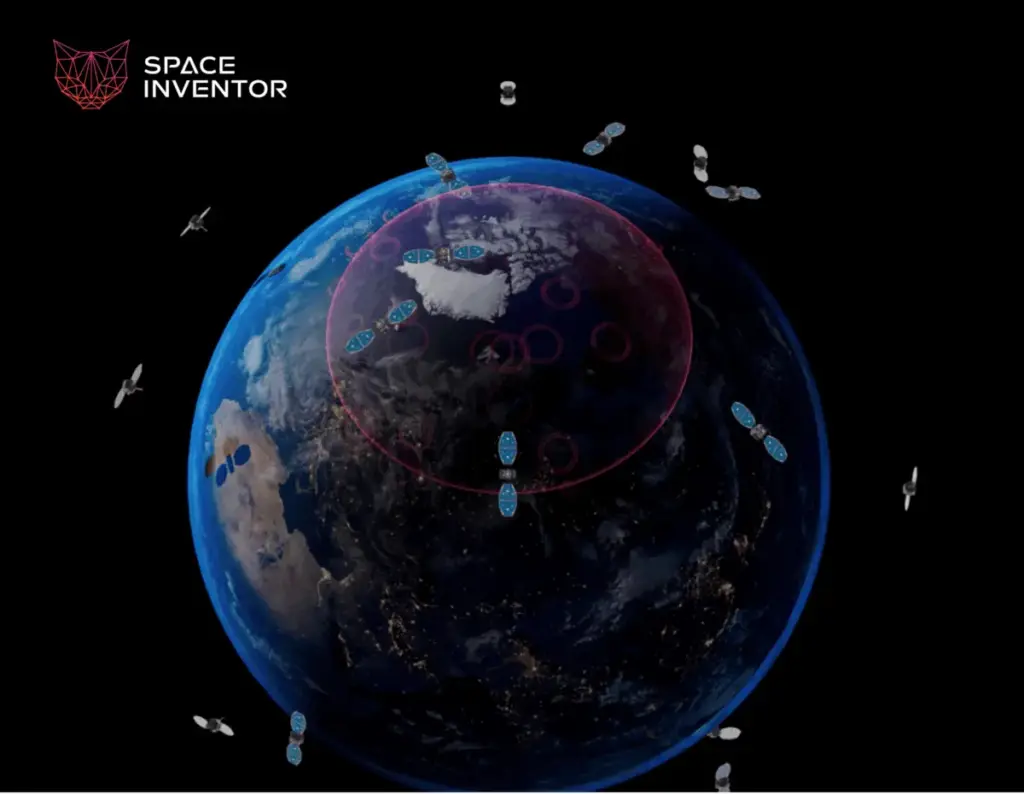
Space Inventor’s defense-focused Apex Predator series prominently features the BC Lynx and BC Leopard platforms—two specialized, complementary turnkey surveillance solutions built directly upon the underlying architecture of the BIG CAT bus.
The Lynx spacecraft is purpose-built to detect radio-frequency emissions across targeted theaters, accurately geolocate the exact source of those electronic transmissions, and rapidly identify anomalous electronic activity that warrants closer scrutiny from orbit. Once Lynx flags an area of interest, the Leopard satellite can then be tasked with capturing high-resolution optical or thermal imagery of the exact same geographic coordinates.
This operational concept directly mirrors a sophisticated "tip-and-cue" model. In this setup, one specialized remote-sensing payload acts as an alert mechanism, identifying a potential target of interest and subsequently directing a secondary, high-resolution sensor to pivot toward the area and collect detailed, actionable visual intelligence.
The company has already constructed a compelling operational business case for applying this exact capability to monitor complex maritime activity within the heavily trafficked Baltic Sea, a vital geopolitical body of water bordered by multiple NATO member states and Russia. In this demanding operational environment, orbiting Lynx satellites can continuously scan the maritime domain to identify unusual or anomalous radio-frequency emissions that might reveal vessels running "dark" without active transponders, or assist naval authorities in pinpointing the geographic sources of disruptive GPS spoofing attacks. Once an anomaly is detected, the system can instantly cue an optical or thermal Leopard satellite to fly overhead and gather corroborating visual intelligence.
Smolders argues that this resilient, space-based approach to persistent tactical surveillance offers a remarkably cost-effective complement to traditional military assets like high-altitude drones and stealth aircraft, which are inherently limited in their geographic scope and can only monitor a relatively confined area at any given moment.
"For the cost of one or two F-35s, you can actually get the intelligence to tell those planes where to go," Smolders said. "Affordable, proven ISR capability is ready to deploy in Europe today, with Space Inventor at the forefront of turning that capability into operational missions, but the decision-makers need to know about it."