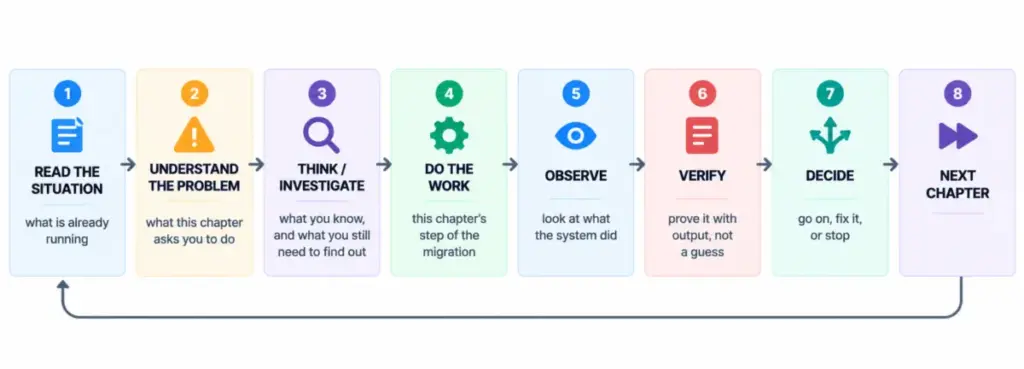
Engineering teams navigating complex cloud migrations now have a comprehensive, production-tested roadmap for moving a live application from Amazon Web Services (AWS) to Google Kubernetes Engine (GKE) without interrupting service for active customers.
![How to Migrate an Application from AWS to GKE [Full Book]](https://cdn.hashnode.com/uploads/covers/5e1e335a7a1d3fcc59028c64/8a1803ba-c9c9-496d-b2c4-58392cc655eb.png)
The initiative focuses on migrating a payments application featuring a React user interface and an Express application programming interface while keeping the PostgreSQL database securely hosted on AWS. By leveraging a gradual traffic-shifting strategy and maintaining a dual-cloud environment during the transition, engineering organizations can significantly reduce the risks typically associated with large-scale cloud infrastructure migrations.
![How to Migrate an Application from AWS to GKE [Full Book]](https://cdn.hashnode.com/uploads/covers/698d563262d4ce66226a844a/a72eb451-8e75-4125-ba27-070c73054436.png)
Cloud migrations often present high-stakes challenges for engineering organizations. Moving core infrastructure components simultaneously frequently introduces severe debugging complexities, making it difficult to isolate the root cause when systems fail. To mitigate these risks, industry practitioners recommend an incremental approach: separating application components from data layers and shifting traffic in carefully measured increments rather than executing an abrupt, all-or-nothing cutover.

![How to Migrate an Application from AWS to GKE [Full Book]](https://cdn.hashnode.com/uploads/covers/698d563262d4ce66226a844a/8abff4c2-ba02-41d0-907f-5c167d485d31.png)
Designing the Migration Strategy
The migration blueprint addresses a common enterprise scenario: an application stack currently running on a single AWS Elastic Compute Cloud instance managed by systemd and nginx, backed by an Amazon Relational Database Service PostgreSQL instance. Rather than attempting to move the entire architecture at once, the strategy mandates migrating only the application’s user interface and application programming interface layers to Google Kubernetes Engine, leaving the database securely in place on AWS.
![How to Migrate an Application from AWS to GKE [Full Book]](https://cdn.hashnode.com/uploads/covers/698d563262d4ce66226a844a/6fd0931a-5d4d-44ff-8531-74ce76b75023.png)
This separation of concerns allows engineering teams to answer a singular, well-defined question: can the application execute reliably on Google Kubernetes Engine without degrading user experience or compromising data integrity? By retaining the database on AWS during the initial phases, teams avoid the added complexity of migrating transactional data alongside containerized application workloads.
![How to Migrate an Application from AWS to GKE [Full Book]](https://cdn.hashnode.com/uploads/covers/698d563262d4ce66226a844a/b613b3b6-75c8-4b75-9cca-02750c9bab8a.png)
Maintaining a dual-cloud environment serves a critical operational purpose: ensuring a rapid and reliable fallback mechanism. Throughout the traffic-shifting phase, both AWS and GKE run identical versions of the application, communicating with the same shared database backend. If anomalies or performance degradations emerge in the new Google Cloud environment, operators can instantly redirect all incoming traffic back to the original AWS infrastructure using an automated rollback script, completely bypassing the propagation delays associated with Domain Name System updates.
![How to Migrate an Application from AWS to GKE [Full Book]](https://cdn.hashnode.com/uploads/covers/698d563262d4ce66226a844a/e734e16e-0bec-4f5e-b542-03b2cecc1980.png)
Building the Destination Infrastructure
Preparing the target environment on Google Cloud involves establishing a secure, scalable foundation using Infrastructure as Code principles. Rather than relying on default networking setups, the architecture implements a dedicated Virtual Private Cloud with a custom subnet and Cloud NAT to provide secure outbound internet access for private GKE cluster nodes.
![How to Migrate an Application from AWS to GKE [Full Book]](https://cdn.hashnode.com/uploads/covers/698d563262d4ce66226a844a/3dfe597d-2949-4ce8-beae-285d3a5a13f2.png)
Security and identity management form a core pillar of the deployment architecture. By avoiding traditional static service account key files, the infrastructure relies on Workload Identity Federation to securely bind Kubernetes service accounts and GitHub Actions workflows to specific Google Cloud IAM identities. This approach eliminates long-lived credentials, significantly reducing the surface area for potential security breaches.
![How to Migrate an Application from AWS to GKE [Full Book]](https://cdn.hashnode.com/uploads/covers/698d563262d4ce66226a844a/fff6c8f3-be7d-4bb3-a525-403f424af320.png)
Furthermore, application secrets such as database connection strings and cryptographic signing keys are managed securely through Google Secret Manager. Kubernetes pods retrieve these values dynamically at runtime using secure container storage interface drivers, ensuring that sensitive configuration data is never exposed within source code repositories or container images.
![How to Migrate an Application from AWS to GKE [Full Book]](https://cdn.hashnode.com/uploads/covers/698d563262d4ce66226a844a/30d53ba8-7337-4be6-8b45-3d37955315b2.png)
Executing Staging Verification and Load Testing
Before exposing any production traffic to the newly provisioned Google Cloud environment, rigorous verification protocols ensure system stability. Automated continuous integration and continuous deployment pipelines handle container image building, vulnerability scanning via Trivy, and deployment directly into a private staging namespace within the GKE cluster.
![How to Migrate an Application from AWS to GKE [Full Book]](https://cdn.hashnode.com/uploads/covers/698d563262d4ce66226a844a/02de98fe-808d-4a5a-8e96-aa9b4fcb5a18.png)
Once staging pods are confirmed operational, engineering teams execute comprehensive validation scripts to test core functional requirements, including health checks, database connectivity, user authentication mechanisms, and transaction idempotency. In distributed payment systems, network retries can inadvertently trigger duplicate transactions if idempotency keys are not strictly enforced. Validating that repeated transaction requests return identical results without debiting accounts multiple times is an essential prerequisite before promoting any workload to production.
![How to Migrate an Application from AWS to GKE [Full Book]](https://cdn.hashnode.com/uploads/covers/698d563262d4ce66226a844a/fc6cf623-39f3-43f9-8c4b-82cc275a361f.png)
Following functional validation, teams subject the staging environment to rigorous load testing. By simulating concurrent user traffic and analyzing performance metrics such as request latency percentiles and error rates, engineers establish a reliable performance baseline. These empirical measurements allow teams to verify that Google Kubernetes Engine meets or exceeds the performance characteristics established during baseline testing on the original AWS infrastructure.
![How to Migrate an Application from AWS to GKE [Full Book]](https://cdn.hashnode.com/uploads/covers/698d563262d4ce66226a844a/23833564-68ec-469e-a404-cf2daca2d22c.png)
Managing the Traffic Shift and Capacity Planning
With production workloads deployed to GKE and validated behind a global external managed load balancer, the migration enters its most critical phase: incremental traffic shifting. Rather than switching entirely to the new cloud provider overnight, operators route an initial fraction of production requests—typically one percent—to the GKE cluster.
![How to Migrate an Application from AWS to GKE [Full Book]](https://cdn.hashnode.com/uploads/covers/698d563262d4ce66226a844a/680819f1-1c81-49b3-9b04-4cfc2aec9cad.png)
Monitoring error rates, latency metrics, and transaction logs at each incremental step allows teams to catch subtle integration or compatibility issues early. Operators gradually increase the traffic weight through intermediate milestones until the GKE environment handles the entirety of production requests. Throughout this process, automated synthetic health checks run continuously to immediately flag anomalies.
![How to Migrate an Application from AWS to GKE [Full Book]](https://cdn.hashnode.com/uploads/covers/698d563262d4ce66226a844a/e1df65a6-b164-403e-935b-f7bbd6500682.png)
A vital lesson learned during large-scale dual-cloud operations involves rigorous database connection pool management. When both AWS and GKE environments run concurrently during intermediate traffic splits, horizontal autoscaling policies on GKE may spin up additional application replicas to handle incoming demand. Because each application process maintains its own database connection pool, the cumulative number of active connections across both cloud environments can quickly approach the maximum connection limit imposed by the database server.
![How to Migrate an Application from AWS to GKE [Full Book]](https://cdn.hashnode.com/uploads/covers/698d563262d4ce66226a844a/055183da-5e97-451b-a341-917bd5e1d198.png)
Engineering teams must calculate the worst-case connection totals prior to traffic migration, ensuring that the combined capacity of all active application replicas remains safely below database limits to prevent connection timeouts and service degradation.
![How to Migrate an Application from AWS to GKE [Full Book]](https://cdn.hashnode.com/uploads/covers/698d563262d4ce66226a844a/d52f2aab-d663-4081-a645-52871d564020.png)
Finalizing the Cutover and Decommissioning Legacy Resources
Once the GKE environment successfully processes one hundred percent of production traffic and maintains stability over an extended operational window, the migration reaches its final phase. Teams compile comprehensive performance reports confirming that customer-facing latency and error rates remained within acceptable thresholds throughout the transition.
![How to Migrate an Application from AWS to GKE [Full Book]](https://cdn.hashnode.com/uploads/covers/698d563262d4ce66226a844a/2c0327bb-ec77-4ed5-9dd4-f0ac575e150c.png)
With the new infrastructure fully proven in production, organizations can safely decommission legacy compute resources. Removing the original AWS EC2 instances and associated networking components eliminates ongoing operational expenditures for redundant infrastructure. Meanwhile, the PostgreSQL database remains operational on AWS, completing a tightly scoped, highly controlled cloud migration that achieves modern container orchestration benefits without introducing unnecessary risks to core enterprise data layers.