









Readers visiting Opensource.com recently may have noticed a distinct quietness across the platform. That relative silence, however, is not a sign of inactivity. Instead, it is the quiet before a transition, as the dedicated community behind the publication works collaboratively on something entirely new. While specific operational details and project outlines remain under wraps for the moment, there is plenty of foundational philosophy to discuss regarding where the community has been, what it represents, and where it is heading next. To understand the significance of this upcoming chapter, it helps to examine the very fabric of the internet and how digital networks mirror the human connections that sustain open source.
The Internet, and Top-Level Domains
To appreciate the nature of digital connectivity, it is worth looking back at how the internet was conceived and structured. Most users recognize that the internet is, fundamentally, a network. By definition, a network is simply a group of interconnected connections. In fact, the term "internet" itself is a portmanteau derived from "interconnected" and "network."
In its earliest incarnations, the internet was remarkably small and specialized. Originally, it consisted of just two primary networks: a military network designed for resilient defense communications, and an academic network intended to link research institutions. As digital technology advanced and personal computing began to flourish, the network expanded rapidly beyond those two original institutional groups.

With this broader popular adoption, it quickly became apparent that different designations were necessary to help users and systems differentiate between various types of entities inhabiting the digital space. For instance, society needed a clear way to distinguish a commercial business entity from a charitable organization, a university from a governmental department, or a network service provider from an individual user.

These crucial designations are formally known as top-level domains, commonly abbreviated as TLDs. Today, the digital landscape features a vast array of TLD extensions catering to every imaginable niche, geographic region, and industry sector. However, for a long period in internet history, there were only a handful of these foundational suffixes available to the public.
These original top-level domains remain remarkably popular and culturally embedded in the modern web experience. Most internet users intuitively understand that when they navigate to a web address ending in .com, they are visiting a commercial site intended for business, retail, or corporate operations. Conversely, when users visit an address terminating in .org, they recognize that they are navigating to a non-profit organization dedicated to a public mission, community service, or advocacy. These suffixes were designed from the beginning to communicate identity and purpose at a glance.
Open Source Is a Network
Just as the internet relies on infrastructure and defined designations, open source relies on structural and human frameworks. In practice, open source can manifest in many different forms and fulfill a wide variety of roles across society. It can be commercial, driving enterprise software solutions and business models. It can be non-profit, supporting public-interest software and digital freedoms. It can be academic, fostering research and educational tools. It can also be cultural, shaping how creative works, documentation, and shared knowledge are distributed and preserved.
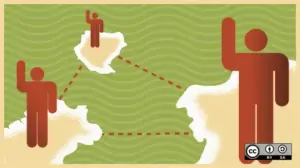
No matter what form it ultimately takes or what industry it serves, open source is always, at its core, a network. Sometimes, that network consists of interconnected computers sharing code repositories, servers, and automated pipelines. More importantly, however, it is a network of people.

Whether contributors, users, and maintainers are gathering in person at an international conference, meeting informally at a local pub, or collaborating asynchronously in an online chat room, open source is essentially a community of human beings working toward shared goals. The software, documentation, and shared standards are the artifacts of that collaboration, but the driving force is always human interaction and shared purpose.
For the past twelve years, the digital publication Opensource.com has been supported by a commercial entity. Throughout that extensive run, the platform has served as a central gathering place for stories, perspectives, and announcements regarding the creation, adoption, and sharing of open source solutions across the globe.
Yet, the people who actually make up the Opensource.com community—the writers, editors, readers, contributors, and advocates—are not commercial entities. They are individuals. They are people sharing ideas, troubleshooting technical hurdles, and building a collaborative future together.
Now, after more than a decade of publication under its current operational model, that dynamic is preparing to evolve. In one month, Opensource.com is set to resolve that operational bug and embark on its next iteration. As the community prepares for this upcoming milestone, readers and contributors are encouraged to stay tuned for further announcements as more specific details regarding the new project come to light.