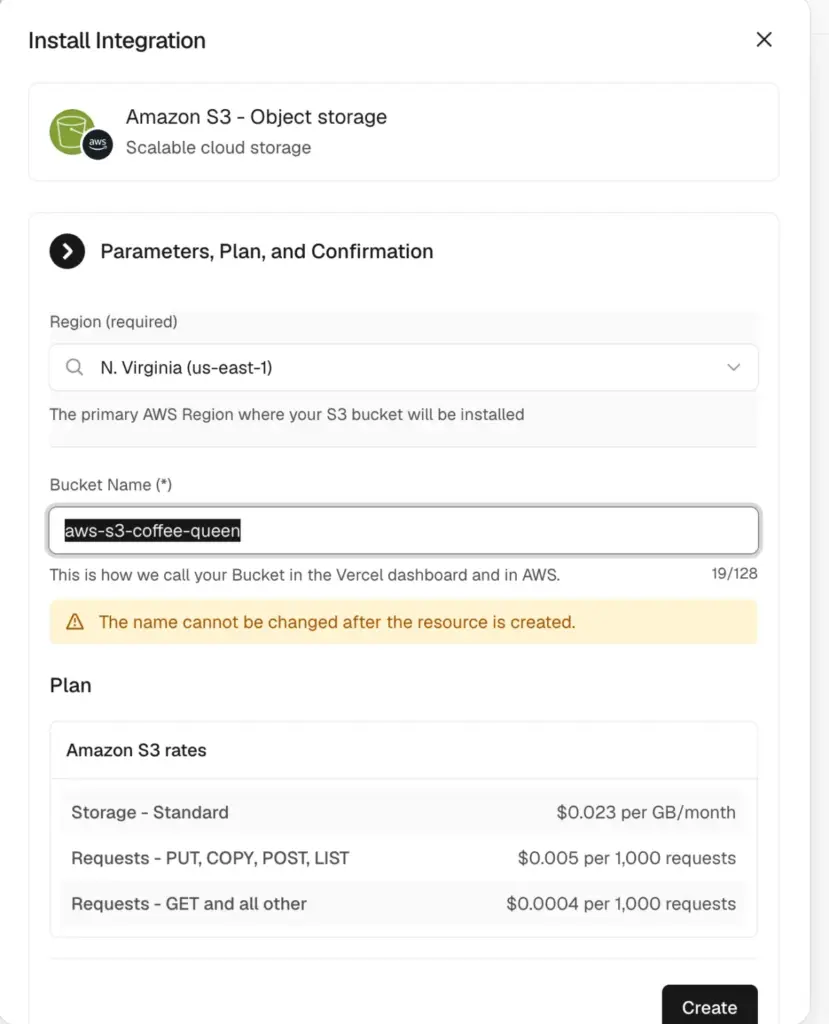
In a move aimed at bridging the gap between high-performance cloud infrastructure and the rapid-deployment needs of modern web development, Vercel has announced a new, native integration for Amazon Simple Storage Service (Amazon S3). Starting today, developers utilizing Vercel’s platform can provision and manage S3 storage—including the specialized S3 Tables and S3 Vectors—directly from the Vercel Marketplace and through v0, the company’s AI-powered generative development tool. This integration effectively allows teams to build full-stack applications that combine Vercel’s front-end deployment capabilities with the robust, scalable storage infrastructure of AWS, all within a unified management experience.
The integration is designed to solve a longstanding friction point for developers. While millions of engineers rely on Vercel to deploy and scale their web and AI applications, the process of configuring backend storage previously required a context switch to the AWS Management Console. Developers had to manually configure IAM policies, manage security credentials, and handle resource provisioning separately from their application code. By bringing S3 directly into the Vercel dashboard and the v0 workflow, the platform now handles the provisioning, connection configuration, and environment variable injection automatically. This capability joins existing integrations for Amazon Aurora, Amazon DynamoDB, and Amazon OpenSearch Serverless, enabling developers to maintain a complete application stack—spanning databases, object storage, and vector search—within a single AWS account and a consolidated billing stream.
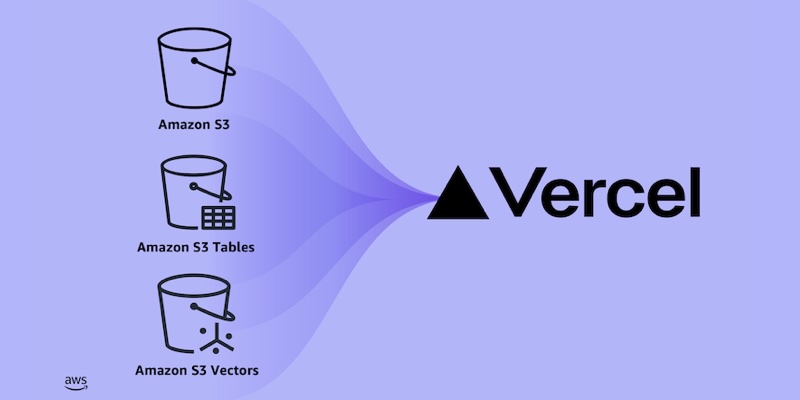
The scope of this integration is significant, as it supports three primary workload categories: everyday object storage, large-scale data analytics, and modern AI development. By providing native access to Amazon S3, S3 Tables, and S3 Vectors, Vercel is positioning itself to support a broader array of application architectures that require more than just static asset hosting.

For general-purpose object storage, the integration simplifies the process of file uploads and management within Next.js applications. By linking an S3 bucket to a Vercel project, the platform automatically injects necessary environment variables such as the AWS region, role ARN, and bucket name. Crucially, the system utilizes short-lived OpenID Connect (OIDC) tokens. At runtime, the awsCredentialsProvider from the @vercel/functions/oidc package handles the exchange with the AWS Security Token Service (AWS STS), ensuring that temporary, scoped credentials are used for every operation. This eliminates the need to store static AWS access keys, significantly enhancing the security posture of the application by ensuring no long-lived credentials are ever exposed or saved within the environment.

The inclusion of S3 Tables represents a major step toward supporting high-performance analytics within the same deployment environment. S3 Tables are purpose-built to provide managed storage for analytics, designed to optimize query performance automatically as data volumes scale. By providing fully managed Apache Iceberg tables with automated maintenance and compaction, the service allows developers to handle complex data workloads with ease. Through this integration, developers can use engines like DuckDB directly within Vercel Functions to perform lightweight queries. Because the integration handles the connection and authentication, developers can attach their S3 Tables buckets and run complex analytical operations, such as aggregations or filtering, without having to manage the underlying infrastructure of a separate data warehouse.
Perhaps most timely is the support for S3 Vectors, which provides a cost-optimized, purpose-built storage solution for AI agents and inference engines. As developers increasingly build RAG (Retrieval-Augmented Generation) applications and semantic search tools, the need for efficient vector storage has skyrocketed. S3 Vectors allows developers to store and query high-dimensional embeddings directly within the same S3 ecosystem, removing the need for a dedicated, separate vector database. In a typical workflow, a developer might generate embeddings using their preferred AI model and then use the S3 Vectors client to perform similarity searches, retrieving the most relevant data for their AI agents in real-time.
The integration with v0, Vercel’s generative AI tool, further accelerates this workflow. By simply describing an application in natural language—such as requesting "a photo gallery where users upload images" or "a support bot that answers questions from my PDFs"—v0 can now automatically provision the appropriate S3 resource, configure the necessary connections, and generate the boilerplate code required to get the application running. This capability reduces the time from conceptualization to functional prototype, allowing developers to focus on the business logic of their applications rather than the underlying infrastructure plumbing.
Furthermore, this unified approach allows for powerful combinations of AWS services. Since every service managed through Vercel shares the same account and authentication framework, developers can easily build hybrid architectures. For example, an application could store file metadata in an Amazon Aurora database while keeping the files themselves in S3, or it could pair document text in DynamoDB with vector embeddings in S3 Vectors for complex, multi-modal retrieval tasks. Because these resources all reside within the user’s own AWS account, developers retain full access to AWS-native tooling, ensuring that they are not locked into a proprietary abstraction but are instead using a streamlined interface to manage standard AWS infrastructure.
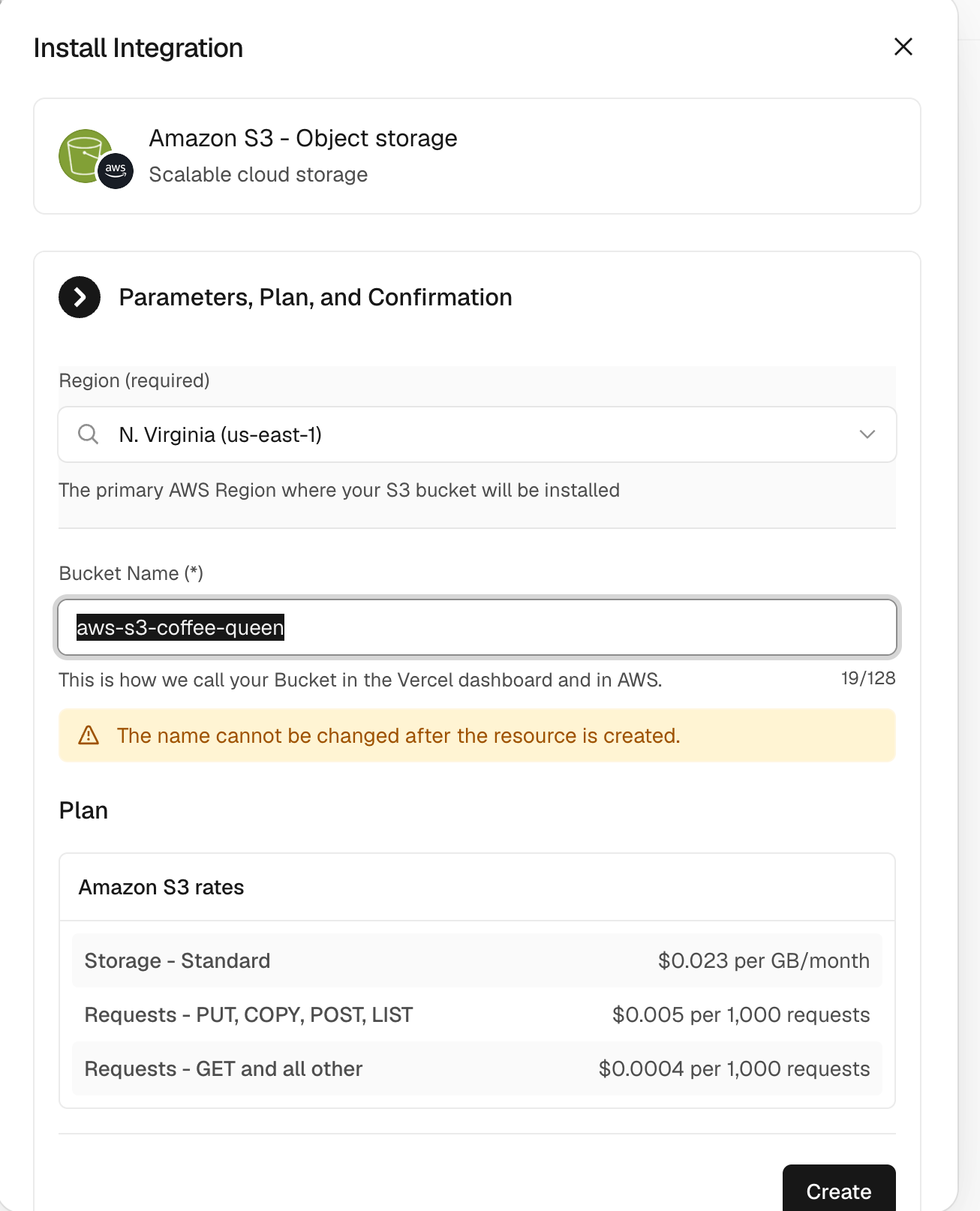
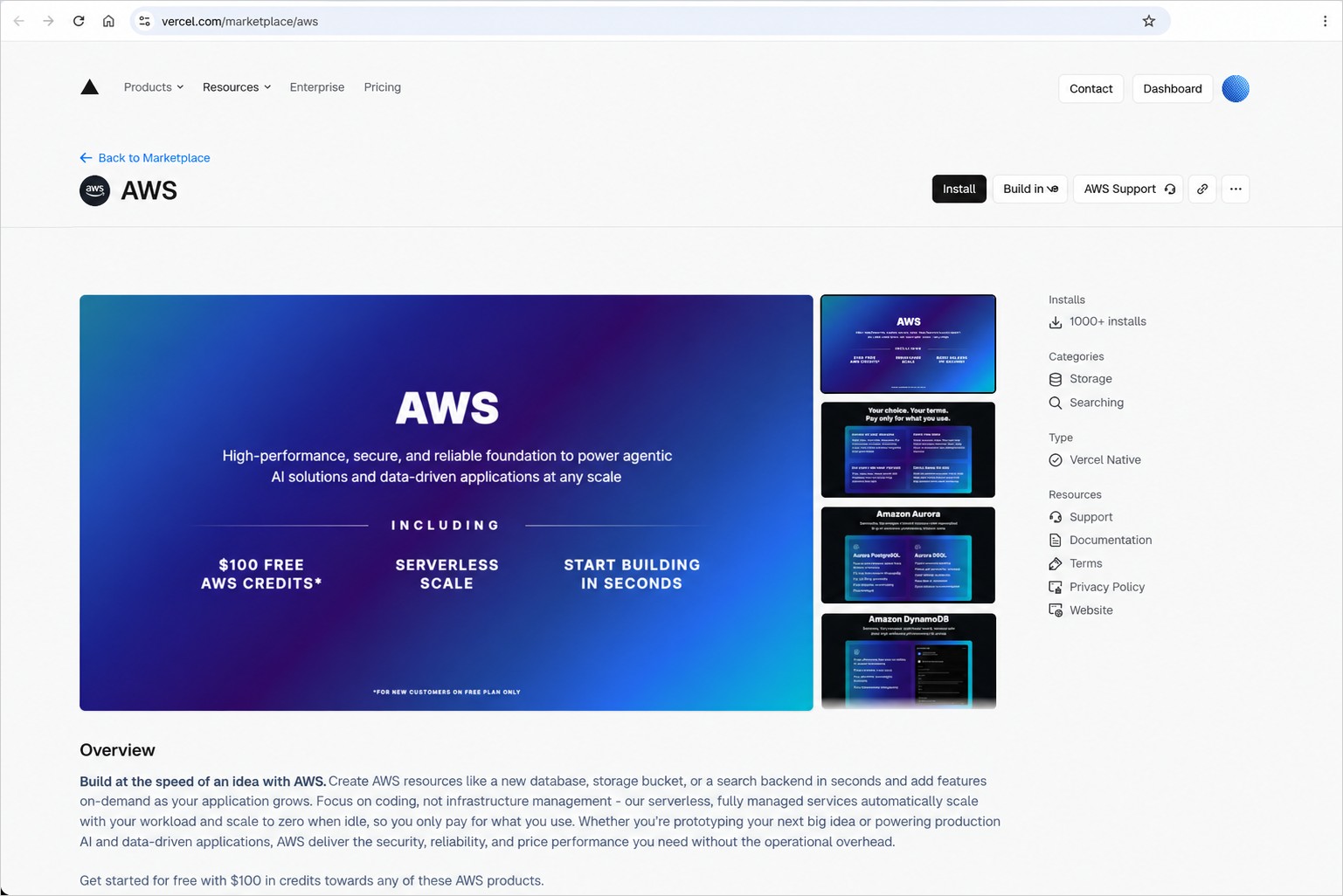
The onboarding process for this integration is designed for simplicity. From the Vercel dashboard, users can navigate to the "Storage" tab, select "Create," and choose the AWS option. After picking the desired bucket type and AWS region, the platform handles the creation of the resource in seconds. Users have the flexibility to either create a new AWS account through the integration—which includes $100 in AWS credits valid for six months—or link an existing AWS account. When an existing account is linked, Vercel respects the user’s existing environment while managing only the new buckets created through the platform. There are no additional charges for the integration itself, and users pay only standard Amazon S3 pricing for the resources they consume.
As the ecosystem matures, developers looking for deeper integration or troubleshooting assistance can leverage the AWS MCP Server and various plugins, which are designed to work with AI tools to help navigate documentation, search for regional availability, and debug common issues. This new capability marks a shift in how web and AI applications are built, moving away from fragmented infrastructure management toward a cohesive, developer-centric experience that leverages the scale and reliability of AWS while maintaining the speed and agility of the Vercel platform. For those looking to explore these features, resources are now live on the Vercel Marketplace and the v0 platform, signaling a new chapter in how cloud-native applications are provisioned and deployed.