In a significant move to bridge the gap between frontend development and robust cloud infrastructure, Vercel has announced the native integration of Amazon Simple Storage Service (Amazon S3) directly into its platform. By making S3 storage resources available through the Vercel Marketplace and its AI-powered interface, v0, the company is aiming to simplify how developers provision, configure, and manage cloud storage for web and AI applications. This development marks a shift in the developer experience, moving away from the often-complex process of manual AWS configuration toward a more streamlined, integrated workflow that keeps the entire application stack—from the database layer to object, vector, and analytical storage—within a single, unified environment.
For millions of developers who rely on Vercel to build, deploy, and scale their applications, this integration removes a persistent friction point. Previously, provisioning storage required developers to navigate away from the Vercel dashboard to the AWS Management Console, where they had to manually configure IAM policies, manage credentials, and establish secure connections. This context switching not only slowed down the development lifecycle but also introduced potential risks in credential management. Now, with the S3 integration, these processes are handled automatically. Whether a developer is building a high-traffic web application or a sophisticated AI agent, the necessary storage resources can be provisioned with a few clicks, ensuring that the infrastructure is ready for deployment without leaving the Vercel environment.
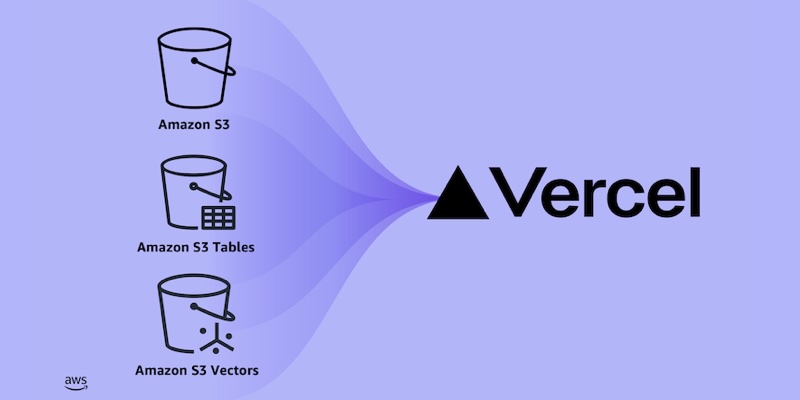
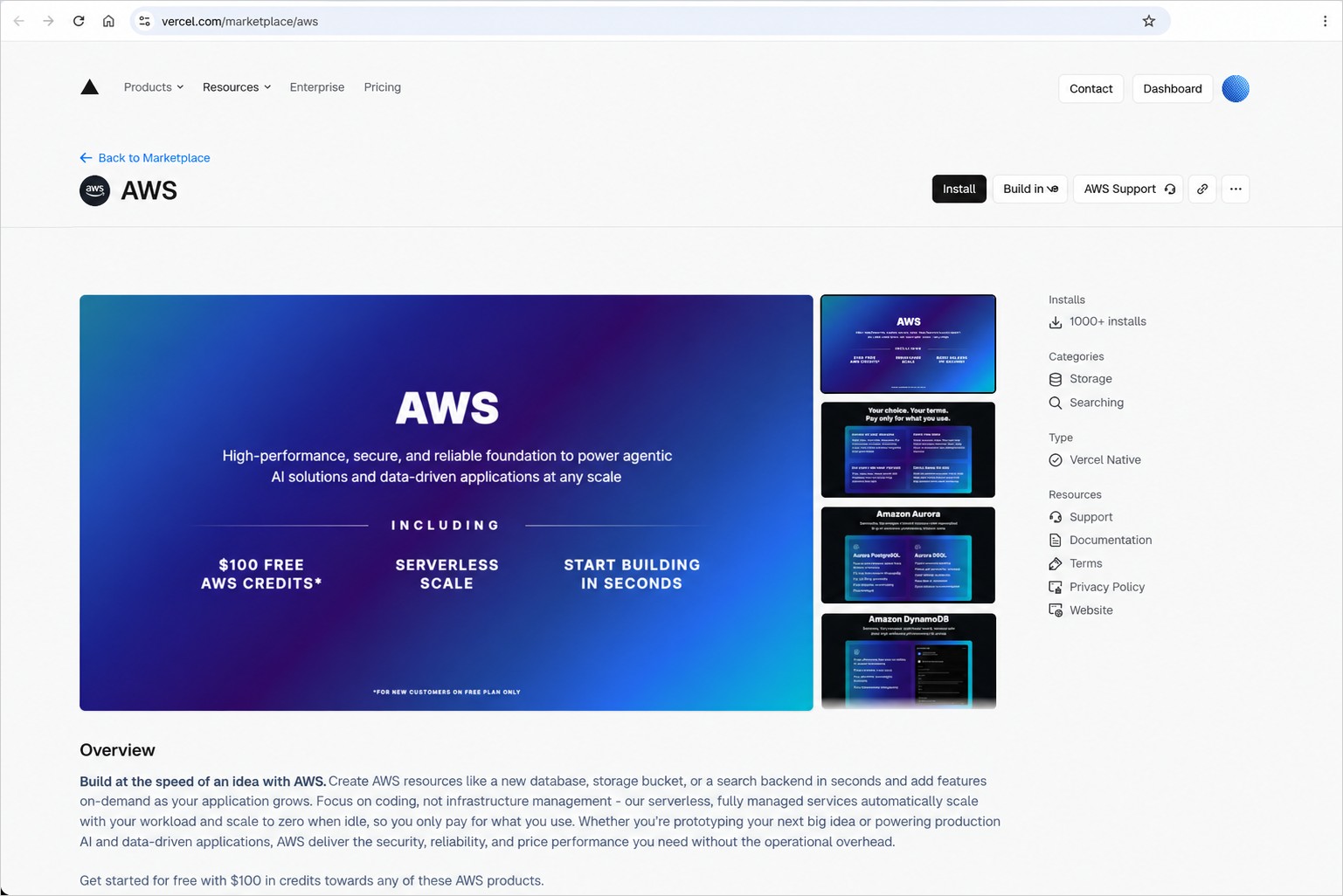
The integration covers three primary storage workloads: everyday object storage, analytics, and AI-driven vector search. This broad coverage is achieved through the inclusion of Amazon S3, Amazon S3 Tables, and Amazon S3 Vectors. By incorporating these services into the Vercel Marketplace, the platform now offers a comprehensive suite of storage options that complement existing integrations for Amazon Aurora, Amazon DynamoDB, and Amazon OpenSearch Serverless. For the developer, this means the ability to manage a complete, production-ready stack on a single AWS account, consolidated under one bill, and managed via a consistent, intuitive interface.

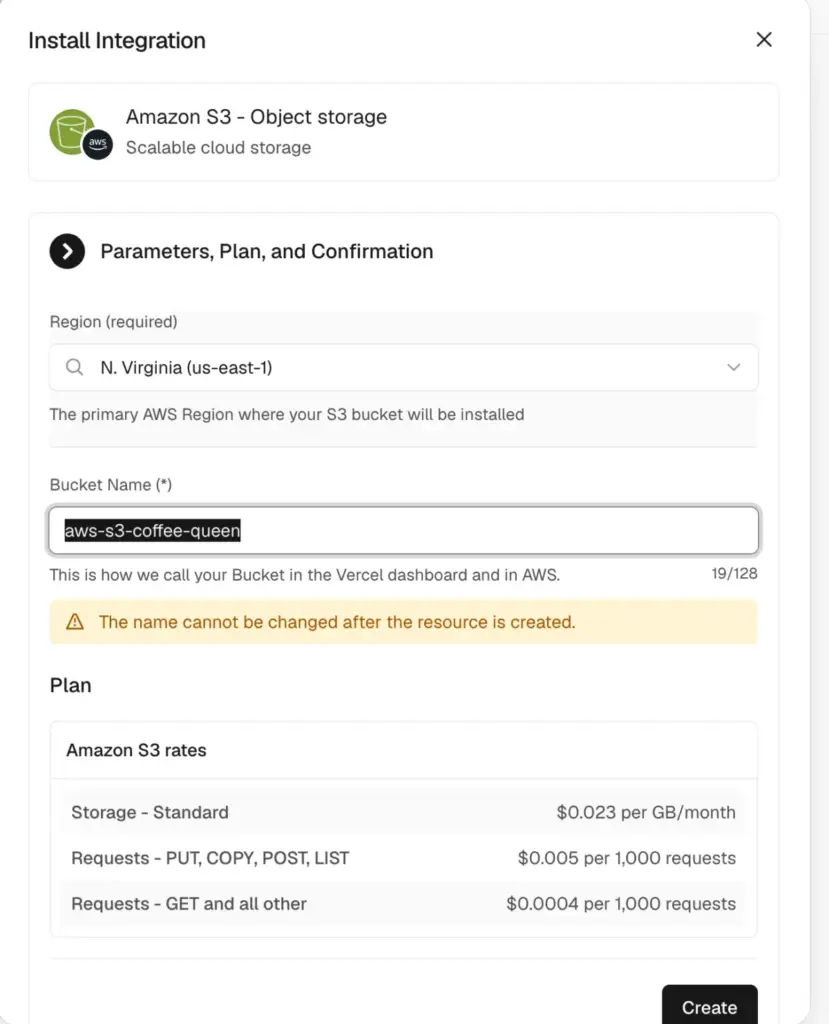
The process of getting started is designed to be frictionless. From the Vercel dashboard, developers navigate to the Storage tab and select the "Create" option. After selecting AWS as the provider, they can choose the specific type of S3 bucket required for their project, pick a preferred region, and initiate the provisioning process. The system handles the heavy lifting, taking only a few seconds to stand up the resource. Once the bucket is provisioned, the integration automatically injects the necessary environment variables—such as AWS_REGION, AWS_ROLE_ARN, and the specific bucket name—directly into the project via the Vercel CLI.
Security has been a central focus of this integration. Rather than relying on static keys, which are prone to leakage or mismanagement, the system utilizes the awsCredentialsProvider from @vercel/functions/oidc. This mechanism exchanges a short-lived OIDC token with the AWS Security Token Service (AWS STS) to generate temporary, scoped credentials for the specific resource. By eliminating the need to store static credentials, Vercel significantly improves the security posture of applications, adhering to modern best practices for cloud-native development.
The versatility of this integration is highlighted by its support for various application requirements. For standard object storage, developers can easily implement file upload and retrieval functionality within their Next.js routes. By leveraging the AWS SDK for JavaScript, developers can interact with their buckets using familiar commands, such as PutObjectCommand for uploading files or ListObjectsV2Command and GetObjectCommand for managing object metadata and retrieval. This simplicity allows developers to focus on application logic rather than the underlying storage plumbing.

For data-heavy applications, the inclusion of Amazon S3 Tables provides a powerful, managed solution for analytics. Designed to automatically optimize query performance as data scales, S3 Tables offer fully managed Apache Iceberg tables with built-in maintenance and compaction features. Because these tables are compatible with any Apache Iceberg REST Catalog-compliant engine, developers can easily integrate them with tools like DuckDB within Vercel Functions. This enables efficient, lightweight analytics queries—such as performing complex aggregations on large datasets—directly from within the application layer. By adding specific configurations to next.config.mjs, developers can ensure that native bindings are correctly handled, maintaining performance without compromising the build process.
Perhaps the most timely addition is the support for Amazon S3 Vectors. As AI agents and RAG-based (Retrieval-Augmented Generation) applications become increasingly prevalent, the need for cost-optimized vector storage has grown. S3 Vectors allows developers to store and query vectors natively, providing a scalable backbone for AI inference and semantic search. While S3 Vectors does not generate embeddings itself—leaving that to the developer’s chosen model—it provides a robust index that can be queried for the closest matches. This integration makes it significantly easier for teams to build intelligent features, such as chatbots that answer questions based on custom document corpora or search engines that understand semantic context, without needing to maintain a separate, dedicated vector database.
The role of v0 by Vercel in this ecosystem is particularly noteworthy. By describing their requirements in natural language, developers can now have the infrastructure provisioned for them automatically. For instance, asking for a "photo gallery where users upload images" will prompt the system to provision a general-purpose S3 bucket. Requesting a "support bot that answers questions from my PDFs" will lead to the configuration of S3 Vectors. This AI-driven provisioning not only handles the creation of the storage resource but also generates the necessary code and connection configuration, allowing developers to move from an idea to a working prototype in minutes.
The ability to combine these new S3 capabilities with existing AWS services on Vercel opens up significant architectural possibilities. Because every service shares the same account and authentication model, developers can easily mix and match components. One might, for example, store file metadata in Amazon Aurora while keeping the raw files in S3, or store document text in DynamoDB while keeping the corresponding vector embeddings in S3 Vectors for high-performance RAG retrieval. This composability ensures that developers are not locked into a rigid framework but can instead build a tailored stack that meets the specific performance and cost requirements of their project.
Flexibility remains a core tenet of this release. Developers have the option to create a new AWS account directly through the Vercel integration, which is an ideal path for those looking to quickly build and test new projects. For teams with existing AWS infrastructure, the integration allows for linking an existing account, ensuring that users can maintain their current billing arrangements and leverage their existing AWS environment. Notably, the integration is designed to respect existing workflows; while Vercel manages the buckets created through its platform, developers retain full access to their AWS-native tooling. This ensures that even as the development process becomes more streamlined, the underlying resources remain fully under the control of the developer, providing a "best of both worlds" experience.
For those getting started, Vercel and AWS have introduced a $100 credit for new AWS accounts created through the integration, valid for six months. The integration itself carries no additional charge, with users simply paying the standard Amazon S3 pricing for the resources consumed. As this feature rolls out to all commercial AWS regions supported by Vercel, it marks a significant step toward a more unified and efficient cloud development lifecycle, reducing the barriers to entry for building high-performance, data-driven applications. Developers interested in diving deeper into the technical specifications, regional availability, or troubleshooting can consult the AWS documentation or engage with the community via AWS re:Post.