








The vibrant and far-reaching open source community is currently hard at work behind the scenes on something entirely new. Regular visitors to Opensource.com may have recently noticed a distinct quietness settling over the platform. That noticeable lull in publishing is not an accident or an oversight; it is the direct result of a major new project currently in the works. While organizers and community leaders note that there are not yet many specific details or timelines available for public announcement, there is already an immense amount of ground to cover and plenty to talk about regarding the future of the platform and its people. What better way to start a conversation about a sprawling, collaborative network than by looking at the entire internet itself?
The internet, and top-level domains
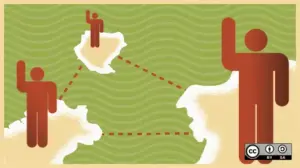
To understand where the open source community is heading and why this upcoming transition matters, it helps to look back at the fundamental architecture of the global network we all rely on every single day. Most internet users know that the internet is, at its core, a network. By definition, a network is simply a group of interconnected connections. In fact, the very word "internet" is a portmanteau derived from "interconnected" and "network."
Historically speaking, the internet began as a network of interconnected networks. In its earliest iterations, it primarily consisted of two distinct entities: a military network designed for resilient communications and an academic network meant for research institutions to share data. As the technology matured and the internet gradually gained popularity outside of those initial, specialized groups, it quickly became apparent that different designations were desperately needed. Society needed a way to differentiate between a commercial entity operating for profit, a charitable organization serving the public good, a university advancing higher education, or a governmental department carrying out public administration.

These crucial designations ultimately became known as top-level domains, commonly abbreviated as TLDs. Today, internet users can choose from a vast and rapidly expanding universe of TLDs, ranging from niche industry identifiers to geographic extensions. However, for a very long time, there were only a handful of these foundational suffixes available to the public.

Those original TLDs remain deeply embedded in internet culture and continue to be overwhelmingly popular today. Most web users instinctively recognize that when they navigate to a web address ending in .com, they are visiting a commercial site intended for business. Conversely, when a user visits an address ending in .org, they understand they are browsing a website dedicated to a non-profit organization, public interest group, or community initiative. These suffixes act as digital neighborhood signs, instantly communicating the underlying purpose and identity of the organization behind the screen.
Open source is a network
Just as the internet relies on a web of interconnected systems to function, the open source movement itself can be understood as a multifaceted network. Open source can take on many different forms, serving various purposes across global industries and societies. It can be thoroughly commercial, driving enterprise software and cloud infrastructure. It can be strictly non-profit, fueling public interest software and digital rights advocacy. It can be entirely academic, supporting scientific research and technological experimentation. It can even be purely cultural, preserving shared knowledge, art, and literature.
No matter what specific form open source takes in any given context, it remains, at its foundational level, a network. Sometimes that network physically manifests as a literal network of computers, servers, and distributed nodes collaborating across continents through version control systems. But most importantly, and most powerfully, it is fundamentally a network of people.
Whether human connections are forged when individuals gather in person at a massive international technology conference, meet casually for a conversation at a local pub, or collaborate continuously in an online chat room, open source is, above all else, a community of living, breathing people. It is driven by human curiosity, shared challenges, mutual aid, and a collective desire to build better tools for everyone.

For the past twelve years, the website Opensource.com has been proudly supported by a commercial entity, acting as a prominent digital hub for the broader movement. Yet, there is a fundamental distinction worth highlighting: the people—meaning the everyday contributors, readers, advocates, and creators, which includes both you and me—that truly make up the Opensource.com community are not commercial entities. We are simply people. We are individuals brought together by a shared passion for creating, adopting, and sharing open source solutions that empower users and foster digital freedom.
That underlying tension between corporate backing and community-driven human identity is precisely what the upcoming changes aim to address. In just one month, Opensource.com is going to resolve that operational bug, shifting the paradigm to better align with the human network that sustains it. Stay tuned for further developments as the community prepares to unveil the next chapter of its journey.