








Artificial intelligence is fundamentally reshaping the lifecycle of modern product development, altering how digital solutions are conceptualized, built, shipped, and measured across industries. As organizations race to integrate advanced machine learning capabilities into their core offerings, a pressing realization has emerged: the greatest challenge in the current technology landscape is rarely a lack of research or raw computational power. Instead, the primary barrier lies in closing the persistent gap between a promising experimental AI prototype and a robust production product that real-world users can genuinely trust and rely upon.
This critical intersection is precisely where the modern artificial intelligence product manager operates. Unlike traditional software product managers who oversee predictable, deterministic systems governed by strict rule-based logic, artificial intelligence product managers must navigate outputs that are inherently fluid, dynamic, and probabilistic. These systems can shift unexpectedly, generate hallucinations, and display inconsistent behaviors across diverse user populations. Consequently, the contemporary role demands a sophisticated fluency in machine learning trade-offs, rigorous evaluation systems, complex compute economics, and evolving regulatory frameworks, all while maintaining clear communication channels with software engineers, legal counsel, and executive leadership.
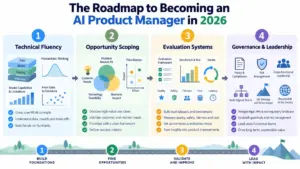
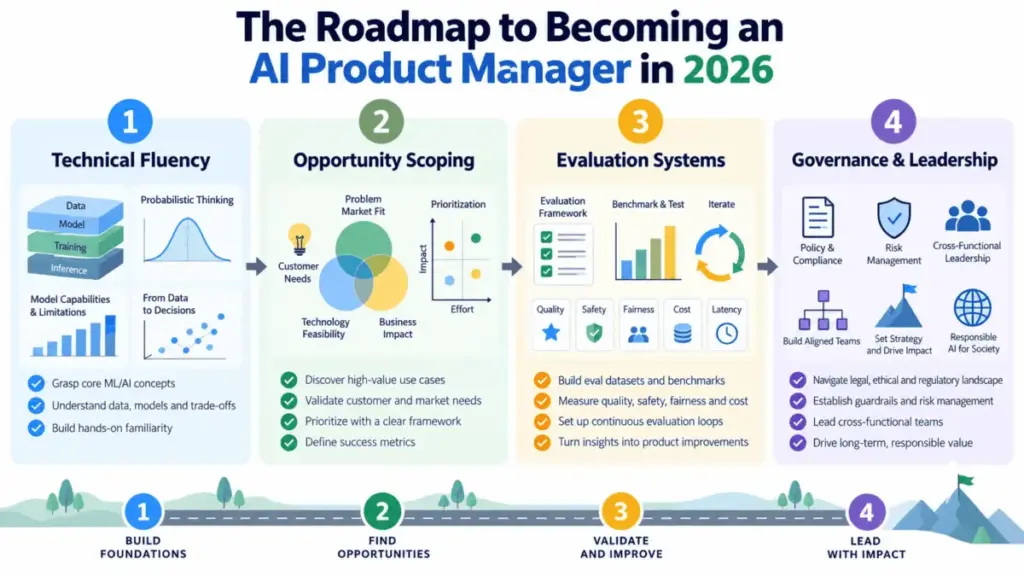
Industry experts have outlined a comprehensive developmental framework to help technology professionals transition into this high-demand discipline, organizing the path into distinct phases that span from core technical fluency to broad organizational leadership. As the landscape matures heading toward 2026, these accumulated skills allow practitioners to manage complex technological transformations effectively.

Developing Technical Fluency and the Probabilistic Mindset
The foundational shift required for any aspiring artificial intelligence product manager involves moving away from traditional deterministic thinking and embracing a probabilistic mindset. Conventional software engineering operates on predictable mechanics where a specific input invariably yields a precise output. In contrast, modern artificial intelligence systems generate outputs that are probabilistic, approximate, and heavily dependent on surrounding context. Rather than treating this variability as a structural flaw to be aggressively engineered away, successful product leaders recognize it as the very terrain they must navigate and manage.
Aspiring practitioners must begin by building deep intuition around major architecture choices they will inevitably encounter in the field. While there is no strict requirement for product managers to implement these complex architectures from scratch, they must understand the fundamental trade-offs well enough to ask the right questions during initial scoping phases and to push back effectively against engineering assumptions during project planning.
At this early stage, professionals must focus equally on managing three core tensions that will define their daily responsibilities: the constant balancing act between system latency, financial cost, and output accuracy. Considerations surrounding token consumption rates, time-to-first-token metrics, and context-window sizing surface in nearly every strategic product discussion. Gaining familiarity with foundational literature, such as comprehensive guides on large language models and practical deep learning courses, helps build necessary architectural intuition without requiring advanced mathematical prerequisites. Professionals often synthesize this knowledge by evaluating various architectural approaches for common business scenarios, such as automated customer support, and documenting their strategic reasoning in writing.
AI Opportunity Discovery and Feasibility Scoping
Once a foundational technical vocabulary is established, the next critical competency involves identifying which potential artificial intelligence opportunities are genuinely worth pursuing and understanding why the vast majority of proposed concepts ultimately fail to justify their development costs.
Frameworks like the AI Product Canvas provide a structured approach for mapping specific business tasks along two distinct axes: the potential value delivered if the system performs exceptionally well versus the operational risk incurred if it fails. High-leverage, low-risk tasks such as automated text classification, summarization, and document extraction typically serve as solid early candidates for implementation. Conversely, high-stakes tasks involving safety, regulatory compliance, or irreversible actions demand substantial evaluation infrastructure before they are deemed ready for production deployment.
A vital capability at this juncture involves navigating the complex build versus buy versus assemble decision matrix. This strategic choice is simultaneously technical and financial, requiring leaders to model the unit economics of compute accurately. Product managers must calculate how gross profit margins hold up as token consumption scales over time, how GPU hosting costs compare against per-call application programming interface fees at ten times current volume, and how specialized database queries interact with retrieval depth. Developing comfort with inference-layer cost modeling separates product leaders who successfully ship sustainable solutions from those who build impressive demonstrations that quickly collapse under real-world commercial loads. Market analysis resources and public pricing documentation from leading model providers help practitioners build this crucial financial intuition.
AI User Experience, Evaluation Systems, and Iteration
The product management lifecycle for artificial intelligence diverges most sharply from conventional software practices when addressing user experience design, evaluation systems, and iterative improvement. Because a probabilistic product’s outputs are never guaranteed, teams cannot rely on traditional binary pass-or-fail testing methods. Instead, organizations must establish dedicated evaluation infrastructure.
Designing user experiences for non-deterministic interfaces introduces unprecedented interface challenges. Product managers must determine how to effectively communicate system uncertainty to end-users without eroding their trust, how to design graceful degradation states for instances when a model provides an incorrect answer, and where to strategically insert human-in-the-loop checkpoints. Furthermore, they must establish reliable feedback loops—incorporating both explicit user ratings and implicit behavioral signals—that allow the underlying system to improve continuously over time.
On the evaluation front, modern practitioners must master eval-driven development. Adversarial testing, commonly known as red-teaming, is an absolute necessity rather than an optional pre-launch step. Before releasing any user-facing artificial intelligence feature, teams must conduct structured adversarial testing, including prompt injection attempts, boundary probing, and worst-case scenario simulations. Integrating these safeguards directly into standard pre-launch checklists ensures safety measures are treated as core infrastructure from day one. Specialized evaluation frameworks and documentation provide the technical backing required to build these measurement pipelines effectively.
AI Governance, Compliance, and Organizational Leadership
The final phase of development shifts the focus from initial product building to enterprise-scale deployment, transitioning individual contributors into roles of broader organizational influence. Artificial intelligence products operating at scale face complex regulatory, legal, and cultural hurdles that require the product manager to act as an effective translator among technical researchers, legal experts, and business executives.
Regulatory literacy has rapidly transformed into a non-negotiable requirement for technology leaders. Emerging global legislation, sweeping executive orders, sector-specific mandates in healthcare and finance, and strict data residency laws across international jurisdictions directly dictate what products can be built, where they can be deployed, and what rigorous documentation must be maintained. While product managers do not need formal legal training, they must possess enough familiarity with these regulations to flag potential exposure early and collaborate productively with corporate legal counsel.
Data lineage and privacy remain ongoing operational concerns in every enterprise environment. Teams must carefully track which customer data is transmitted to external model providers, what sanitization pipelines exist before data interacts with a model, and how opt-out policies are enforced. In corporate settings, rigorous compliance standards significantly influence underlying architectural decisions.
Perhaps the most underappreciated competency at this leadership level is cross-functional orchestration: the ability to seamlessly align research engineers who focus primarily on technical benchmarks, legal teams focused on mitigating liability, and non-technical executives focused on revenue growth and risk management. The product manager’s primary responsibility is to maintain strategic clarity across all these disparate groups without losing critical context or fidelity in translation.
As the industry continues to mature, the artificial intelligence product manager role remains dynamic, offering incoming practitioners a unique opportunity to help define its long-term boundaries. The discipline ultimately relies on maintaining intellectual honesty regarding technological uncertainty, avoiding exaggerated claims about model capabilities, building robust fallback systems, and treating evaluation as essential infrastructure rather than an afterthought. While the underlying technical landscape will inevitably continue to shift at a rapid pace, the core professional responsibilities remain constant: understanding technical trade-offs, scoping initiatives with rigor, measuring what truly matters, and building lasting trust with every stakeholder involved in the development lifecycle.