









In a significant expansion of its serverless ecosystem, Amazon Web Services has announced that GPU support is now available for EC2 G-series instances within AWS Lambda Managed Instances (LMI). This development marks a pivotal shift for developers who have long sought to run resource-intensive workloads—such as machine learning inference, complex media processing, scientific simulations, and advanced rendering—within the streamlined, operational framework of a serverless architecture. By bridging the gap between high-performance GPU hardware and the ease of serverless deployment, AWS is providing a path for organizations to leverage specialized compute power without the traditional burden of managing underlying infrastructure.
Eliminating the Complexity of GPU Infrastructure
Historically, deploying GPU-accelerated applications required a deep commitment to infrastructure management. Engineering teams were tasked with selecting specific instance types, manually installing and reconciling GPU drivers, managing CUDA library versions, and planning for capacity shifts. Furthermore, developers had to write custom logic for scaling and build complex event integrations to connect the GPU-based processing steps with the remainder of their application stack.
The new GPU support for Lambda Managed Instances fundamentally removes these operational hurdles. Functions are now deployed as standard Open Container Initiative (OCI) images. Once a developer points a function toward a container image, Lambda assumes full responsibility for provisioning, auto-scaling, and integrating with AWS event sources. This architecture eliminates the need for manual cluster management, device plugins, or the tedious task of maintaining Amazon Machine Images (AMIs). Because these functions are built upon the Lambda Managed Instances foundation, they offer the benefits of Amazon EC2 pricing and high-performance compute while maintaining the "serverless simplicity" that has defined the service since its inception.
Addressing Utilization and Cost Challenges
One of the most persistent issues facing organizations deploying GPU workloads is the high cost of idle hardware. Because GPUs are expensive resources, low utilization rates—common when a single workload fails to fully saturate a processor—can quickly lead to unsustainable cloud expenditures. In many cases, a small inference task might require a full instance, leaving the vast majority of the GPU’s capacity unused while the customer continues to pay for the entire provisioned unit.
This new integration directly addresses this inefficiency. By consolidating functions onto shared instances and keeping GPUs active across concurrent requests, the Lambda environment maximizes the utilization of every GPU being billed. This means that organizations no longer have to choose between over-provisioning for performance and under-provisioning for cost. The ability to trigger these functions using the same event sources as standard Lambda functions—coupled with identical security and billing models—allows developers to integrate GPU acceleration into their existing workflows with minimal friction.
Enabling Diverse Workloads Beyond Traditional ML
While the capability is heavily optimized for inference tasks, its utility extends well beyond standard machine learning models. The architecture is designed to handle a broad spectrum of non-ML workloads, including media transcoding, complex rendering, and scientific computing. It is particularly well-suited for custom models that may not be available on higher-level abstraction services like Amazon Bedrock, providing a flexible "bring-your-own-model" environment.

Within the broader Lambda programming model, these GPU-accelerated functions serve as critical components in larger, multi-step applications. Developers can leverage Lambda Durable Functions to orchestrate long-running workflows, incorporating checkpointing and automatic recovery to ensure reliability. For agentic workloads, the system allows for a highly efficient handoff: a Lambda MicroVM can execute the logic-heavy, CPU-based tasks of tool-use, then trigger a GPU-accelerated function for the intensive inference phase. This modular approach allows for sophisticated application designs that remain highly scalable and maintainable.
The service also supports extended function timeouts of up to 90 minutes for asynchronous and event source mapping invocations, which is a major boon for batch processing and long-running GPU tasks. With support for container images up to 32 GB, ephemeral storage up to 32 GB, and significant memory allocation, these functions are designed to handle heavy-duty processing requirements without forcing developers to re-architect their systems for a distributed environment.
Operationalizing GPU Deployment
The practical application of this technology is designed to be intuitive for those already familiar with the AWS ecosystem. By utilizing a base image—such as the provided vLLM image—developers can deploy an LLM endpoint by simply configuring a few environment variables, such as the MODEL_ID. Lambda then handles the heavy lifting of downloading the model weights, managing GPU memory, and serving incoming requests.
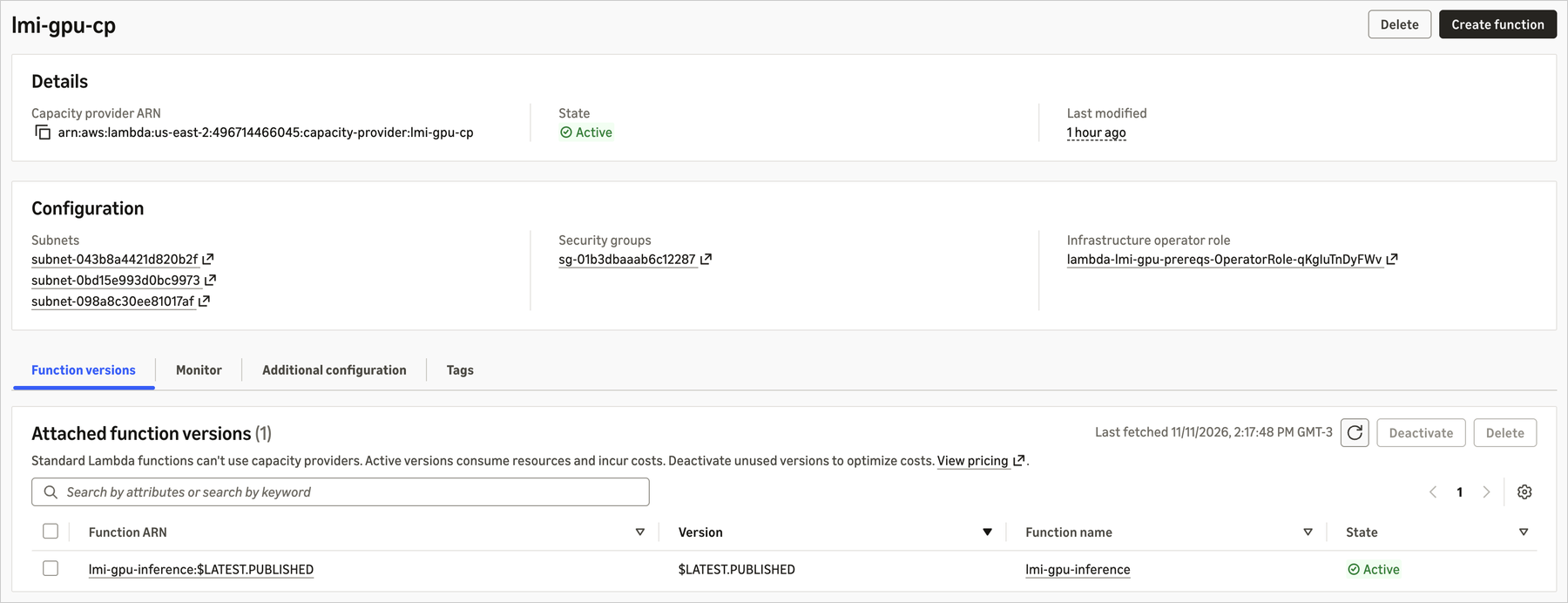
When setting up these functions, developers can define a capacity provider that specifies which GPU instance types are permitted, allowing Lambda to auto-scale and select the most cost-effective option available. This flexibility extends to cross-generation scaling, which helps reduce the likelihood of "Insufficient Capacity Errors" during periods of high demand. For those with strict compliance or availability requirements, the system also supports EC2 On-Demand Capacity Reservations (ODCR), allowing organizations to reserve specific GPU capacity that Lambda will automatically utilize.
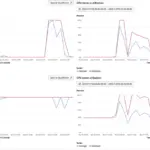
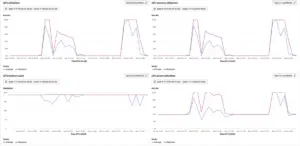
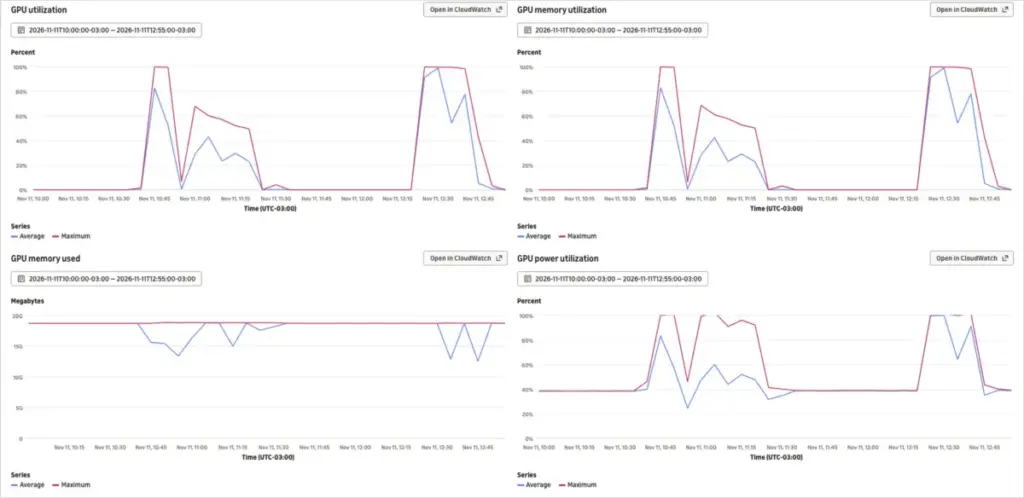
Furthermore, monitoring has been simplified to provide deep visibility into the performance of the accelerator. Because GPU-specific metrics—including GPU utilization, memory usage, and power consumption—are integrated directly into the AWS Lambda console and Amazon CloudWatch, teams can gain immediate insights into how their code is interacting with the hardware. This data is essential for both performance tuning and cost management, providing a clear signal for developers to adjust their concurrency settings to drive higher throughput.
Security, Compliance, and Ecosystem Integration
By maintaining consistency with existing AWS IAM policies, VPC configurations, and networking standards, GPU-accelerated functions fit seamlessly into a secure enterprise environment. This is a marked improvement over many third-party serverless GPU solutions that often exist outside the native AWS networking and identity stack, creating potential silos.
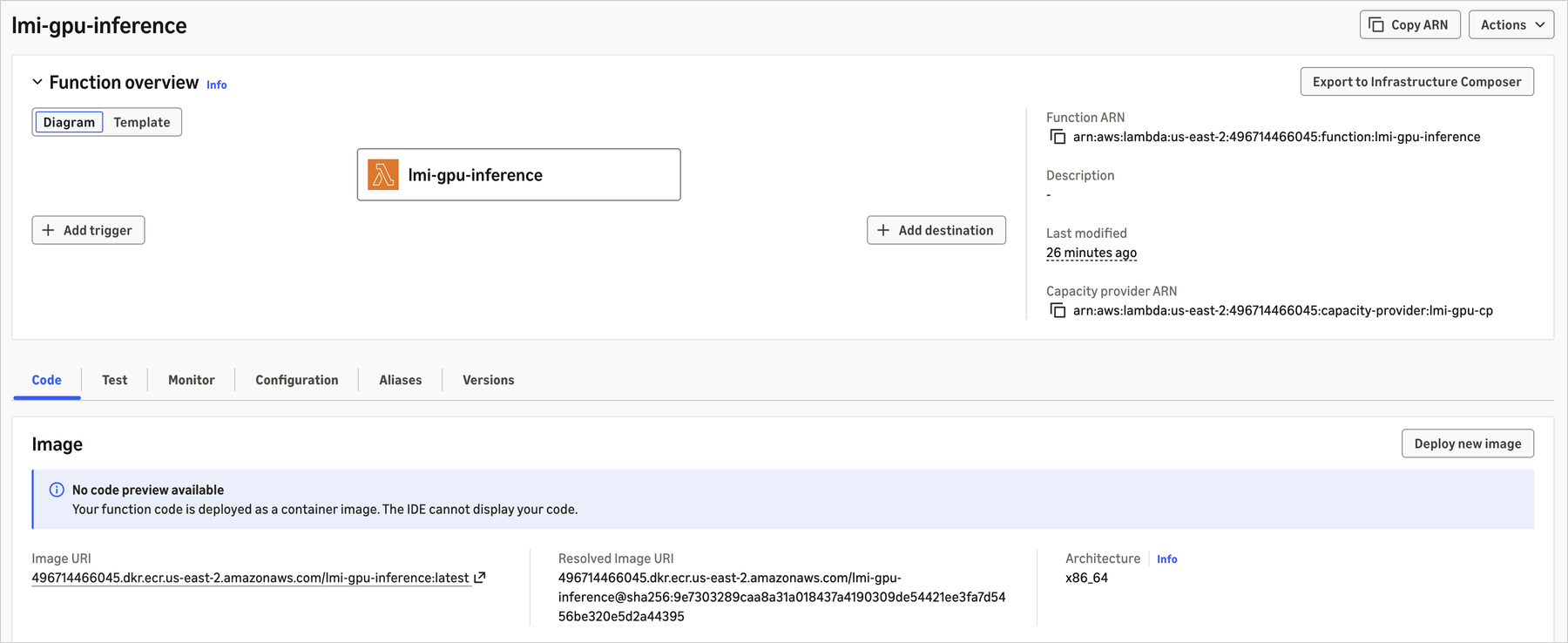
The ecosystem support is equally robust. Because the deployment workflow relies on familiar tools like the AWS CLI, CloudFormation, AWS CDK, SAM, and Terraform, moving a GPU-powered function into a production CI/CD pipeline is straightforward. The use of Seekable OCI (SOCI) lazy loading further optimizes the experience by allowing functions to start executing before the entire container image has been downloaded, reducing startup times by up to 70 percent.
The current launch supports a wide array of Amazon EC2 G-series instances, including the G4dn, G5, G6, G6f, Gr6, Gr6f, and G6e families, with plans to expand support to additional instance types in the future. Pricing is designed for transparency: customers pay the underlying EC2 instance fee—which remains compatible with existing Savings Plans and Reserved Instances—along with a 9.75 percent management fee and the standard Lambda request fee.
This evolution represents a mature step forward for the serverless model. By removing the barriers of hardware management, driver compatibility, and complex orchestration, AWS is enabling a broader segment of the developer community to tap into the power of GPU-accelerated computing. Whether it is for real-time inference, high-performance data processing, or intelligent agentic workflows, the ability to deploy these workloads with the same ease as a simple script significantly lowers the barrier to entry for modern, AI-driven applications. As the industry continues to push toward more compute-intensive, intelligent software, this integration ensures that the infrastructure supporting these innovations remains as agile as the code itself.