











Software engineers are increasingly viewing the environmental impact of their code not just as a secondary concern, but as a critical component of professional engineering. According to a new study conducted by GitHub in collaboration with the Yale Program on Climate Change Communication, there is a profound, unmet demand among developers for the tools, metrics, and best practices required to build more energy-efficient software. While the desire to reduce the carbon footprint of digital infrastructure is widespread, the research highlights a significant "action gap": developers want to minimize wasted compute, but they currently lack the standardized methodologies to measure their impact and implement meaningful change.
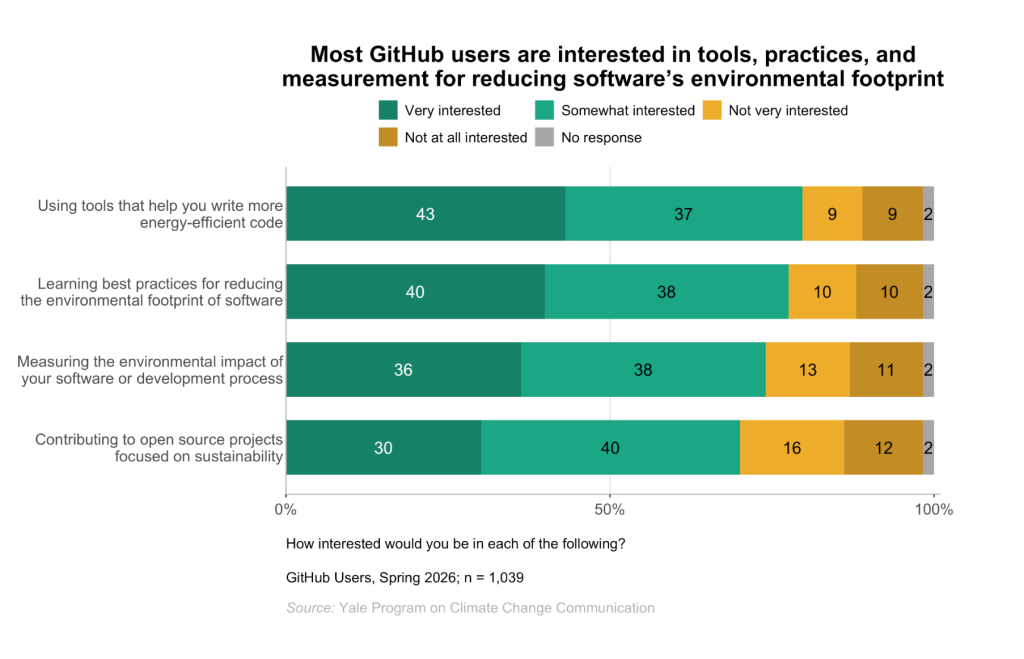
The survey, which engaged 1,039 GitHub users in the United States, reveals that developers are highly cognizant of the relationship between their work and the broader climate crisis. Eight out of ten respondents expressed a keen interest in tools designed to assist in writing more energy-efficient code. A similar majority sought out best practices to reduce the environmental footprint of their software, while nearly 75% of those surveyed explicitly requested reliable methods to measure the impact of their development processes. These findings suggest that for the modern developer, the push toward efficiency is no longer just about performance optimization or cost-cutting; it is increasingly viewed as an ethical imperative.
Developers’ Environmental Concerns in the Age of AI
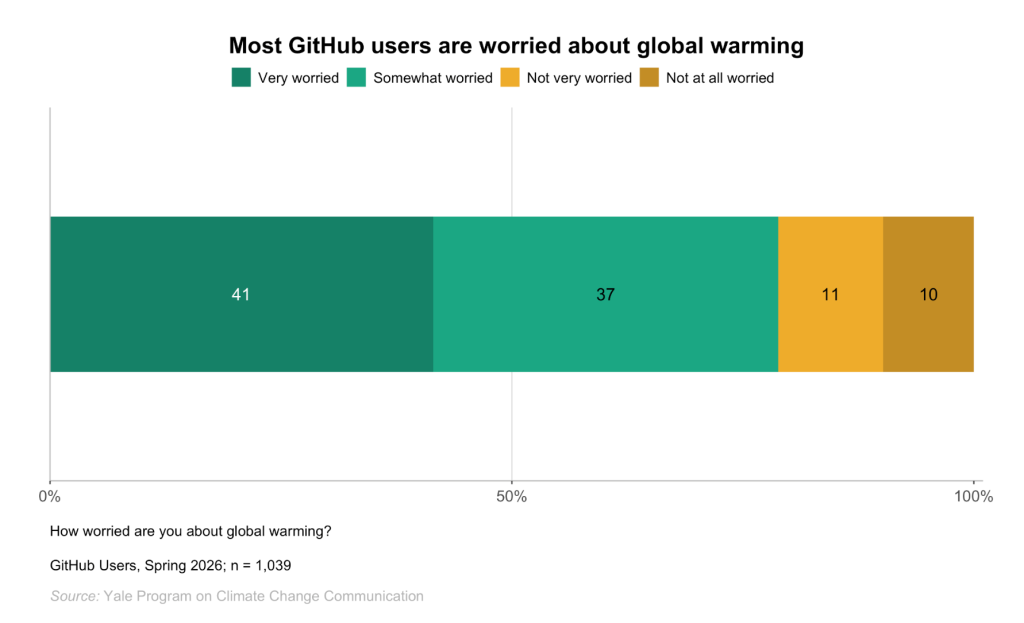
The discourse around the environmental impact of technology has been sharpened by the rapid ascent of artificial intelligence, which requires massive computational resources. The survey, which reached out to a representative sample of GitHub’s U.S.-based active users, probed attitudes toward climate change, the role of the tech sector, and the specific footprint of software systems. The results indicate that the GitHub community holds a significantly higher level of concern regarding global warming than the general U.S. adult population.


When compared against data from Yale’s "Climate Change in the American Mind" project, the contrast is stark. Roughly 86% of GitHub users surveyed believe that global warming is happening, compared to 68% of the broader U.S. population. Furthermore, 82% of developers consider the issue personally important, and a clear majority express worry about the potential for harm to themselves and future generations. While these results represent a specific subset of developers who have opted into marketing communications—and thus should be viewed as a reflection of that specific community rather than the entire global developer population—the trend is clear: software engineers are thinking deeply about the environmental consequences of the systems they architect.
The Challenge of Translating Concern into Code
Despite this clear consensus on the importance of sustainability, there is a widespread feeling among developers that their individual efforts have little impact. Only 10% of survey respondents believe that the way they currently develop and write software has a "large effect" on reducing their personal environmental footprint. Conversely, 63% believe their personal impact in this area is small. This perceived impotence stems not from a lack of care, but from a lack of a clear, actionable path forward.
Developers are not asking for abstract climate policies; they are asking for the same level of engineering rigor they apply to security, performance, and reliability. The open-ended responses from the survey paint a picture of a workforce eager for concrete guidance. Respondents identified a need for help in estimating the footprint of their repositories and CI/CD workflows, identifying unnecessary execution of GitHub Actions, and understanding how to effectively compare AI-driven compute demands against traditional software workloads.
There is also a growing skepticism toward "greenwashing." Several developers emphasized that making environmental claims without empirical evidence is counterproductive. They correctly noted that faster code does not always equate to lower energy consumption. The relationship between compute and emissions is complex, influenced by a variety of variables including hardware efficiency, workload duration, regional power grid carbon intensity, and the specific time of day when tasks are executed. To make a genuine impact, developers need measurements that are as nuanced and accurate as the claims they hope to support.
Reframing Efficiency as a Core Engineering Discipline
The most effective way to address this challenge, according to the researchers, is to integrate efficiency into the standard engineering lifecycle. Efficiency is already a hallmark of high-quality software; optimizing code often leads to lower infrastructure costs, reduced latency, and improved performance. When developers treat "wasted compute" as a technical debt to be managed, they naturally align environmental goals with business objectives.
Instead of approaching sustainability as a separate, niche task, developers are encouraged to focus on measurable waste in four primary areas: execution time, CPU utilization, memory allocation, and network transfer volume. Each of these metrics serves as a proxy for computational demand. The key, however, is transparency. When a developer submits a pull request intended to improve efficiency, they should include the before-and-after benchmarks, the methodology for those tests, and an acknowledgment of any trade-offs—such as increased memory usage or decreased code maintainability. This is the hallmark of professional engineering: replacing vague labels like "greener" with data-driven evidence.
Leveraging AI for Sustainable Development
As AI tools become more integrated into the development process, they can also serve as a force multiplier for efficiency. While humans must remain the final arbiters of code quality, AI agents can handle the labor-intensive task of scanning large repositories for potential optimizations. GitHub’s "Daily Efficiency Improver" workflow, for instance, is designed to identify opportunities across various layers of the stack, including data handling, I/O operations, and frontend performance.
The workflow operates by reviewing a repository for inefficiencies, running existing tests to ensure stability, and generating draft pull requests that present the evidence for the proposed change. Crucially, this system does not automate the decision to merge; it provides the data and the suggested fix, leaving the final review to the maintainer. This approach ensures that developers remain in control, treating every AI-generated recommendation as a hypothesis that must be validated by tests and benchmarks before it is accepted into the production codebase.
By incorporating these checks into the existing engineering loop, teams can turn environmental concern into a consistent, sustainable practice. A repository-level workflow can surface the issue, a draft pull request can outline the fix, and standard testing procedures can verify the outcome. This loop provides exactly what the survey respondents were looking for: a practical, repeatable, and transparent path toward reducing the environmental impact of software. As the industry continues to scale, embedding this discipline into the daily workflow of every developer may prove to be one of the most effective strategies for long-term digital sustainability. The full report, "Software Developers on Climate Change, AI, and Sustainable Software," offers further insights into these findings and provides a foundation for organizations looking to foster a more efficient, conscious approach to engineering.