







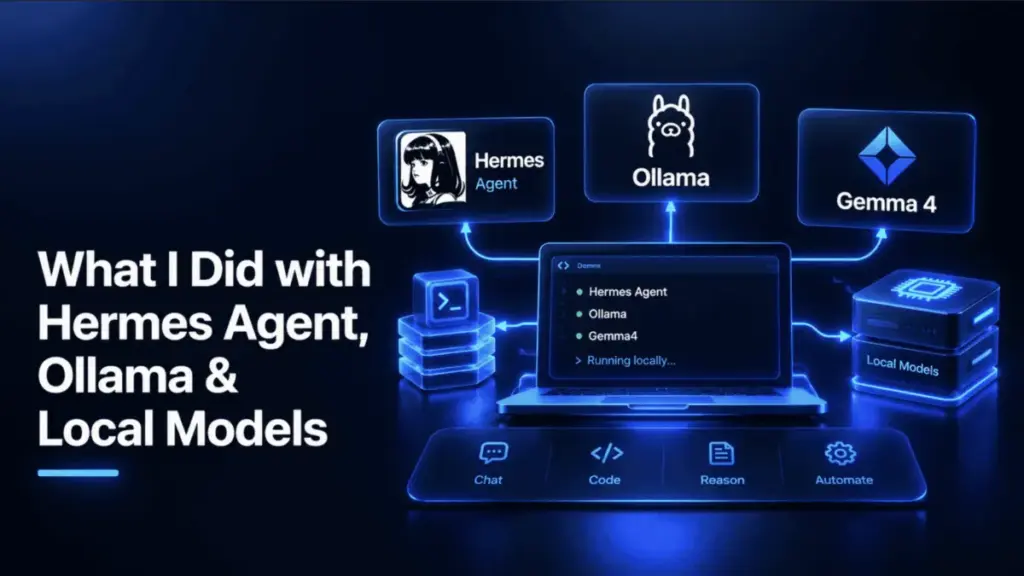
The modern landscape of artificial intelligence is largely defined by cloud-based services, subscription fees, and recurring monthly bills that scale alongside usage. For many everyday tasks, such as planning a trip, researching a destination, finding suitable accommodations, and generating flight searches, users are expected to route personal preferences and queries through centralized cloud providers. Seeking an alternative that eliminates subscriptions, protects data privacy, and operates entirely on local hardware, software engineer and technical writer Shittu Olumide has developed a fully functional, multi-agent travel research team powered by Hermes Agent and Ollama.
The project, which demonstrates the practical viability of running sophisticated AI workflows on consumer hardware, pairs an open-source orchestrator with a local model runner. By combining these two technologies, developers and enthusiasts can build customized, autonomous agent teams that execute real-world tasks—ranging from live web browsing to executing custom code scripts—without sending sensitive data to third-party servers or incurring unexpected operational costs.
At the core of the project is Hermes Agent, an open-source AI agent developed by Nous Research under the permissive MIT license. Designed to bridge the gap between traditional conversational chatbots and genuine autonomous agents, Hermes is capable of reading and editing files on a local machine, executing terminal commands, and browsing the live web. These capabilities form the foundation of a travel planning project that requires real-time information retrieval rather than static, pre-trained responses.
Hermes features multi-agent orchestration, a capability that allows a primary coordinator agent to delegate specific tasks to specialist sub-agents and synthesize their findings into a cohesive output. This architecture mirrors professional team delegation. Additionally, persistent memory allows the agent to retain contextual details across sessions, such as a traveler’s budget, preferred travel style, or past itineraries, preventing the need to restart the configuration process with every new interaction. Support for the Model Context Protocol further expands its utility, connecting the agent to isolated sandbox tools like web search servers while accommodating custom Python-based tools.
To provide the cognitive engine for these agents, the setup utilizes Ollama, an open-source tool designed to download, manage, and serve large language models directly on a local computer. Ollama exposes these models through a local application programming interface that mirrors cloud-provider endpoints, replacing remote URLs with a local host address. Because Ollama’s API is fully compatible with OpenAI standards, Hermes can interact seamlessly with models running entirely on a local central processing unit or graphics processing unit.
Running local models means that user inputs and queries remain entirely on the host machine, eliminating per-token billing structures and relying solely on the electricity consumed by the hardware. While consumer hardware may not match the raw processing speed or scale of massive frontier cloud models, the trade-off is often well worth it for specialized tasks like research, planning, and tool execution.
The travel planning project, conceptualized under the working title Wanderlist, is designed to perform four distinct jobs through a coordinated team of local agents. A central coordinator receives the user’s initial trip request and distributes responsibilities among three specialists: a destination scout to research entry requirements and attractions, a stay finder to suggest reputable neighborhoods and accommodations, and a flight finder to generate functional flight search links and contextual pricing data.
Configuring this system requires hardware capable of running a model with robust tool-calling support. Effective multi-agent orchestration and custom tool execution demand a language model that reliably understands when and how to invoke functions rather than simply generating fluent text. Software configurations point Hermes to Ollama’s local endpoint, establishing a direct connection that bypasses the need for external API keys.
The architectural design of the travel team relies heavily on role separation. The root coordinator handles incoming requests and delegates tasks to the sub-agents while maintaining access to a persistent memory database for user preferences. The destination scout is explicitly instructed to perform fresh web searches for entry and visa requirements rather than relying on model memory, mitigating the risks associated with outdated regulations. Similarly, the stay finder compiles well-regarded neighborhood guidance and price ranges from recent travel sources without inventing specific listings. The flight finder combines web search context with a custom Python tool designed to build accurate search URLs.
Because no comprehensive, free real-time flight-pricing API is universally accessible, the project adopts a practical approach by programmatically generating Google Flights search URLs using natural-language query parameters. A custom Python script handles input validation for origins, destinations, and travel dates, ensuring that malformed data triggers immediate error handling rather than producing broken links. Utilizing URL encoding standards guarantees that multi-word city names and special characters are processed correctly before reaching the browser.
The practical application of this multi-agent team becomes clear during an interactive session. When a user requests a budget-conscious trip to Portugal from Madrid with an interest in history and food, the coordinator immediately springs into action. It delegates the destination research to the scout, neighborhood recommendations to the stay finder, and itinerary pricing context along with a clickable search link to the flight finder. The system synthesizes these distinct threads into a comprehensive briefing while securely saving the user’s preferences for future planning sessions.
The resulting project illustrates that sophisticated AI workflows do not inherently require expensive cloud infrastructure or recurring subscriptions. By leveraging open-source tools like Hermes Agent and Ollama, developers can construct practical, privacy-focused automation systems capable of handling complex, multi-step research tasks entirely on local hardware.