









Healthcare systems generate massive volumes of data every single day, ranging from routine clinical visits and laboratory blood work to complex diagnoses, specialized prescriptions, and high-resolution medical imaging. For software developers, data engineers, and researchers working to build modern healthtech applications, having access to realistic patient data is an absolute necessity. Whether designing a robust healthcare analytics pipeline, testing an Electronic Health Record system, or experimenting with predictive machine learning algorithms, technical teams require data that accurately reflects the intricate operational realities of actual medical environments.
Yet, this requirement collides with a profound industry challenge: real patient data is highly sensitive, strictly regulated by privacy laws, and exceptionally difficult to access safely. Navigating this landscape creates a persistent dilemma for developers seeking to innovate without exposing confidential patient information. To bridge this gap, the technology and healthcare sectors have increasingly turned to synthetic healthcare data as a viable, secure alternative for development and testing.
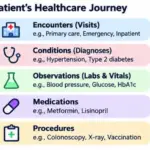
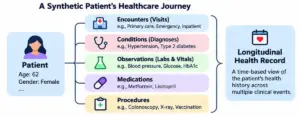
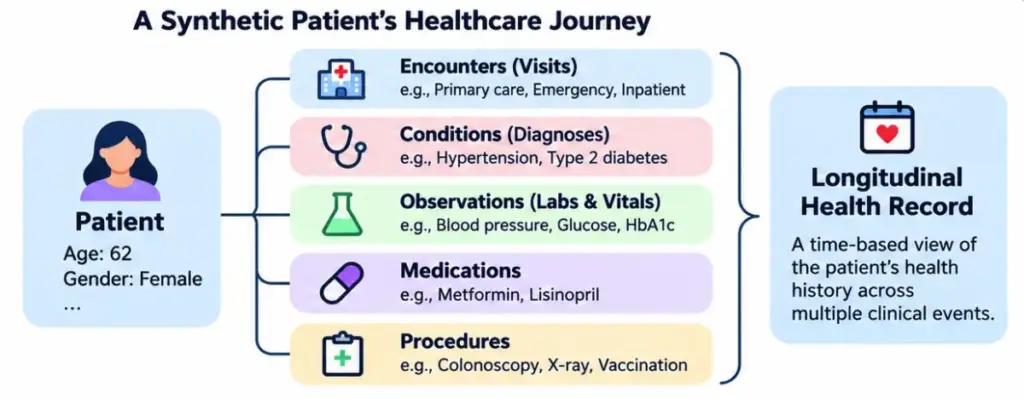
A prominent approach in this domain involves utilizing Synthea, an open-source synthetic patient population simulator originally developed by MITRE. Rather than producing arbitrary rows of disconnected text, the tool simulates entire patient lifecycles over extended periods. By modeling longitudinal healthcare events—including medical conditions, clinical encounters, pharmaceutical prescriptions, surgical procedures, and diagnostic observations—the simulator creates structured data that closely mirrors real-world clinical documentation.

The mechanics of synthetic data generation differ fundamentally from traditional data de-identification methods. While de-identification begins with authentic patient records and strips away direct personal identifiers such as names and home addresses, synthetic information is generated completely from scratch through simulation models and predefined clinical rules. Consequently, artificial records do not directly represent any actual living person’s specific medical history, offering a cleaner boundary for privacy compliance during early-stage development and engineering stress tests.
Industry professionals leverage these simulated datasets across a wide variety of development scenarios. Engineers frequently rely on synthetic records to validate data ingestion pipelines, test interoperability standards between disparate healthcare software platforms, and prototype advanced analytics workflows. Furthermore, these datasets allow researchers to safely study the structural relationships inherent in complex medical schemas without running afoul of stringent data governance frameworks.
Operating the simulator involves configuring environment prerequisites, primarily centered on compatible long-term support versions of the Java Development Kit, alongside standard command-line tools like Git and Python. Once the source code repository is cloned and built locally using Gradle, administrators can execute commands to generate specific population sizes tailored to their project requirements. Command-line parameters allow operators to control target numbers, establish random seeds for consistency, and manage demographic filters.
A notable observation during experimental generation runs highlights how population dynamics function within the software. When requesting a specific population target, the simulator often yields a slightly higher number of records due to built-in demographic overflow settings. These adjustments account for simulated mortality events occurring prior to the reference date, ensuring the surviving population remains statistically coherent according to the underlying configuration models. Operators seeking exact demographic caps can toggle specific overflow parameters, though doing so alters how the broader population distribution is ultimately modeled.
The resulting output from a simulation run is typically exported into structured comma-separated value files or Health Level Seven Fast Healthcare Interoperability Resources formats. These files categorize information across distinct operational domains, dividing data into separate logs for patient demographics, clinical encounters, active conditions, laboratory observations, administered medications, and diagnostic procedures. Because a single patient accumulates numerous interactions with the healthcare system over a lifetime, a relatively modest group of initial synthetic profiles quickly expands into tens of thousands of individual clinical events.
Analyzing these interconnected records requires leveraging data manipulation libraries within programming languages like Python to reconstruct a patient’s clinical journey chronologically. By establishing relational links through shared patient and encounter identifiers, researchers can trace how an individual moves from an initial outpatient consultation through subsequent diagnoses, specialized testing, and therapeutic interventions. This relational mapping underscores the complexity of medical data, where a single hospital visit can simultaneously generate multiple observations and diagnostic conditions.
Despite their clear utility in software development and engineering environments, synthetic datasets carry inherent limitations that technical teams must carefully evaluate. Because the underlying information is generated via simulation models and algorithmic rules, it does not constitute authentic clinical evidence. Simulated behavioral patterns and documentation workflows may not fully capture the chaotic inconsistencies, documentation errors, or systemic anomalies characteristic of real-world healthcare environments. Consequently, models or pipelines trained exclusively on synthetic inputs must undergo rigorous validation before deployment in live clinical settings.