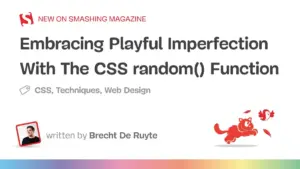







Design systems have long thrived on consistency, alignment, and rigid mathematical grids. For years, web developers and design engineers have spent countless hours obsessing over uniform design tokens, predictable layouts, and pixel-perfection. However, the arrival of the native CSS random() function—recently shipped in Safari and rolling out in Chrome 156, with encouraging signs from Mozilla regarding Firefox—is prompting a fundamental industry conversation about where controlled chaos, human-like imperfection, and playfulness actually fit into modern web architecture.
When the specification first landed, it raised an immediate question among frontend engineers accustomed to absolute control: why introduce randomness into stylesheets when the industry has spent the last decade making the web more predictable? Spacing scales, locked typography, and strict color tokens are badges of skill in design engineering. If a layout component shifts even a fraction of a pixel unexpectedly upon refresh, it is traditionally logged as a bug rather than applauded as creative expression. Yet, stepping away from the browser reveals that the physical world is never entirely uniform.
Take historical letterpress printing, where ink bleeds subtly into paper grain, characters feature microscopic tilts, and baselines are rarely straight. Similarly, a scattered deck of photographs or the organic flicker of streetlights at night possesses an analog messiness that makes environments feel alive, organic, and inherently human. In contrast, modern web interfaces can sometimes feel sterile, a sensation compounded by unguided large language models churning out uniform, highly predictable templates. The new CSS random capability seeks to reintroduce that tactile charm without requiring heavy JavaScript libraries or preprocessor loops that generate hundreds of lines of static code.
Specified under the CSS Values and Units Module Level 5, the random() function generates pseudo-random values natively within the browser engine. The formal syntax accepts minimum bounds, maximum bounds, and optional parameters for step increments and caching keys. Developers can define random angles, fluctuating widths, or varying animation durations using standard comma-separated arguments. Crucially, the minimum and maximum boundaries must share identical unit types—such as angles, lengths, time values, or unitless numbers—unless paired with internal calc() functions to ensure proper resolution.
To manage situations where properties must remain synchronized, such as maintaining a 1:1 aspect ratio for a square element while varying its dimensions, the specification introduces element-scoped caching keys. By assigning a shared dashed identifier alongside the element-scoped keyword, browsers ensure that independent properties on a single element reference the same random seed, preventing layout distortion while preserving overall variety across different components on the page.
Beyond numerical ranges, the broader CSS specification also outlines a future random-item() function designed to select randomly from a predefined list of tokens or keywords, though that feature lacks browser support for now. Meanwhile, developers experimenting with numerical randomness today are utilizing standard progressive enhancement techniques, wrapping their dynamic styles inside @supports queries to ensure robust fallback behavior across older rendering engines.
In practical demonstrations created by design engineers to test these boundaries, the applications extend far beyond abstract shapes into typography, layout structuring, and scroll-driven animations. By targeting individual character spans within a heading, developers can apply microscopic rotations, positional nudges, and subtle opacity variations that mimic vintage print typography. A corresponding hover state allows the chaotic elements to instantly snap back into rigid alignment, creating a dynamic interaction between playful imperfection and structural order.
However, introducing such visual styling requires careful attention to accessibility standards. Breaking words into individual character spans for styling purposes can cause screen readers to interpret and announce characters individually or introduce unnatural pauses. Proper implementation requires utilizing structural accessibility attributes, such as hiding the visual character spans from assistive technologies while providing the complete, unsegmented text string via appropriate labeling for screen reader users.
Further explorations into procedural animation demonstrate how random values can govern complex motion without external scripting. By assigning individual jump heights, rotation angles, and durations to textual characters combined with negative animation delays, elements can simulate continuous, organic bouncing rhythms the moment a document loads. Similar principles apply to card layouts and portfolio grids, where random tilts and dynamic shadows calculated from tilt angles replace rigid multi-column structures with expressive, editorial layouts.
When paired with scroll-driven animations and sibling-index queries, the CSS random() function allows developers to construct sophisticated interactive experiences, such as digital card decks that fan out dynamically across the viewport or marquee text rows traveling at varying velocities. By balancing mathematical formulas for structural positioning with random jitter values for human-like variance, these implementations achieve organic fluidity while remaining lightweight and performant.
Despite the creative potential, industry experts emphasize the importance of context when deploying randomness in production environments. Use cases that benefit most from procedural variance include marketing pages, lifestyle portfolios, editorial layouts, and decorative UI elements where absolute uniformity is not a functional requirement. Conversely, data-dense dashboards, financial interfaces, form controls, and enterprise tools where alignment directly impacts readability and user efficiency remain domains where strict consistency is paramount.
Furthermore, any implementation of random motion or transformation must strictly respect user accessibility preferences, including media queries for reduced motion. Ensuring that animation states can be flattened or neutralized for users who experience motion sensitivity remains a core responsibility in maintaining inclusive digital design standards.
Ultimately, the introduction of native CSS randomness bridges a long-standing gap in web development, allowing designers and engineers to infuse digital interfaces with organic character without sacrificing performance or maintainability. As browser support broadens, the feature offers a fresh perspective on how modern stylesheets can balance rigorous foundational systems with a renewed sense of playfulness and visual warmth.