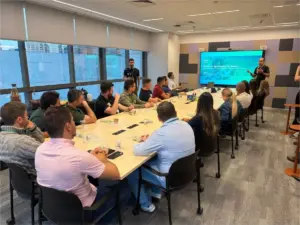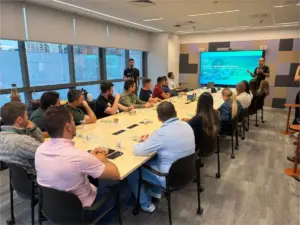








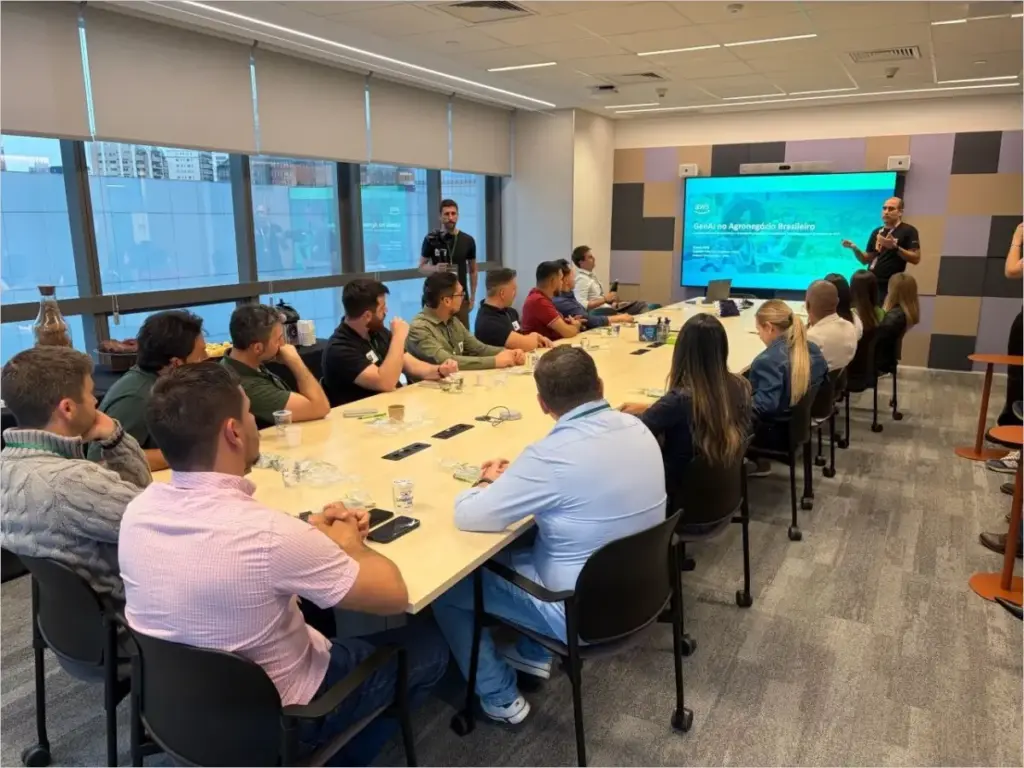
Technology moves at a blistering pace, and for those working on the front lines of industry, the gap between theoretical potential and practical implementation is narrowing daily. A few weeks ago, I had the privilege of presenting to a group of commercial and technology leaders from the Brazilian agribusiness sector at the AWS office in São Paulo. Our discussion centered on the strategic integration of generative AI across the various stages of modern agricultural operations. Throughout the session, one recurring theme emerged: the industries we traditionally view as "old-school" are often the very environments where the rapid adoption of new technology determines who gains a competitive edge.
There was no debate among the attendees about whether AI belongs in agriculture; that question has already been answered. Instead, the focus has shifted entirely to the mechanics of delivery. Leaders wanted to know who receives the AI-generated insights, in what language, and—crucially—on which devices, particularly when the end-user is navigating between remote farm sites or operating heavy machinery. This context is exactly why I find the recent updates to Amazon Polly so significant. By adding 14 new voices to the Generative engine, including two in Brazilian Portuguese, AWS is addressing a fundamental interface requirement: when a user has both hands on a steering wheel, the only viable interface is voice. This isn’t just a routine feature update; it is a vital step toward making sophisticated AI tools accessible in the field.
While my time in Brazil highlighted the potential of AI to revolutionize workflows, the broader news from AWS this week took a much sharper, more defensive turn. We are currently witnessing a reality where the window between the disclosure of a software vulnerability and its active exploitation has effectively vanished. AWS underscored this shift with the launch of a new security service designed specifically for this high-stakes environment, supported by sobering evidence from their own honeypot networks.

AWS Continuum: A New Paradigm for Vulnerability Management
The introduction of AWS Continuum represents a fundamental shift in how organizations handle security vulnerabilities. Rather than functioning as a traditional scanner that simply generates an overwhelming list of issues, Continuum reframes vulnerability management as a comprehensive, end-to-end process. By constructing a sophisticated context graph from a user’s repositories and their live AWS environment, the service can accurately map how a vulnerability might actually be leveraged within that specific infrastructure.
Continuum assigns an evidence level to every finding and, impressively, attempts to reproduce exploitable findings within an isolated sandbox. This provides security teams with actual proof-of-concept code, allowing them to visualize the threat rather than reacting to a generic severity label. The system ranks issues based on their proximity to business-critical systems, effectively prioritizing the risks that pose the greatest danger to operations. When a fix is identified, the service can generate a pull request, streamlining the remediation workflow. Currently, every remediation requires human approval—ensuring that developers retain control—though there is a clear roadmap toward autonomous fixes gated by confidence thresholds.
The urgency behind this development was made clear by recent findings from Amazon Threat Intelligence. In a stark demonstration of the current threat landscape, the team identified a PHP2Shell exploitation attempt in their MadPot telemetry on October 17. This occurred four days before the public disclosure of CVE-2026-109618 and CVE-2026-109619. Furthermore, by the time the vulnerabilities were formally disclosed, functional proof-of-concept exploits were already circulating roughly twelve hours before the official embargo was set to lift. This reality necessitates a change in how we view patch management: assuming a delay between disclosure and exploitation is a dangerous mistake. Security investigations must now begin at the earliest known point of exploitation, not the date of public disclosure. AWS Continuum is currently available in the US East (N. Virginia) and US West (Oregon) regions.
Simplifying Service Exposure with Amazon ECS Gateway
Managing the networking complexities of modern applications remains a significant challenge for platform teams. With the introduction of Amazon ECS Gateway, AWS is seeking to decouple the concerns of network management from application development. This new service allows platform teams to define a single gateway—complete with subnets, security groups, TLS certificates, listener settings, and AWS WAF web ACLs—that serves as the entry point for their organization’s services.
For application teams, the adoption process is streamlined through a gateway connector. Once added to a service definition, ECS automatically provisions the necessary infrastructure, including ACM certificates, unique DNS hostnames, listener rules, and target groups, while configuring security groups to accept traffic exclusively from the Application Load Balancer. The economic efficiency here is notable: a single ALB can support up to 25 services, and the system dynamically scales by provisioning or removing ALBs based on demand. A single gateway can associate with as many as 10,000 clusters, with a maximum of five gateways per cluster. Because it supports incremental adoption, teams can transition to this model without disrupting existing load balancer configurations. Amazon ECS Gateway is available at no additional charge in all commercial regions where Amazon ECS is supported.
A Broad Spectrum of Updates
Beyond these major announcements, the past week saw several other significant developments across the AWS ecosystem. The upgrade to the Amazon Polly Generative engine is perhaps the most consumer-facing, expanding the catalog to 57 voices across 11 languages and 25 locales. The addition of Hindi and Finnish, alongside the two new Brazilian Portuguese voices, marks a substantial increase in the service’s global utility.
In the realm of high-performance computing, the public beta of TorchNeuron brings native PyTorch support to AWS Trainium. By allowing users to switch their model execution to the ‘neuron’ target via a simple configuration change, AWS is lowering the barrier for developers to leverage their custom hardware without requiring complete rewrites of their codebases. This aligns with a broader strategy of preventing hardware lock-in, enabling developers to choose the compute that best suits their model requirements.

For those working with machine learning models, new customization options in Amazon SageMaker AI allow for training sessions without the burden of manual GPU management. Users can now control the post-training loop, including custom loss functions and reward signals, while SageMaker AI handles the complexities of GPU allocation, distributed execution, and fault recovery. This update also brings support for newer models like Muse Glimmer, Qwen 3.8, and Ministral 3.
Furthermore, developers utilizing Amazon Bedrock can now leverage structured outputs for Anthropic Claude models. By ensuring that the models return schema-compliant JSON, AWS is removing the need for fragile custom parsing and retry logic. This is a game-changer for automating tasks that require high reliability, such as extracting data from financial reports or routing support tickets based on specific intent. Additionally, Amazon ElastiCache Serverless for Valkey now supports zero-downtime online migrations, providing a seamless path for users to move from self-managed Valkey or Redis OSS environments to a fully managed service.
The ecosystem continues to evolve with new tools for agentic workflows, such as the AWS Agent Registry, which serves as a managed catalog for MCP servers and agent skills. This allows orchestrators to discover capabilities at runtime rather than requiring hard-coded integrations at build time. We also saw insightful documentation on "tokenomics" for coding agents, offering developers open-source tools to benchmark the cost and quality of various models. On the enterprise front, U.S. Bank shared a compelling case study on their successful migration of 119 TB of data from Oracle Exadata to Amazon RDS for Oracle, demonstrating the power of config-driven pipelines and robust data synchronization tools.
As we look toward the end of the year, all eyes are turning to Las Vegas for AWS re:Invent, taking place from November 30 to December 4. With over 2,200 sessions planned, the event is set to be a massive gathering of the cloud community. In the meantime, local engagement continues with events like the AWS Community Day Brasil Norte in Belém, which serves as a fitting conclusion to a busy season of innovation and growth. It is clear that the focus for the remainder of the year is on stability, security, and making the power of generative AI as accessible as possible for users across the globe.