











In a significant development in the ongoing battle against international cybercrime, federal agents have arrested a high-profile executive from a Canadian cybersecurity firm. The arrest, which took place in Pennsylvania on Thursday, is directly linked to the federal investigation into the notorious hacking group known as "ShinyHunters." This group recently managed to infiltrate the Federal Bureau of Investigation, exfiltrating highly sensitive data pertaining to thousands of bureau personnel.
The apprehension was confirmed by multiple sources familiar with the matter. While initial reports from The New York Times and a brief statement issued by FBI Director Kash Patel on X (formerly Twitter) confirmed that a Canadian national had been taken into custody in Pennsylvania on suspicion of providing assistance to the hacking syndicate, the individual’s identity remained shielded by the early nature of the proceedings.
A Target of Opportunity at a Cyber Conference
According to information obtained by KrebsOnSecurity, the suspect was in Pennsylvania to attend the Cyber Risk Summit, a high-level industry gathering held at the Loews Philadelphia Hotel from October 5 to October 7. The suspect’s professional background is deeply entrenched in the niche world of cyber insurance and ransom negotiation—a sector that often sits at the uneasy intersection of corporate crisis management and the criminal underground.

The investigation appears to have reached a critical turning point, with federal authorities centralizing the case within an FBI field office in Texas. This shift suggests a coordinated effort to dismantle the infrastructure supporting ShinyHunters, a group that has plagued the digital security landscape with increasing frequency and sophistication.
Industry records from the Cyber Risk Summit indicate that a prominent Canadian security company, Cypfer, was the primary sponsor of the event. Among the individuals linked to the conference was Edward Dubrovsky, a veteran of the Canadian cybersecurity scene. Dubrovsky, who has been associated with another security firm known as CyberSteward, had explicitly signaled his intent to attend the summit in recent LinkedIn communications.
While early reports identified Dubrovsky as a founder of Cypfer, a spokesperson for the company reached out to clarify that he was not a founder or co-founder, but rather served as a managing director before his resignation in December 2025. Regardless of the internal corporate structure, the arrest of an individual with such deep expertise in the mechanics of ransomware negotiations highlights the FBI’s aggressive new posture toward those who facilitate, rather than merely perpetrate, cyber extortion.

Charges and Judicial Movement
Court records filed in the Eastern District of Pennsylvania on October 8 confirm the arrest of an individual identified as Edward Dobrovsky—a name that bears a striking similarity to the cybersecurity expert. While the primary criminal complaint remains under seal, publicly available documents indexed by CourtListener shed light on the nature of the charges. The defendant faces counts of "conspiracy to threaten to impair the confidentiality of information with the intent to extort money" and "interference with commerce by threats."
The gravity of the situation is underscored by the swift movement of the case. On October 9, a formal notice was filed to transfer the proceedings to the Eastern District of Texas, which is currently the epicenter of the bureau’s broader ShinyHunters investigation. As of the latest updates, the U.S. Bureau of Prisons inmate locator confirms that a 54-year-old Edward Dubrovsky is currently being detained in a federal facility in Philadelphia.
As of this writing, Dubrovsky does not appear to have retained legal counsel, nor has a public defender been appointed to represent him in court. The lack of representation at this early stage reflects the complexity and the fast-moving nature of the case, which has left many in the cybersecurity community questioning how deep the influence of groups like ShinyHunters has penetrated the ranks of legitimate security firms.
The Anatomy of an Extortionist
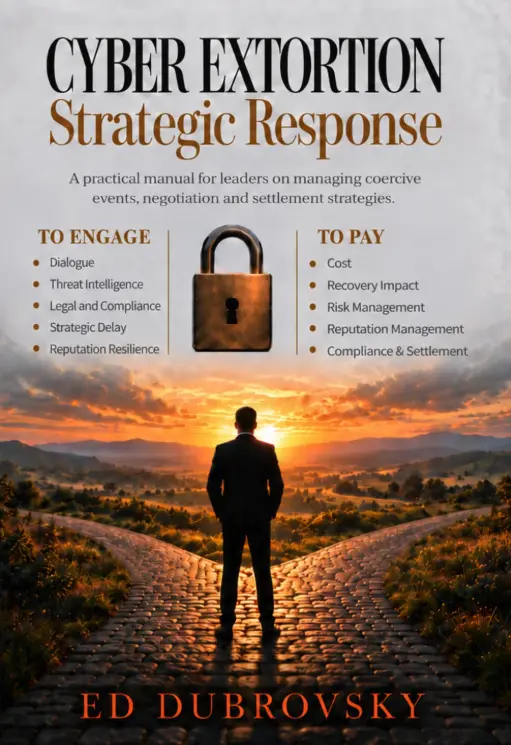
The case brings renewed attention to the specialized, and often controversial, field of ransomware negotiation. Dubrovsky is the author of Cyber Extortion Strategic Response, a 252-page volume that purports to offer a roadmap for how organizations can survive a digital hostage situation. The book’s premise—that engaging with criminals is a strategic necessity rather than a moral failure—is a sentiment echoed in many of the author’s previous professional posts.
"At the heart of the book is a critical distinction: communicating with a criminal is not the same as negotiating a payment, and negotiating is not a commitment to pay," an excerpt from the book reads. "Engagement can serve other objectives, including testing claims, gathering information, creating time, and preserving options while the organization evaluates its next move."
This philosophical approach to crisis management is exactly what law enforcement is now scrutinizing. The FBI’s concern is that, in the wrong hands, the tools and tactics used to "negotiate" with hackers can be weaponized to facilitate extortion, turning security professionals into unwitting or willing accomplices to the very criminals they claim to be working against.

A Broader Pattern of Infiltration
ShinyHunters has established a reputation for aggressive, high-stakes data theft. By utilizing sophisticated phishing campaigns and stolen credentials, the group targets the corporate accounts of software-as-a-service providers, siphoning massive amounts of proprietary data and holding it for ransom. The FBI estimates that the group has successfully extorted more than $70 million from victims within the current year alone.
The investigation into the group has been a multi-national effort, gaining momentum last month when Dutch authorities apprehended Pepijn van der Stap, a convicted cybercriminal. The devices seized during that arrest have provided the FBI with a treasure trove of intelligence, and sources suggest that further charges against other principals at companies specializing in ransomware negotiation are likely in the pipeline.
The arrogance of the group has been a defining feature of the investigation. Following Van der Stap’s arrest, a member of the group operating under the pseudonym "Rey" assumed control and began publicly taunting the FBI. The group went as far as to leak data stolen from the FBI’s own online recruitment portal—information that included unit designations, professional specializations, and, most alarmingly, medical and psychiatric records of prospective agents.
This provocation appears to have been the group’s undoing. Last week, Reuters reported that "Rey," identified as a teenager named Saif Al-din Khader, had been detained and is now cooperating with investigators. The investigation into Khader’s activities revealed that the group was actively targeting a navigation and digital aviation unit divested by Boeing in late 2025, a move that brought the full weight of federal law enforcement down upon them.
As the legal proceedings against Dubrovsky and others continue, the cybersecurity industry remains in a state of flux. The line between legitimate security consulting and criminal facilitation has become increasingly blurred, and the FBI’s recent actions signal a new era of enforcement. For firms that have built their business models around paying off hackers, the message from the federal government is clear: the era of no-questions-asked settlements may be coming to a permanent end. With the investigation shifting to Texas and key players now in custody, the coming months are expected to reveal just how far the influence of ShinyHunters reached into the heart of the security industry.