









For nearly forty years, John Steinbach has called his Manassas, Virginia, home his own. But in January 2026, he opened his mail to find an electricity bill totaling $281—a sharp leap from the roughly $100 he had paid just the month before. Speaking with Consumer Reports, Steinbach noted that the figure was far beyond anything he had ever experienced. What troubles him most is the trajectory of future rates as a growing number of power-hungry artificial intelligence data centers plug into the electrical grid in his surrounding community.
Steinbach is far from alone in his apprehension. A Gallup poll conducted in March 2026 revealed that seven in ten Americans oppose the construction of AI data centers in their local areas, with nearly half of those respondents expressing strong opposition. This sentiment spans political affiliations, reflecting majorities of opposed residents among Democrats, Republicans, and independents alike.
This wave of grassroots resistance has already upended infrastructure planning across the nation. According to data tracked by Data Center Watch, local opposition disrupted approximately 120 projects during the first half of 2026. This included at least 45 projects valued at an estimated $68 billion that stalled out during the second quarter alone.

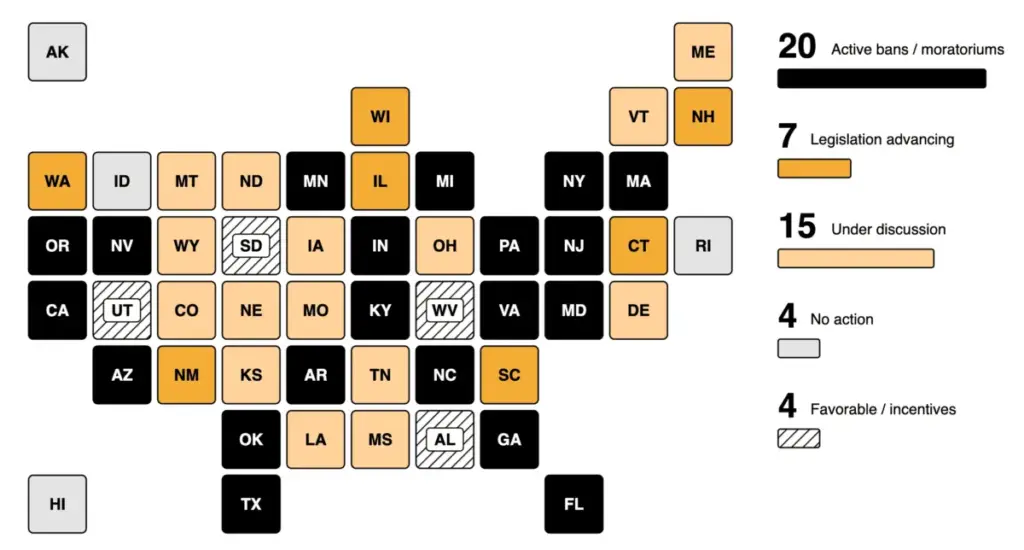
Jurisdictions nationwide are slamming the brakes on development. Roughly 379 U.S. municipalities have enacted moratoriums or outright bans on data centers. In August, the Indianapolis City Council voted 23 to 1 to halt new construction through 2027. Charlotte implemented a 150-day approval pause after a city survey registered 78% local opposition, and the Brookings Institution reports that political candidates across the country are increasingly running campaign advertisements targeting the facilities.
Public debates are typically framed around whether these massive digital storehouses should be built at all. Yet, a much more complicated dilemma lies underneath the surface: who ultimately pays, and who decides? The financial and environmental costs land locally and immediately, while the economic benefits often materialize regionally or nationally at a much later date. The regulatory frameworks governing how these burdens and rewards are split were established long before the advent of AI-scale electricity demand.
Why AI Changed the Mathematical Equation
Traditional cloud computing data centers were designed around general-purpose servers whose energy loads fluctuate in tandem with live user traffic. By contrast, modern artificial intelligence clusters pack graphics processing units much more densely, generate substantially higher amounts of heat per rack, and draw continuous power around the clock during intensive model training runs. This fundamental shift alters what a single technology campus demands from local electrical grids and municipal water networks.
According to a report prepared for the Department of Energy by the Lawrence Berkeley National Laboratory, U.S. data centers consumed approximately 176 terawatt-hours of electricity in 2023, accounting for roughly 4.4% of the nation’s total electricity consumption. The contested battleground centers on the rapid growth projected for the near future.
A power report published in January 2026 by Bloom Energy projected that U.S. data center IT loads will nearly double, climbing from approximately 80 gigawatts in 2025 to roughly 150 gigawatts by 2028. While this projection comes from an industry vendor that sells on-site power generation systems, it highlights a legitimate logistical bottleneck recognized across the energy sector. Utilities currently anticipate delivering electrical capacity 1.5 to 2 years later than developers’ timelines require. Consequently, developers project that roughly a third of upcoming data centers will run entirely on on-site power generation by 2030, bypassing traditional utility timelines by building their own dedicated power plants.
Electricity Bills and the Cost of Infrastructure Expansion
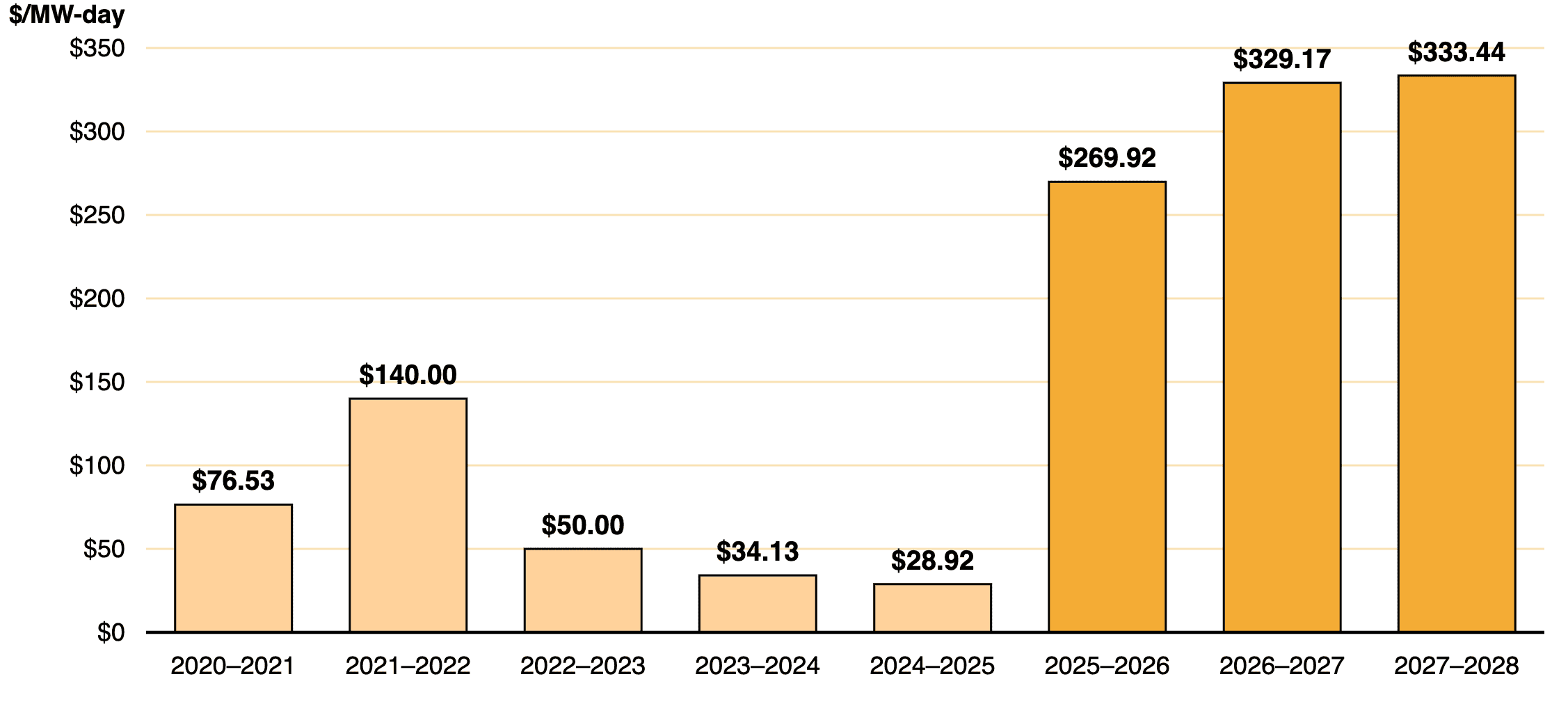
Concerns regarding rate spikes often begin with regional wholesale markets. PJM Interconnection, the regional grid operator serving 13 states and the District of Columbia, conducts capacity auctions to compensate power plants for remaining available during peak demand periods.
The clearing price in these auctions escalated dramatically, moving from $28.92 per megawatt-day for the 2024–2025 period to $269.92 for 2025–2026, before hitting the designated price cap in subsequent auctions at $329.17 and $333.44. PJM’s independent market monitor attributed 63% of the 2025–2026 increase—equating to about $9.3 billion—directly to rising data center load.
Other metrics point in a similar direction. Energy Information Administration data shows residential electricity prices in Virginia rose roughly 13% over a 12-month period. A survey conducted in January 2026 by the Global Strategy Group and the Chesapeake Climate Action Network Action Fund found that nearly three-quarters of Virginia voters held data centers responsible for the hikes.
Looking ahead, a peer-reviewed modeling study conducted by researchers from North Carolina State University, Carnegie Mellon University, and other institutions projects that wholesale electricity prices could be 6% to 29% higher nationwide by 2030 compared to a baseline without data center growth, with surges reaching up to 57% in the hardest-hit regions. These figures represent wholesale modeling rather than direct retail utility bills.

Conversely, the technology industry argues that large industrial consumers typically help lower overall rates. An Electric Power Research Institute study analyzing data from 2015 to 2024 found that each doubling of data center capacity correlated with an average 3.5% reduction in retail prices, as large and steady electricity loads allowed utilities to spread fixed operational costs across a broader base of sales.
An Amazon-funded study conducted by energy consultancy E3 concluded that Amazon’s utility payments in four service territories met or exceeded the actual costs of serving its facilities, generating an average net surplus of about $3.4 million per site. A separate E3 report funded by the Data Center Coalition estimated that load growth accounted for roughly 50% of the 2025–2026 PJM rate increase—significantly lower than the independent market monitor’s assessment. Meanwhile, the free-market Institute for Energy Research found no statistically significant correlation between a state’s total number of data centers and its average electricity prices.
Empirical evaluations often land on a cautious "not yet." The New Jersey State Policy Lab at Rutgers University found no statistically significant effect on utility-level residential bills through 2024, though researchers emphasized that "not yet" is not synonymous with a clean bill of health.
Historical economic benefits depended heavily on the presence of spare grid capacity. If infrastructure is constructed to meet projected demand that ultimately fails to materialize, the fixed costs of expanding grid capacity will be distributed across a smaller population of regular ratepayers. Because expenditures for grid hardening, replacement, and expansion continue to climb, the central question is no longer whether data centers have inflated past bills, but who will foot the bill for the next wave of inevitable grid expansion.
Water Consumption and Localized Stress
Water-cooled data centers can consume millions of gallons of water on a single hot summer day, putting immense pressure on municipalities situated in arid regions. Arizona, for instance, faces a federal mandate requiring a 760,000 acre-foot reduction in its use of the Colorado River, translating to a cut of roughly 27% to 30%.
This environmental context heavily influences municipal decisions. In August 2025, the Tucson City Council unanimously rejected Amazon’s proposed Project Blue amid intense community pressure, while the town of Chandler similarly voted down a separate AI data center proposal 7 to 0 that December. In Florida, the Orange County vice mayor proposed a one-year moratorium on new facilities, pointing to a projected regional groundwater deficit of 96 million gallons per day by 2045.
While viral online estimates suggest that every 100-word AI prompt consumes roughly half a liter of water—a figure derived from early UC Riverside calculations during the initial GPT-4 era—tech companies report far lower operational figures. Google’s internal metrics for a median Gemini text prompt indicate water usage of approximately 0.26 milliliters, or roughly five drops, though that measurement accounts strictly for on-site consumption.
At a macro level, the Lawrence Berkeley National Laboratory estimates that U.S. data centers directly consumed about 17.5 billion gallons of water in 2023, a total that could easily double or quadruple by 2028. Analysts often note that this represents a minor fraction of overall U.S. freshwater usage, comparable to the water footprint of select golf courses.
However, national totals obscure acute local stress points. A planned Google campus in Botetourt County, Virginia, could utilize between 2 million and 8 million gallons of water daily in a rural county where many residents depend on residential wells. In response, the county has allocated $300 million toward developing a new regional water supply, funded in part by anticipated project tax revenues.
Evaluating Local Economic Returns: Jobs Versus Tax Revenue
The strongest economic argument presented by the data center industry centers on municipal tax contributions. Facilities across Northern Virginia generated an estimated $1.3 billion in local property taxes in 2024, with total supported local revenue exceeding $2 billion, according to the Chamber of Progress.
Quincy, Washington, is frequently cited as a success story for small-town transformation. In that agricultural community, roughly 30 data centers account for an estimated 57% of local property tax revenues. That expanded tax base helped finance a $120 million high school, a hospital, new police and fire stations, and a $30 million water reuse facility constructed in partnership with Microsoft.
In Texas, industry metrics cited by the Texas Tribune claimed 61,060 direct jobs and $3.5 billion in state and local tax contributions for 2023. Company representatives noted that a proposed $10 billion campus would inject $50 million annually into Lacy Lakeview, a community of approximately 7,000 residents. Even legislative auditors in Virginia ranked the state’s data center tax exemption as its second most productive economic incentive, generating $6.1 million in personal income for every $1 of foregone revenue.
By contrast, the employment footprint of individual data centers is relatively modest. A Brookings Institution analysis of approximately 1,500 facilities found that a county’s initial large data center typically creates between 100 and 200 jobs over a decade, with negligible impact on local wage levels. Consequently, state incentive thresholds reflect these modest employment metrics, with states like Texas requiring a minimum footprint and the creation of 20 jobs for sales tax exemptions, while Maryland asks for five jobs and a $2 million investment in targeted areas. While construction jobs provide a substantial short-term boost, they conclude once the physical infrastructure is completed.
State capitals are actively recalibrating these incentive structures. Governors in Illinois, Massachusetts, Nebraska, Nevada, and Ohio either paused or restructured data center tax breaks, while Arizona instituted a three-year freeze on new awards. Virginia maintained its sales tax exemption but introduced a temporary 1.1-cent-per-kilowatt-hour electricity tax on data center usage running from July 2026 through June 2028, capped at $600 million annually.
Air Pollution, On-Site Generation, and Local Control
When tech companies determine that local electrical grids cannot interconnect fast enough to meet aggressive deployment schedules, some bypass utility infrastructure entirely. In Memphis, Tennessee, xAI deployed trailer-mounted methane gas turbines—reaching as many as 35 units based on aerial imaging by the Southern Environmental Law Center—near Boxtown, a neighborhood already burdened by industrial pollution. For subsequent phases, the company placed additional turbines just across the state line in Southaven, Mississippi, totaling 46 units by mid-2026.
Initially classified as non-road mobile engines, the turbines avoided standard air permitting requirements until an Environmental Protection Agency rule confirmed that large stationary turbines require formal environmental review. SpaceX, which acquired xAI, subsequently operated 69 turbines and announced it would take over a year to remove unpermitted units while constructing a permanent 1.2-gigawatt natural gas power plant. Environmental advocacy groups filed lawsuits under the Clean Air Act, while the U.S. Department of Justice intervened on the company’s behalf, characterizing the turbines as a matter of national economic and energy security.
Independent air quality analyses yielded mixed results. Satellite data evaluated by University of Tennessee researchers indicated a 3% rise in average nitrogen dioxide levels following the facility’s opening, with peak concentrations spiking significantly near the site. Conversely, University of Memphis researchers modeling local air quality found only minimal changes in fine particulate matter, though they noted their methodologies could not detect several specific hazardous compounds. While average emissions impacts appeared modest, residents and environmental advocates pointed out that the additional pollution was introduced into an airshed that already exceeded federal health standards.
Beyond environmental disputes, communities frequently clash over transparency and zoning processes. In Louisiana, applied digital projects and multi-billion-dollar investments were initially negotiated under nondisclosure agreements signed by state senators and local officials, shielding early talks from public view. Similar secrecy prompted legislative pushback, with lawmakers in multiple states introducing bills to ban nondisclosure agreements for public-private utility negotiations.
Zoning regulations have also become a flashpoint. In Aurora, Colorado, a proposed 500-megawatt campus was slated for administrative approval without a public hearing because existing municipal zoning already permitted data center construction. Such friction has driven municipalities to adopt rigorous checklists requiring developers to disclose projected water use, traffic, noise, and economic impacts prior to consideration.
At the state level, governors and regulatory bodies are pulling oversight upward. Texas officials ordered comprehensive audits of every data center seeking a grid connection and temporarily halted state-level permitting for new projects until the evaluations are completed.
Addressing the Underlying Demand Risk
Both critics and advocates of the AI expansion often operate on the shared assumption that projected compute demand is an absolute certainty. Industry projections estimate global data center capital spending could reach $6.7 trillion by 2030, and infrastructure planning frequently treats this trajectory as immutable.
If actual demand falls short of these expectations, however, the financial burden does not simply disappear. Utilities that construct dedicated generation capacity and transmission lines for projects that are subsequently downsized or canceled must still recover those capital expenditures from their ratepayer base. This structural risk explains why regulatory commissions are increasingly implementing minimum financial commitments and strict exit terms. In Virginia, state regulators already mandate that the largest power customers pay for at least 85% of their contracted transmission and distribution demand and 60% of generation demand, regardless of whether they consume that electricity.
Ultimately, the friction surrounding AI data center expansion highlights a persistent structural imbalance. The immediate costs—spanning capacity charges, strained water supplies, land use changes, and localized air emissions—fall heavily on local communities in the near term. Conversely, the economic rewards and technological advancements accrue regionally or nationally over a longer horizon. As state legislatures and municipal councils continue to refine policy tools, the core challenge remains ensuring that rapid technological growth is paired with fair, transparent, and sustainable infrastructure frameworks.