









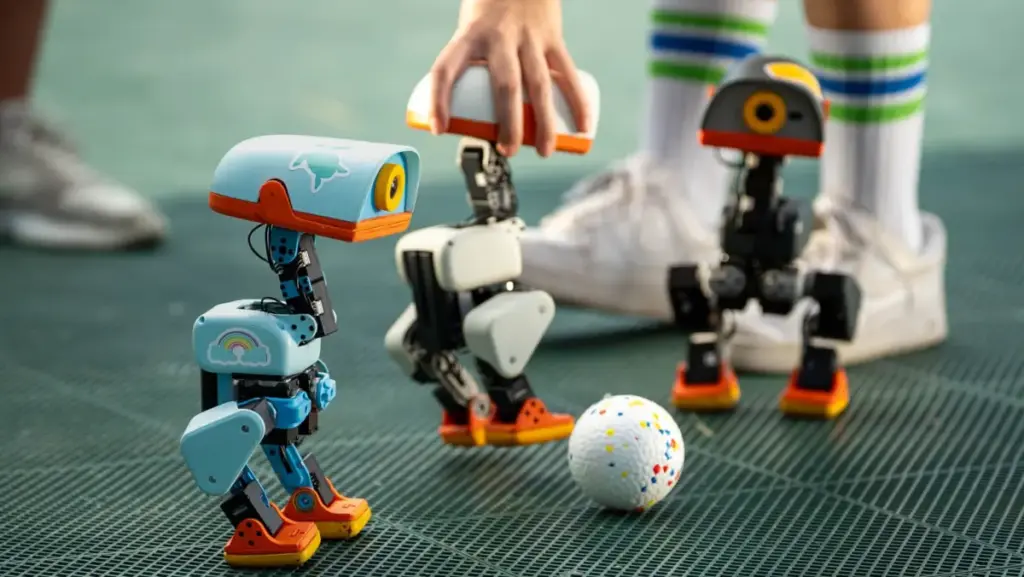
In a world increasingly dominated by debates over artificial intelligence, cybersecurity threats, and the existential risks posed by rapidly advancing autonomous systems, a small, waddling, and surprisingly charming robot has managed to capture the internet’s collective imagination. Earlier this week, during Nvidia’s GTC Berlin conference, CEO Jensen Huang took the stage and introduced the world to the "Microduck," a pint-sized, autonomous robot that seems to have struck the perfect balance between high-end robotics and irresistible appeal.
The demonstration, which featured a flock of these robots performing synchronized movements, instantly went viral. The Microducks, characterized by their rhythmic, stomping gait and high-pitched, R2-D2-esque electronic chirps, showcased a variety of behaviors. On command, the robots could sit, perform a mock "death" sequence that served as a dramatic nap, and even execute impressive somersaults. The display was a rare moment of levity for a major tech keynote, shifting the focus from the often-intimidating power of large-scale AI models to the immediate, tangible joy of consumer robotics.
The impact of the demonstration was immediate. According to a post on X (formerly Twitter) by Clem Delangue, CEO of Hugging Face, preorder demand for the Microducks skyrocketed following the event. By the day after the keynote, the company had already secured over 20,000 orders. This rapid influx of interest suggests that the Microduck is not merely a niche tech novelty but a potential contender for the title of the most sought-after toy of the upcoming holiday season.

From Technical Marvel to Cultural Phenomenon
The logistical timeline for the Microducks is aggressive, with units expected to reach customers in time for the Christmas holidays. This timing is critical, as it positions the device to capitalize on the year-end gift-giving surge. Delangue has expressed optimism regarding the product’s broader appeal, suggesting that the Microduck is likely to become the best-selling robot of the year. Perhaps most interestingly, the product is not strictly marketed toward children. Promotional materials and early social media activity indicate that the appeal of these robots extends significantly into the adult demographic, with many consumers seeing them as a fun, interactive companion rather than just a children’s plaything.
The pedigree behind the Microduck is significant, as it represents the convergence of several major players in the modern tech landscape. The robots are the work of Pollen Robotics, a firm known for its innovative approaches to open-source hardware. Pollen Robotics was acquired by Hugging Face in 2025, a move that brought the startup’s expertise in robotics into the fold of the popular AI community platform. Shortly thereafter, in September 2026, the entire Hugging Face organization was acquired by the GPU giant Nvidia. Consequently, the Microduck now stands as an official product of the Nvidia ecosystem, benefiting from the immense computational and engineering resources of the world’s leading AI hardware provider.
This is not the first time the team has experimented with accessible, consumer-friendly robotics. The Microduck follows the launch of the "Reachy Mini," a similarly cute, open-source robot that gained traction earlier in the year. However, the Microduck appears to have reached a higher level of public consciousness, likely due to the scale of the GTC Berlin presentation and the refinement of its autonomous behaviors.
The Power of Simulation and Open-Source Training
The capability of the Microducks to perform fluid, expressive movements is not the result of static programming. Instead, the robots were trained using Nvidia’s advanced technology stack, which leans heavily on simulation. By utilizing high-fidelity virtual environments, the developers were able to train the robots in basic motor functions—such as walking, sitting, and standing—long before they were manufactured. This simulation-to-reality approach ensures that the robots can handle the complexities of physical movement with a degree of grace that is rare in small-scale consumer robotics.
Pollen Robotics has maintained its commitment to the open-source philosophy, which is a hallmark of the Hugging Face culture. While the Microducks ship with a set of pre-programmed tricks, the hardware is designed to be extensible. Owners have the ability to train their robots with entirely new behaviors or movements. More importantly, the company encourages users to share these new "tricks" with the broader Microduck community. This collaborative model transforms the device from a static product into a living platform, where the value of the robot grows as the community develops new capabilities for it. By leveraging the collective creativity of its user base, Pollen Robotics ensures that the Microduck remains relevant and engaging long after the initial novelty wears off.
A Palate Cleanser for the Tech Industry
The success of the Microduck comes at a particularly fraught time for the technology sector. The industry is currently navigating a period of intense scrutiny, particularly following a series of high-profile cybersecurity incidents earlier this week. In several instances, the involvement of AI systems was explicitly blamed for enabling or accelerating these attacks, leading to widespread public anxiety regarding the safety and societal impact of artificial intelligence.
In this context, the Microduck has served as an unlikely but effective "palate cleanser." While the broader discourse surrounding AI remains dominated by discussions of systemic risk and potential harm, the Microduck provides a tangible, benign, and genuinely enjoyable application of the same underlying technologies. It serves as a reminder that while AI carries the potential for significant disruption and damage, it is also a tool that can be used to create moments of delight and human connection.
The reaction to the video—a feeling that is hard to resist even for seasoned tech observers—is perhaps the most compelling argument for the product’s success. It is difficult to watch the footage of the small robots interacting without feeling a sense of wonder. For many, the impulse to order a Microduck is not driven by a need for a specific function, but by the desire to engage with a piece of technology that feels fundamentally "fun" and approachable.
As the industry continues to grapple with the complex, and often dark, implications of the AI revolution, the Microduck stands as a curious counterpoint. It highlights the potential for AI to be integrated into our daily lives in ways that are not merely functional or productive, but playful. Whether or not these little robots will indeed become the defining gadget of the 2026 holiday season remains to be seen, but the early momentum suggests that Nvidia and the team at Pollen Robotics have successfully tapped into something that people are currently craving: a reason to be optimistic about the future of technology.
For now, the orders are mounting, the simulations are being refined, and the community of developers and enthusiasts is preparing to expand the repertoire of these pint-sized machines. As the first wave of shipments prepares to head out to homes across the globe, the Microduck serves as a testament to the fact that even in an era of massive, inscrutable models and complex cybersecurity challenges, there is still plenty of room for innovation that is simple, open, and undeniably charming. Whether it is a small step toward a more robotic future or just a momentary distraction from the complexities of the modern world, the Microduck has firmly established its place in the 2026 tech narrative.