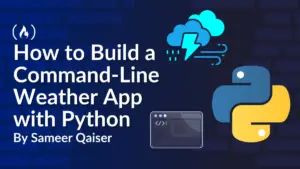










For many novice programmers, the journey through Python often hits a familiar plateau. After moving past basic terminal prompts that merely accept input and echo text back to the screen, the desire arises to build software that interacts with the broader digital ecosystem. Seeking a bridge between static scripts and dynamic applications, developers are increasingly turning to lightweight command-line projects, such as terminal-based weather utilities, to demystify how programs communicate across the internet.
The core concept behind these applications is straightforward yet foundational for modern software development. Users input a city name directly into their terminal, and the program queries a remote server to display the current temperature and wind speed. While modest in scope, this approach offers a practical entry point for mastering Application Programming Interfaces, handling Hypertext Transfer Protocol requests, parsing complex data formats, and processing command-line arguments.
Understanding the Mechanics of Modern APIs
For developers encountering APIs for the first time, the concept can occasionally feel abstract. At its core, an API serves as a standardized messenger, allowing one software program to request and receive information from another. In the context of meteorology, public services provide endpoints that accept specific parameters—such as geographic coordinates—and return structured data packets containing current atmospheric conditions.

The process typically begins by addressing a fundamental hurdle: weather services usually require latitude and longitude rather than human-readable city names like Karachi or New York. To bridge this gap, developers utilize free geocoding services, such as the Open-Meteo geocoding API. By sending an HTTP GET request containing the target city name, the application retrieves a matching location record, extracts the precise geographical coordinates, and prepares them for the next stage of the data pipeline.
Once the coordinates are established, the script directs a secondary request to a forecast endpoint. By specifying parameters such as two-meter temperature and ten-meter wind speed, the application isolates current conditions from broader meteorological datasets. This targeted extraction prevents the program from being overwhelmed by multi-day forecasts or historical records, ensuring that the script remains fast and responsive.
Interfacing Directly Through the Terminal
A critical component of building command-line utilities is handling user input dynamically. Rather than relying on interactive prompts that pause execution, developers often leverage Python’s built-in system module to capture arguments passed directly during script execution. This allows users to invoke the program from the command line alongside their target location.
By utilizing argument parsing techniques, scripts can successfully process multi-word city names—such as Washington or New York—without breaking. If a user forgets to provide a location, the program gracefully intercepts the missing input and displays usage instructions rather than crashing unexpectedly.
Error handling plays a vital role in maintaining the reliability of these terminal utilities. Network disruptions, timeout issues, and unexpected JSON responses are common challenges when dealing with external web services. Developers incorporate robust exception handling to catch connection errors and malformed data, ensuring that the application informs the user of connectivity problems in plain language rather than dumping raw tracebacks onto the screen.
Beyond the Basics: Expanding Utility and Skill
As developers successfully deploy their initial weather utilities, the project frequently serves as a springboard for more advanced programming concepts. Common enhancements explored by programmers include adding support for multi-day forecasts, converting temperature units between Celsius and Fahrenheit, or caching recent search results to minimize unnecessary network requests.
Experienced programmers emphasize that the true value of these introductory projects lies in the process of building them from scratch rather than simply copying code. Encountering and debugging unexpected errors during independent implementation is widely regarded as a critical milestone in solidifying fundamental concepts like functions, dictionaries, and error management.
Once programmers master the fundamentals of fetching and parsing remote data through a weather utility, the acquired patterns can be applied across a wide variety of domains. The underlying architecture—querying an endpoint, processing the response, and presenting the results—remains consistent whether a developer is building a movie database lookup, a cryptocurrency tracker, or a sports score monitor.