









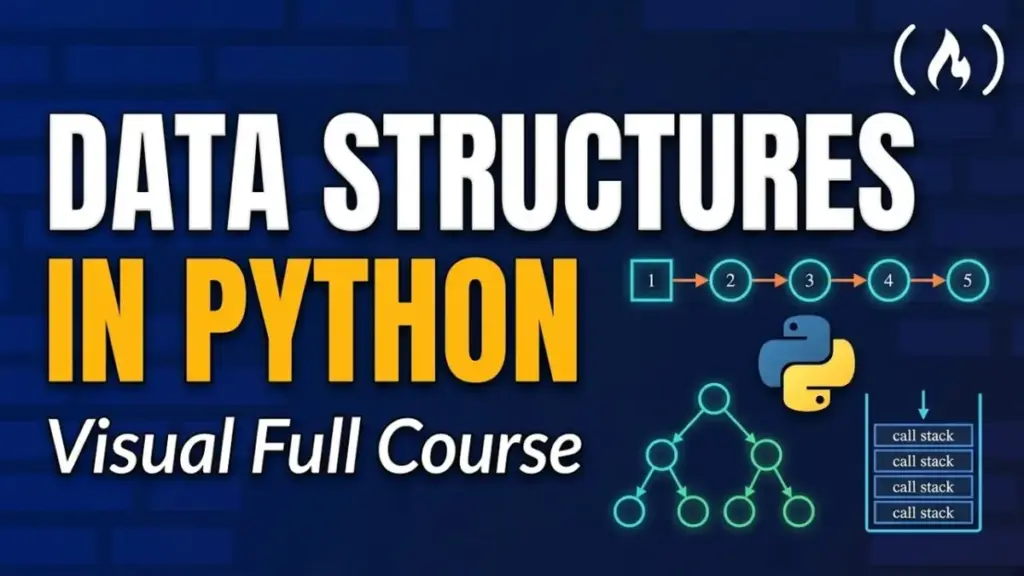
The foundation of any efficient software application lies in how it organizes, processes, and retrieves information. For both aspiring developers and seasoned engineers, understanding data structures and algorithms is a fundamental milestone. To help learners navigate these often-challenging computer science concepts, freeCodeCamp.org has published a comprehensive new course on its YouTube channel. Taught by instructor Javid Bodurov, the 2.5-hour program focuses on teaching data structures and algorithms using Python, combining clean code examples with custom animations and visualizations to demystify abstract theoretical ideas.
Data structures serve as the organizational architecture of programming. Concepts such as arrays, linked lists, stacks, queues, hash tables, trees, heaps, and graphs dictate how a program stores data in memory and directly impact how fast it can perform essential operations like searching, inserting, and removing items. Alongside these structures, the course covers Big O notation, the mathematical standard used in computer science to describe how the execution time or memory consumption of an algorithm grows as the size of the input increases. By understanding Big O, developers can evaluate the efficiency of their code and make informed decisions about which data structures to employ for specific computational problems.
Designed specifically with beginners in mind, the course maintains an accessible entry barrier. It assumes only a foundational understanding of Python programming, such as familiarity with basic variables, loops, functions, and lists. Rather than treating Python’s built-in data types as a black box, the curriculum takes a hands-on, constructive approach. Students learn to build each data structure completely from scratch, gaining a deep appreciation for the mechanics working underneath the surface. Once a structure is built manually, learners then compare their custom implementations directly with the high-performance tools that Python already provides out of the box, such as dictionaries, sets, deques, and the heapq module.
This comparative methodology bridges the gap between theoretical computer science and practical software engineering. By constructing data structures line by line, students move beyond rote memorization and develop an intuition for why certain structures excel in particular scenarios. For instance, comparing a manually implemented queue with Python’s optimized deque allows learners to see the performance trade-offs involved in real-world application development. Furthermore, the inclusion of custom animations and visual representations throughout the lessons aims to address a common pain point in computer science education. Abstract pointers, recursive tree traversals, and heap reorganizations can be notoriously difficult to grasp through text alone; visual learners stand to benefit significantly from seeing these dynamic processes rendered graphically step by step.
The release of this educational resource aligns with freeCodeCamp’s broader mission of providing accessible, high-quality technical education to a global audience. Operating as an open-source curriculum and learning platform, freeCodeCamp has historically focused on breaking down socioeconomic barriers to entering the tech industry. The organization frequently collaborates with expert instructors to produce rigorous video courses covering everything from web development and machine learning to core computer science fundamentals. The addition of this Python-focused data structures and algorithms course adds another vital resource to the platform’s extensive library, supporting individuals who are preparing for technical interviews or seeking to strengthen their fundamental programming background.
Technical interviews at many software companies notoriously emphasize data structures and algorithms, making proficiency in these areas crucial for career advancement. While higher education computer science degrees spend semesters covering these topics, self-taught developers and career switchers often have to piece together their understanding from disparate online tutorials and dense textbooks. Curated video resources like the one offered by Javid Bodurov provide a structured, engaging alternative that synthesizes theory, visualization, and practical implementation into a single cohesive narrative. By keeping the runtime focused at two and a half hours, the course delivers high-density learning without overwhelming the viewer.
The full course is currently available to stream for free on the official freeCodeCamp.org YouTube channel. Viewers can watch the complete presentation, pause and review code examples, and study the visual animations at their own pace. As the technology landscape continues to evolve and the demand for efficient, scalable software remains high, foundational knowledge in computer science continues to be one of the most durable and valuable investments a programmer can make in their professional development. Through initiatives like this latest course release, learners around the world gain another practical tool to help bridge the gap between novice coding and professional engineering competency.