









Lindsey Elliott has a fascination with the unsung heroes of the global industrial economy: bolts. While most people see them as simple, utilitarian fasteners, Elliott sees them as the critical points of failure—and opportunity—within the vast, interconnected network of pipes that keep the world running. At last year’s 13th annual Bolting Symposium, she found herself among kindred spirits, famously engaging in a competitive game of “Bolting Bingo” alongside a room full of self-proclaimed “torque dorks.” While the event was lighthearted, the subject matter it addressed is anything but.
A former engineer and planner at ExxonMobil, Elliott spent years observing the daily operational challenges of maintaining the massive infrastructure responsible for moving oil, gas, and petrochemicals. Her professional focus eventually narrowed to a singular, pervasive issue: the bolted flange joint. These joints, which connect sections of industrial piping, are essential to infrastructure safety and integrity, yet they remain a source of significant physical strain and danger for workers. For years, Elliott watched as pipefitters performed the grueling, repetitive task of loosening and tightening these massive bolts, a process that contributes to high injury rates and physical burnout across the industry.
The problem is compounded by a persistent labor shortage. As the industrial workforce ages and fewer young workers enter the trades, the burden on existing personnel has grown untenable. “Those people get really tired when they’re asked to work 12 hours a day for three months in a row,” Elliott explained during an interview at TechCrunch Disrupt, where her startup, Nexterity, is being showcased as part of the Startup Battlefield 200. “I’ve talked to pipefitters across the U.S. and across Canada, and I have just repeatedly been told that North American pipefitting productivity is notoriously low.”
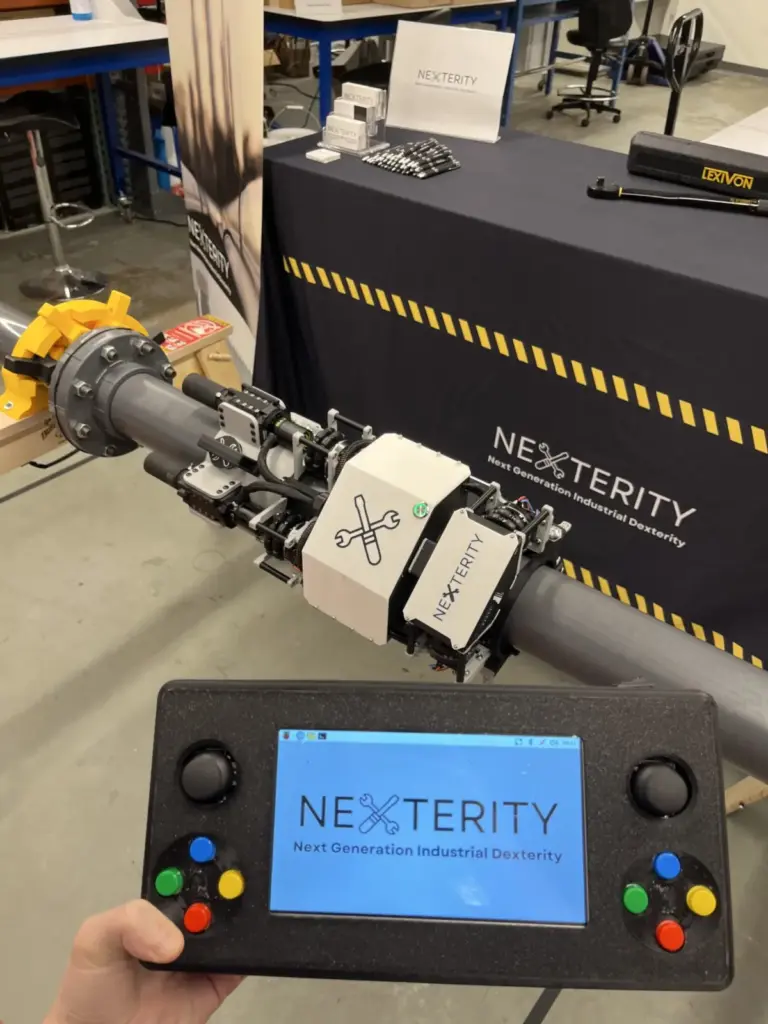
This realization served as the catalyst for Nexterity. Elliott’s vision is to replace the manual, high-risk labor of bolt maintenance with a specialized, remote-controlled robot. By automating this specific, repetitive task, Nexterity aims to fundamentally transform the daily realities of blue-collar workers in the energy and manufacturing sectors. The goal is simple in its ambition: to make the work safer, more efficient, and more sustainable. As Elliott put it, the company’s philosophy can be distilled into a pithy mantra: “More dork, less torque.”
The technology behind the solution is as practical as the problem it addresses. The Nexterity robot is designed as a two-piece modular system that clamps securely around a pipe. Once attached, the unit is powered by batteries and capable of sliding along the pipe’s axis to reach the flange. From there, it can simultaneously loosen or tighten four bolts at once, a feat that would traditionally take a human worker significant time and physical exertion.
Portability was a primary design requirement. Elliott emphasized that Nexterity has developed various configurations of the robot to accommodate different standard pipe sizes, yet each unit is engineered to be compact enough to fit inside a standard Pelican case. This design choice allows a single worker to transport the equipment to a job site easily, providing the kind of agility that is rarely seen in heavy industrial machinery. This flexibility is central to the startup’s business model; rather than forcing companies to purchase expensive, immovable assets, Nexterity treats its robots as rental construction equipment, allowing firms to deploy them on an as-needed basis for specific projects.
The path to this design was paved by years of direct engagement with the experts who know the industry best. Beyond the connections she made at the Bolting Symposium, Elliott spent extensive time consulting with members of the Pressure Vessels and Piping Division of the American Society of Mechanical Engineers. Through these dialogues, she gained a granular understanding of the industry’s pain points. She learned that approximately 80% of industrial piping falls into a diameter range of two to eight inches, known in the industry as NPS2 to NPS8.
“What I learned from the people—the ‘torque dorks,’ per se—is that 80% of our pipes are between two to eight inches in diameter,” Elliott said. “When you have that much repeatability, you have a fantastic candidate for automation.”
By focusing on this specific, highly repeatable segment of the market, Elliott has identified a clear pathway to scale. While the initial idea might seem straightforward to an outsider, it addresses a massive, often overlooked gap in industrial automation. Many assume that the most significant technological advancements in the energy sector are focused on software, AI, or renewable energy generation, but Elliott argues that the most immediate, high-impact improvements can be found in the mundane, physical infrastructure that supports those systems.
The market potential for such a tool is vast. Beyond the oil and gas sector, which first sparked her interest, the same piping standards are utilized in almost every heavy industrial environment. From water and wastewater treatment facilities to food and beverage processing, mining operations, nuclear power plants, and even the emerging sector of green and sustainable manufacturing, the need for safe, reliable, and efficient pipe maintenance is universal.
“I think it would shock a lot of people just how big this market is,” Elliott noted. “I mean, day-to-day, most of us don’t think about piping infrastructure, but even water, wastewater, water treatment, food and beverage, mining, nuclear—any kind of green and sustainable manufacturing facility—they all use the same kind of piping.”
For Nexterity, the road ahead involves moving from concept to widespread adoption. As the company prepares for further growth, the focus remains on proving the reliability of their robots in the field and demonstrating to skeptical industry leaders that automation can be a partner to, rather than a replacement for, the skilled labor force. By removing the most physically taxing aspects of the job, Nexterity hopes to alleviate the burnout currently plaguing the sector, potentially making the pipefitting profession more attractive to a new generation of workers who are more comfortable working alongside robotic systems.
Elliott’s background as an engineer and planner provides her with a unique perspective on the hurdles of adoption. She understands the risk-averse nature of industrial operations, where safety and uptime are paramount. Consequently, the Nexterity team has prioritized a design that is not only effective but also robust, user-friendly, and capable of withstanding the harsh environments inherent in industrial facilities.
As the company continues its journey through the Startup Battlefield at TechCrunch Disrupt, the attention is squarely on whether this “torque-dork-inspired” solution can achieve the ubiquity that Elliott envisions. If successful, the company could set a new standard for how routine maintenance is handled, potentially setting off a ripple effect of efficiency improvements across the massive, invisible web of pipes that serve as the circulatory system of the global economy. For now, Elliott remains focused on the bolts, the pipes, and the people who keep them running, one remote-controlled turn at a time.