








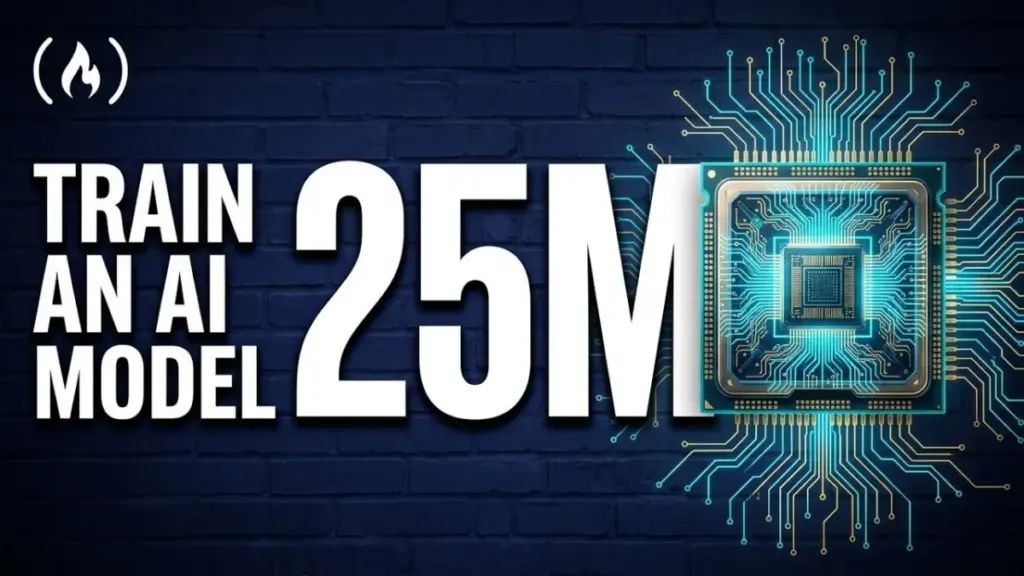
What makes this release particularly notable for the developer community is its accessibility. While modern large language models often require clusters of enterprise-grade hardware and massive data centers to train, the course demonstrates that a scaled-down version of the GLM-5.3-Flash model—featuring approximately 25 million parameters—can be successfully constructed and trained on a standard consumer-grade CPU. This design makes cutting-edge artificial intelligence concepts approachable for students, hobbyists, and professional developers who want to understand the inner workings of multimodal architectures without needing access to expensive cloud computing infrastructure.
The curriculum guides learners through the entire lifecycle of model development, spanning both pre-training and post-training phases. At the core of the project is a compact architecture tailored for efficiency. The model utilizes a 260-token byte-level vocabulary paired with a 192-token context window. Furthermore, it incorporates a lightweight vision encoder designed to process 32-by-32-pixel images, compressing visual input into a manageable sequence of 16 tokens. This multimodal capability allows the model to process both text and visual data, reflecting the broader industry shift toward systems that can understand multiple data modalities simultaneously.
Throughout the course, students are taken behind the scenes of how modern artificial intelligence systems evolve from raw parameter initialization into functional problem-solvers. A striking example highlighted in the curriculum involves the model’s performance before and after targeted post-training interventions. Initially, the base model struggles with logical and coding challenges, successfully solving zero out of 24 evaluated Python tasks. However, following a structured reinforcement learning phase, the model’s performance jumps significantly, enabling it to successfully solve 16 of the 24 Python tasks. This dramatic improvement serves as a practical demonstration of how reinforcement learning and alignment techniques unlock the hidden potential within neural network architectures.
The release aligns with freeCodeCamp’s broader mission to democratize technical education. Over the years, the platform’s open-source curriculum and video resources have helped more than 40,000 individuals secure employment as software developers. By breaking down complex machine learning topics into understandable, hands-on components, this new course bridges the gap between high-level theoretical research papers and practical implementation.
All source code, presentation slides, and experimental data associated with the GLM-5.3-Flash project have been made publicly available. Developers and learners interested in exploring the codebase and following along with the video can find the repository linked directly in the description of the course, which is currently streaming on the freeCodeCamp.org YouTube channel.