








The artificial intelligence credentialing market has experienced unprecedented growth, fundamentally reshaping how labor markets evaluate technical talent. According to recent labor market research from Revelio Labs, AI-related credentials account for nearly 30 percent of all professional certifications being pursued by workers, representing an astonishing twentyfold increase compared to pre-ChatGPT levels.
This massive expansion has created a stark bifurcation within the professional development landscape. On one side are a select few credentials that employers actively screen for during the hiring process and that correlate directly with measurable salary premiums. On the other side is a burgeoning ecosystem of commercial programs designed primarily to generate revenue for their creators while offering virtually no hiring signal to the professionals who purchase them.
Industry hiring managers face an uncomfortable reality: the vast majority of available AI certifications are simply not worth the investment. Candidates who successfully secure roles in today’s competitive market typically present fewer certifications combined with deeper, demonstrable production experience. For senior hiring managers, listing five distinct AI certifications without an accompanying project portfolio often serves as a red flag. Conversely, a single robust cloud certification paired with a public repository of deployed projects proves far more convincing during technical evaluations.
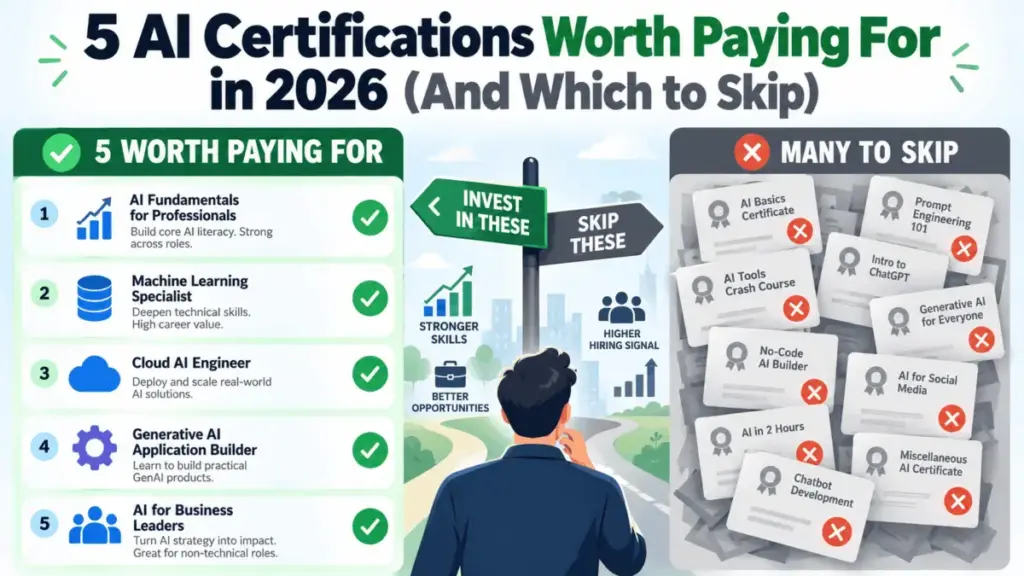
Nevertheless, certain credentials retain genuine value for specific, concrete reasons. The issuing organization typically commands established employer trust, the examination rigor tests production-relevant skills rather than rote memorization, and the credential appears frequently in active job postings. Industry data highlights five specific credentials that meet these rigorous standards, alongside several popular pathways that professionals are advised to skip.
Before evaluating specific programs, professionals must account for recent shifts in the credentialing landscape. The AWS Certified Machine Learning Specialty exam was permanently retired on March 31, 2026. While outdated web pages continue to recommend it, the exam is no longer available. Additionally, Microsoft’s Azure AI Engineer Associate certification is undergoing significant updates, requiring candidates to verify its current status on official portals before scheduling.
Google Cloud Professional Machine Learning Engineer
Standing as the highest-impact cloud machine learning certification available, this professional-level credential commands widespread industry recognition. Multiple salary analyses indicate that holders of this certification command roughly a 25 percent salary premium compared to uncertified peers, representing the largest differential among current machine learning credentials.
The examination comprehensively evaluates the full machine learning engineering lifecycle within the Google Cloud ecosystem. Candidates must demonstrate proficiency in designing and building pipelines using Vertex AI, productionizing and monitoring models at scale, and selecting appropriate machine learning architectures for distinct business constraints. A substantial update incorporated generative AI content, including building solutions using Vertex AI Agent Builder and the Model Garden, substantially broadening the scope of the exam to align with modern production environments.
Google recommends at least three years of industry experience and one year working specifically within Google Cloud before attempting the examination. Because hands-on experience outweighs memorized definitions, the credential successfully signals to employers that a candidate possesses practical, deployment-ready engineering capabilities.
AWS Certified Machine Learning Engineer – Associate
Following the retirement of the older Specialty-level exam, Amazon Web Services introduced the updated Associate-level machine learning credential to better reflect modern engineering demands. While the legacy exam leaned heavily on classical algorithms and theoretical foundations, the current associate credential adopts a broader, more practical approach with explicit coverage of generative AI workloads on Amazon Bedrock, MLOps patterns, SageMaker JumpStart, and retrieval-augmented generation pipelines.
The examination domains emphasize data preparation, model development, workflow deployment and orchestration, and ongoing system monitoring and security. This focus on deployment and maintenance mirrors what employers demand from practitioners who can manage a model across its complete operational lifecycle rather than merely building it in a development environment. Priced accessibly relative to professional tiers, this credential correlates with a notable salary premium and appears consistently in job postings for technical roles within AWS-centric organizations.
DeepLearning.AI Deep Learning Specialization
For practitioners seeking a rigorous, conceptually grounded foundation in neural networks without tying themselves to a single cloud vendor, the DeepLearning.AI Deep Learning Specialization hosted on Coursera remains a widely respected non-vendor certificate.
It is important to distinguish this offering from proctored, exam-based credentials. As a course completion certificate rather than a secure proctored exam, it does not carry the direct hiring signal of a major cloud platform certification. However, having been completed by nearly a million students with consistently high marks, the program covers fundamental neural networks, convolutional networks, sequence models, and natural language processing through substantive academic work rather than superficial overviews. Industry educators note that while enterprise HR departments often favor major tech brand names, this specialization provides an invaluable conceptual baseline for data scientists bridging the gap toward advanced production engineering.
Microsoft Azure Data Scientist Associate
Microsoft Azure maintains a strong presence in enterprise data science recruitment, frequently appearing prominently in job postings across regulated sectors such as financial services, healthcare, and large-scale corporate IT. The Azure Data Scientist Associate credential directly reflects this market reality.
The examination evaluates a candidate’s ability to implement and run machine learning workloads using Azure Machine Learning, covering experiment design, data preparation, model training, evaluation, and deployment. Positioned closer to the applied data science side than infrastructure-heavy cloud exams, the certification focuses on building and managing models on a managed platform. The inclusion of an annual, free renewal assessment ensures that practitioners maintain relevance as platform tooling evolves.
Databricks Certified Machine Learning Professional
As organizations increasingly adopt unified data analytics platforms, Databricks has established itself as a standard component of the enterprise data stack. For data scientists and machine learning engineers whose daily workflows center on large-scale data processing using Apache Spark and MLflow, the Databricks Certified Machine Learning Professional credential validates specialized platform expertise.
The exam tests advanced, practical skills within the Databricks environment, including pipeline tuning, experiment tracking, feature engineering at scale, and production deployment. Because the credential assumes existing comfort with Spark and distributed computing, it offers powerful differentiation for technical professionals operating within large-scale data teams.
Evaluating What to Skip
Not all credentials offer a return on investment. Industry experts caution against generic artificial intelligence certificates launched by unknown entities during the recent market surge, as hiring managers rarely recognize bootcamp brands lacking established track records. Prompt engineering certificates are similarly discouraged, as prompt engineering functions as a rapidly evolving practical skill rather than a static credential suitable for formal certification.
Furthermore, high-cost university professional certificates carrying multi-thousand-dollar price tags rarely appear as mandatory requirements in technical job postings, making them difficult to justify purely as hiring signals for technical data science roles unless sponsored by an employer. Vendor-neutral AI foundations certificates, while potentially useful for general IT professionals transitioning into adjacent fields, add minimal differentiation for experienced data scientists and machine learning engineers.
Ultimately, successful professionals approach certifications as structured learning vehicles rather than mere collection badges. Aligning credential pursuit with a target employer’s technical stack, ensuring adequate hands-on production experience, and pairing formal examinations with a robust portfolio of deployed projects remain the most reliable strategies for navigating the modern AI job market.