










In the fast-paced ecosystem of artificial intelligence, new breakthroughs, paradigms, and paradigm-shifting frameworks are announced almost daily. Recently, social media channels, technology YouTube creators, and prominent AI influencers have turned their collective attention toward a new offering from TypeSafe AI named Jev. Across the digital landscape, commentators have rushed to label the technology as a radical departure from everything that came before it, framing it as a complete reinvention of how artificial intelligence processes and understands information.
However, beneath the heavy layers of marketing hype and social media excitement lies a much more nuanced reality. For practitioners, data scientists, and machine learning engineers who have spent years deploying classification systems, zero-shot classifiers, and various natural language processing architectures, many aspects of Jev look remarkably familiar. That familiarity does not strip the model of its value; TypeSafe AI has clearly engineered a novel architecture and tailored training approach designed to solve a very specific operational problem. Even so, there remains a substantial engineering and theoretical gap between refining an existing class of natural language processing systems and inventing an entirely new foundational category of artificial intelligence.
At present, independent researchers and developers still know very little about Jev’s internal architecture, exact model size, or underlying training configuration. Consequently, many of the most dramatic performance and efficiency claims rely heavily on benchmarks and metrics published directly by TypeSafe AI. Cutting through this fog of promotional excitement requires looking past the trending discussions to examine what Jev actually is, how it functions under the hood, and where it fits within the broader landscape of modern machine learning technology.

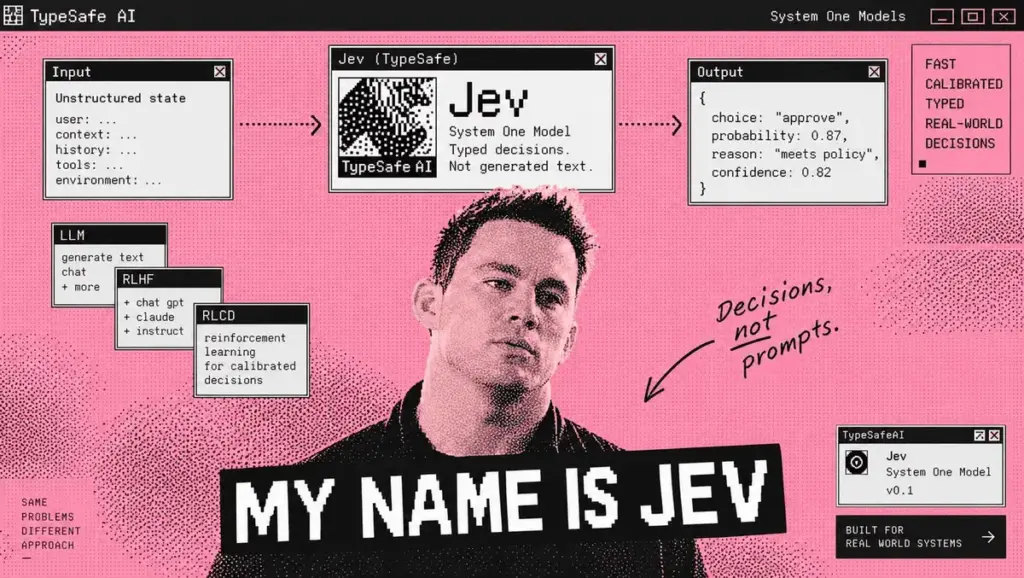
At its core, Jev is an artificial intelligence model engineered specifically for rapid, structured decision-making rather than open-ended text generation. TypeSafe AI has categorized it as a "System One Model," explicitly distinguishing it from conventional large language models that are built to draft essays, write complex software code, or engage in lengthy, multi-turn conversational interactions. To understand the operational difference, consider a standard customer service scenario where an application receives an incoming support message from a frustrated user stating that they upgraded their subscription yesterday but can no longer access the paid features.
When processed by a traditional generative language model, the system might consume significant computational resources to compose a polite, comprehensive, and empathetic support reply. In contrast, Jev evaluates that exact same customer message against a predefined, fixed set of categorical choices and outputs a probabilistic distribution across those options. For instance, the model might assign sixty-four percent probability to technical issues, twenty-three percent to sales inquiries, thirteen percent to billing concerns, and zero percent to cancellations.
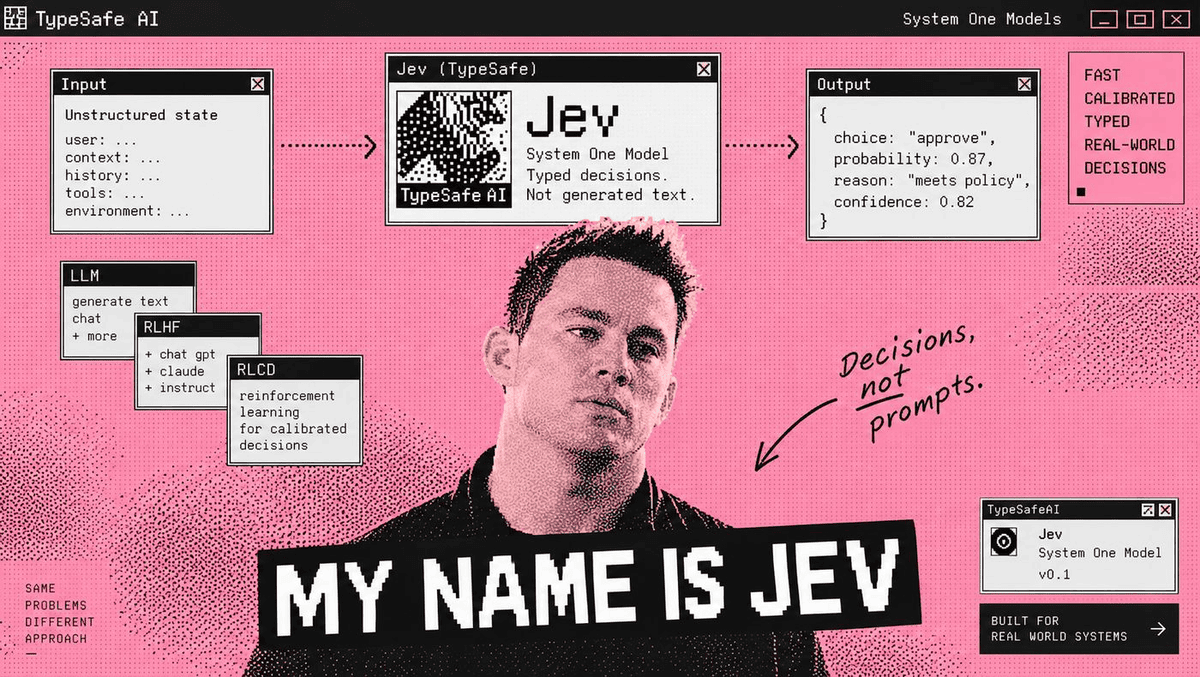
In this scenario, Jev selects "Technical" as the primary classification, but the accompanying probability distribution reveals that the request carries a degree of ambiguity. This capability is practically significant for software developers because an enterprise application can utilize both the categorical decision and the model’s internal confidence score to automate the next operational step. High-confidence routing can automatically direct the ticket to the appropriate engineering queue, while lower-confidence classifications can be flagged and routed to a human supervisor for manual review.
Classification, scoring, intent detection, and request routing are foundational machine learning problems that have been studied and deployed for decades. Where TypeSafe AI diverges from traditional approaches is in constructing a dedicated model specifically optimized around these typed, probabilistic decisions, rather than taking a massive, general-purpose large language model and prompting it to mimic a classifier through constrained decoding or engineered system prompts.
To explain this operational philosophy, TypeSafe AI describes Jev as a System One Model, drawing inspiration from behavioral psychology and cognitive science frameworks surrounding System 1 and System 2 thinking. In human cognition, System 1 thinking is rapid, instinctive, and automatic, allowing individuals to make split-second decisions based on immediate environmental cues without conscious deliberation. Jev mirrors this concept by generating structured decisions and probabilities instantaneously, bypassing the generation of long text chains or complex reasoning steps. Conversely, System 2 thinking is slower, deliberate, analytical, and effortful. This cognitive style mirrors how reasoning-focused frontier language models operate when they are tasked with solving intricate mathematical problems, formulating multi-step strategic plans, or working through complex logical inquiries.
The underlying philosophy championed by TypeSafe AI is not that one system should entirely replace the other. Instead, System One models are exceptionally useful for high-throughput, low-latency operational decisions, whereas System Two models remain indispensable when deep, multi-step logical reasoning is mandatory.
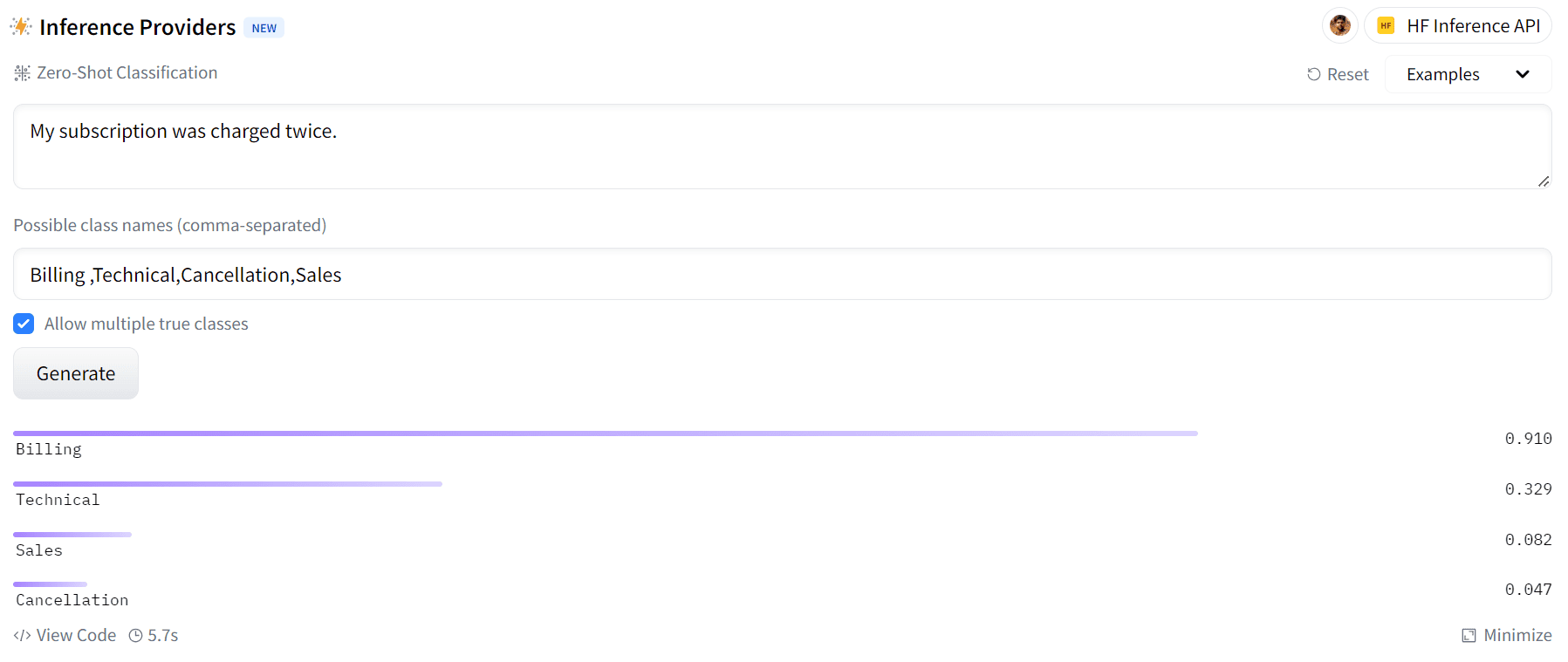
A frequent question raised by machine learning practitioners is whether Jev is fundamentally just a glorified zero-shot classifier. Philosophically and functionally, Jev shares a striking spiritual resemblance to zero-shot text classification frameworks. Zero-shot classifiers have long empowered developers to supply a piece of unstructured text along with arbitrary, user-defined candidate labels, eliminating the need to train a dedicated custom model from scratch for every unique set of categories.
For years, natural language processing engineers have leveraged modern natural language inference models for lightweight zero-shot classification tasks, a methodology that gained widespread popularity around 2019 and 2020, even as the foundational concepts of zero-shot learning stretch back much further into the history of artificial intelligence research. Dismissing Jev as merely an old zero-shot classifier would be equally inaccurate, however. TypeSafe AI has designed the model around simultaneous multi-structured decisions, parallel inference execution, and a specialized training regimen focused tightly on calibration. The core problem space may be mature, but the product wrapping, architecture, and developer workflow around it represent a fresh engineering iteration.

This operational focus raises questions about how Jev compares to standard large language models like GPT, Claude, or Gemini. Industry experts generally agree that Jev does not belong in the same capability tier as frontier large language models. Frontier models are built as general-purpose engines designed to excel across a massive spectrum of tasks, including software development, creative writing, multi-step logical reasoning, tool invocation, and open-ended conversation. Jev is intentionally narrow in scope, built primarily to ingest text and yield structured decisions. While developers can force modern general-purpose language models to output structured data through specialized function calling or constrained decoding features, doing so still requires utilizing a massive, computationally expensive, and slow model for what is fundamentally a straightforward classification task. By tailoring Jev specifically for that narrow job from its foundational design upward, TypeSafe AI has engineered a model that operates with dramatically reduced latency and cost.
The exceptional speed and low cost associated with Jev stem directly from its specialized architecture. Rather than generating text token by token in a sequential autoregressive loop, Jev is optimized to deliver structured decisions directly and in parallel. TypeSafe AI credits this efficiency to a specialized architecture, a parallel sampler, and calibration-focused training paradigms. Because the broader technological concept of lightweight classification models has existed for years within open-source ecosystems, the truly compelling aspect of Jev is not simply that it is cheaper than frontier language models, but rather how its internal architecture has been tailored specifically for high-speed, structured decision-making workloads.
Evaluating Jev’s accuracy remains a challenge due to the current lack of extensive, independent benchmarking data. TypeSafe AI reports that Jev achieves roughly sixty-eight percent accuracy on its internal workflow evaluations, but industry analysts note that internal benchmark scores do not automatically translate to real-world performance. Furthermore, the reference answers used in these internal evaluations were frequently generated by frontier language models rather than independently verified ground-truth datasets. Early independent tests conducted by external developers have shown promising figures, including high accuracy on specific fact-checking tasks and strong agreement across small document sets, but these evaluations remain limited in scope. Consequently, machine learning engineers view TypeSafe AI’s performance figures as promising indicators rather than definitive proof of general accuracy, emphasizing the need for rigorous, independent benchmarks.
Another frequently discussed claim surrounding Jev is that it completely eliminates hallucinations. Technically, this statement is accurate, but the specific wording is easily misunderstood. If a developer configures Jev with a fixed schema containing the options "Billing," "Technical," and "Sales," the model is structurally incapable of returning an out-of-bounds label like "Legal," because that choice simply does not exist within the defined schema. However, Jev can still select "Billing" when the objectively correct classification for the customer message was "Technical." Therefore, the model remains capable of making incorrect decisions. In practical terms, "zero hallucinations" translates closer to "zero out-of-schema outputs" rather than flawless decision-making accuracy, a distinction of paramount importance for software architects designing mission-critical enterprise systems.
When comparing Jev directly against frontier large language models, the advantages become most apparent in pricing and inference speed. Because Jev is a specialized model tackling a much narrower domain, it demands significantly less computational overhead and generates minimal output tokens compared to an expansive general-purpose model handling complex conversational interactions. If Jev can classify incoming support tickets or route user intents substantially faster and at a fraction of the financial cost, the operational advantage is clear. The more meaningful evaluation for enterprise adoption is whether Jev can maintain a level of decision quality close enough to frontier models that developers can safely substitute expensive API calls without degrading application reliability.
To achieve this reliability, TypeSafe AI utilizes a proprietary training methodology known as RLCD, which stands for Reinforcement Learning for Calibrated Decisions. The foundational principle behind this approach centers on calibration. A predictive model can maintain high categorical accuracy while performing poorly at estimating its own internal certainty. Calibration ensures that the mathematical probabilities output by the model accurately reflect how frequently those specific predictions are correct in practice.
Under a well-calibrated system, when Jev returns a high confidence score alongside a classification, that decision should prove correct at a statistically predictable rate. This calibrated uncertainty transforms probability into a usable software engineering primitive. Enterprise workflows can automatically execute actions when confidence surpasses a defined threshold while seamlessly escalating ambiguous cases to human reviewers. Unlike Reinforcement Learning from Human Feedback, which aligns models toward human-preferred conversational tones and styles, RLCD optimizes Jev specifically to generate probability distributions that accurately communicate algorithmic uncertainty.
In practical application, Jev is best deployed as a rapid decision-making layer embedded within a broader software architecture rather than as an end-user interface generating final conversational responses. Early adopters are actively experimenting with the model for automated ticket routing, intent detection, content moderation, and orchestrating multi-agent decision pipelines.
Ultimately, whether TypeSafe AI’s Jev can be classified as a revolutionary breakthrough depends entirely on one’s perspective. Classification, intent detection, zero-shot learning, and calibrated probabilities are all mature concepts within the data science community, and specialized models running faster and cheaper than massive general-purpose systems are a natural evolution of hardware and software optimization. What TypeSafe AI has successfully accomplished is a comprehensive rethinking of the architecture, inference pipeline, calibration methods, and developer experience surrounding these familiar technical challenges. That execution may well establish Jev as an exceptionally useful product for enterprise engineering teams, even if it represents a sophisticated refinement of existing principles rather than the invention of an entirely new form of artificial intelligence.