







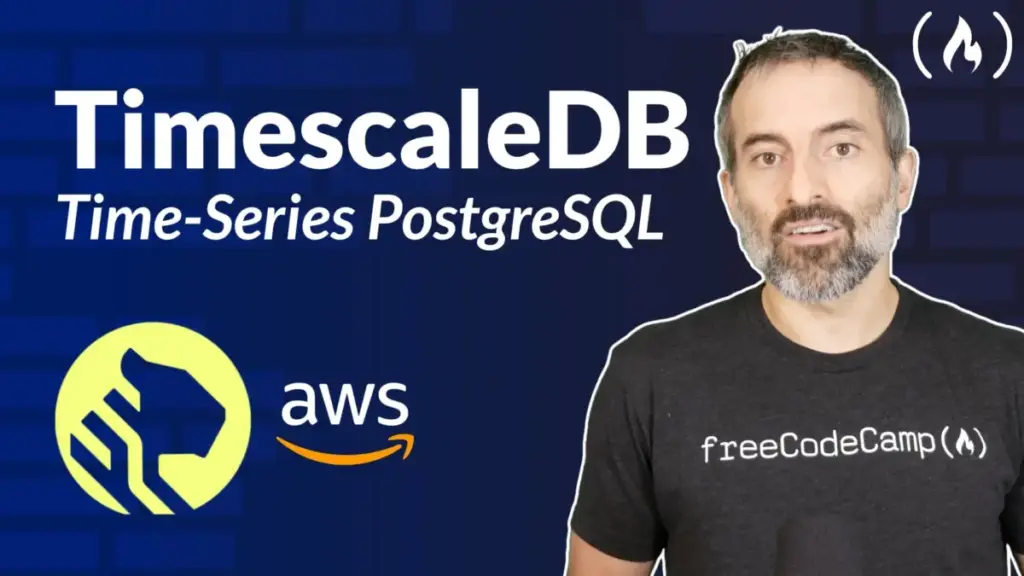
Managing massive, rapidly growing datasets efficiently has become one of the most critical skills for modern software developers across industries. Whether an engineering team is tracking high-volume API request logs, monitoring sprawling Internet of Things (IoT) fleet telemetry, or building real-time analytical dashboards for artificial intelligence agents, handling unoptimized time-series data can quickly bring standard relational database management systems to a crawl. To address this widespread industry challenge, the educational platform freeCodeCamp.org has announced the release of a brand-new, comprehensive course dedicated to TimescaleDB on its official YouTube channel.
The newly published four-hour video course is designed to teach developers how to transform a standard PostgreSQL instance into a high-performance, optimized time-series database. As modern applications generate unprecedented volumes of timestamped records, traditional database setups often struggle with query latency, storage bloat, and scaling limitations. This educational offering steps in to bridge that knowledge gap, providing engineers with the practical tools needed to optimize query speeds, drastically reduce storage footprints, and ensure that analytical dashboards remain lightning-fast even as data scales into the millions or billions of rows.
Time-series data represents a unique class of information where every record is intrinsically tied to a specific point in time. In contemporary software architecture, this data type is ubiquitous. From financial trading systems capturing microsecond price fluctuations to energy grids monitoring smart meters across continents, the sheer velocity of incoming data demands specialized storage and retrieval strategies. While PostgreSQL is widely celebrated for its robustness, reliability, and rich feature set, it is not inherently tuned out of the box to handle the massive insertion rates and time-bound query patterns typical of time-series workloads without proper extensions and architectural patterns.

TimescaleDB addresses this limitation by functioning as an open-source time-series database powered by PostgreSQL. It provides the reliability, security, and relational capabilities of a traditional SQL database while introducing automatic partitioning across time and space, known as hypertables. This architectural approach allows developers to maintain standard SQL syntax and relational integrity while benefiting from the speed and efficiency typically associated with NoSQL or specialized columnar databases.
Through the newly released freeCodeCamp.org curriculum, students will dive deep into these mechanics, gaining hands-on experience that bridges theoretical concepts with real-world application. The course moves beyond basic database administration, guiding learners through advanced optimization techniques that are vital for production environments. Participants will discover how to configure hyper-tables, implement efficient data retention policies, utilize data compression algorithms to save valuable disk space, and execute complex time-series queries with minimal computational overhead.
The educational material is structured around practical implementation, walking participants through the process of building two complete, production-ready projects entirely from scratch. By constructing these real-world applications, students can see firsthand how TimescaleDB handles continuous data ingestion, real-time aggregation, and analytical querying under realistic workloads. This project-based learning model ensures that developers do not just understand the concepts in abstract terms, but leave with tangible code and architectural patterns they can immediately integrate into their professional projects.
The launch of this course comes at a time when the demand for specialized data engineering skills is at an all-time high. As organizations increasingly adopt AI-driven monitoring systems, automated infrastructure, and data-heavy applications, the ability to manage time-series data effectively can make the difference between a scalable application and a costly infrastructure bottleneck. By partnering with expert instructors to bring this content to its global audience, freeCodeCamp continues its mission of making high-quality, technical education accessible to everyone, completely free of charge.
The full four-hour TimescaleDB course is now available for public viewing on the freeCodeCamp.org YouTube channel. Developers, database administrators, and software engineers looking to elevate their PostgreSQL expertise and optimize their data architectures can access the complete video instruction online. Alongside this specialized release, freeCodeCamp maintains its broader open-source curriculum, which has historically helped more than 40,000 individuals transition into professional software development careers through self-paced learning and practical project experience.