






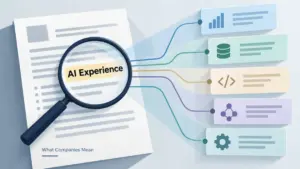


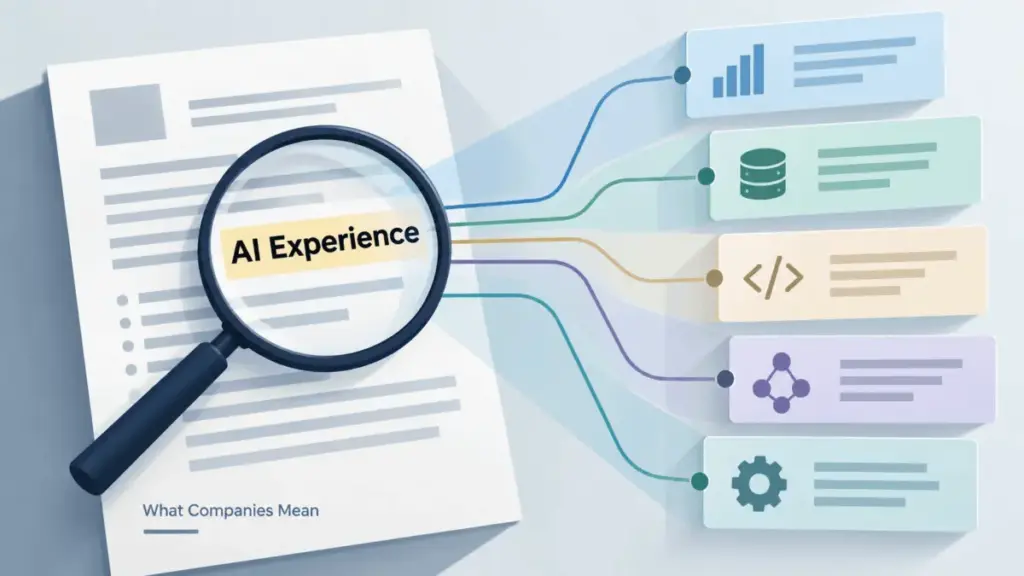
Job postings across the technology, retail, finance, and healthcare sectors increasingly feature a familiar requirement for data analysts, statisticians, and researchers: "AI experience." However, this ubiquitous phrase has grown to mean wildly different things depending on who wrote the listing, the specific industry context, and the business problems the organization is trying to solve. A hiring manager at a traditional retail enterprise, a fast-moving biotech startup, and a legacy financial services firm may all use the exact same two words to describe completely different technical expectations, daily workflows, and desired candidate profiles.
This widespread ambiguity presents a major hurdle for job seekers trying to navigate the modern labor market. Industry observers and hiring experts point out that the phrase acts more like a marketing signal than a precise technical competency. To help professionals decode these postings, career strategists have broken down what employers are actually asking for, how to read between the lines of corporate job descriptions, and how traditional statistical knowledge naturally maps onto what companies currently label as artificial intelligence experience.
The Phrase Has No Standard Definition
Unlike traditional technical requirements such as "five years of regression analysis experience" or "native proficiency in R," the term "AI experience" carries no shared, standardized meaning across organizations. It functions primarily as a catch-all marketing term rather than a rigorously defined technical metric.
This lack of definition is rarely an accident. Human resources departments and hiring teams frequently fail to reach an internal consensus on what specific technical capabilities they actually need before publishing a requisition. Instead, they write "AI experience" because it signals corporate modernity, aligns the company with current technological trends, and effectively filters for candidates who have actively monitored recent developments in machine learning and automated systems.
Consequently, the burden falls on the job applicant to decode the listing. The job description itself, the broader industry context, and the designated seniority level of the position all carry critical context that reveals what the company genuinely requires to solve its day-to-day operational challenges.
The Four Categories of Corporate AI Needs
A closer examination of modern job listings reveals that most corporate uses of "AI experience" fall into four distinct categories. Understanding which category applies to a specific role fundamentally changes how candidates should frame their professional background during the application and interview process.
The first category revolves around basic tool familiarity and operational adaptability, where companies simply want employees who are comfortable using generative AI tools, large language models, and automated assistants to boost everyday productivity. The second category emphasizes conceptual awareness, requiring analysts to understand the fundamental limitations, biases, and operational risks of machine learning outputs so they can safely interpret data without blindly trusting automated recommendations.
The third category demands hands-on modeling experience, where organizations expect candidates to build, train, tune, and deploy machine learning models using specific programming languages and frameworks. Finally, the fourth category focuses on domain-specific AI knowledge, which is common in specialized sectors like healthcare or quantitative finance, where professionals must apply machine learning techniques to proprietary, highly regulated datasets. Recognizing these distinctions prevents candidates from misrepresenting their skills or overlooking roles where their current abilities are more than sufficient.
Translating Statistical Backgrounds into AI Competency
For many traditional data analysts and statisticians, the panic over lacking AI experience is largely unfounded. Statistical training forms the foundational bedrock of almost everything classified as artificial intelligence in a modern business context. The perceived gap between a traditional statistician and a contemporary AI practitioner is primarily one of vocabulary and tooling rather than underlying mathematical reasoning or analytical logic.
Professionals do not need to overhaul their resumes or completely retrain; rather, they need to learn how to translate their existing achievements into the vocabulary that contemporary hiring managers use. For example, where a traditional resume might state that a candidate "built predictive regression models to forecast quarterly customer demand," a hiring manager searching for AI experience reads about someone who successfully understands supervised learning, feature engineering, and rigorous model evaluation. By framing past experience around tangible business outcomes and analytical reasoning processes, the direct connection to artificial intelligence becomes immediately visible to recruiters.
Reading the Job Posting as a Statistical Document
Job seekers should approach corporate job postings the exact same way they would approach any complex dataset: with a healthy dose of analytical skepticism and a laser focus on what the empirical evidence actually supports.
Headline requirements listed at the very top of a job description are typically aspirational wish lists. Companies routinely list every cutting-edge skill they would ideally want, fully knowing that no single human candidate will check every single box. An "AI experience" requirement buried deep within a long list of twelve secondary qualifications often carries far less weight than the core responsibilities outlined in the body of the text. The day-to-day duties and the specific business problems the role is designed to solve provide much more accurate signals regarding what the team actually needs.
As a general rule of thumb, headline requirements tend to reflect what the human resources department thinks sounds impressive, while the body of the posting reflects what the hiring manager’s team actually does on a Tuesday afternoon. Paying close attention to linguistic modifiers also helps clarify expectations. When a posting states that AI experience is merely "preferred," it represents a secondary nice-to-have skill. Conversely, when it is listed as "required" with no further elaboration, it usually points toward basic tool literacy or conceptual awareness. When specific machine learning libraries and development frameworks are explicitly listed, it signals a demand for hands-on technical modeling.
The Seniority Signal
The designated seniority level of an open role changes the interpretation of AI experience substantially, dictating whether a company is looking for basic execution, cross-functional collaboration, or high-level strategic governance.
For junior-level positions, employers are primarily looking for adaptability. They want to see comfort with emerging tools, a willingness to learn proprietary internal systems, and a lack of fear when interacting with automated outputs. At the mid-level, the requirement shifts toward informed collaboration. Mid-level analysts are expected to work effectively alongside dedicated software engineering teams, contribute meaningfully to model evaluation discussions, and successfully bridge the persistent communication gap between technical data science units and non-technical business stakeholders.
For senior-level roles, AI experience translates directly into strategic judgment. Senior leaders must possess the deep analytical maturity to know precisely when artificial intelligence is—and is just as importantly, when it is not—the correct solution to a business problem. They must be capable of communicating technical limitations clearly to executive leadership and helping the wider organization avoid the significant financial and reputational costs associated with careless technology deployment.
Common Misconceptions Among Job Seekers
Job seekers frequently fall into several common traps when attempting to position themselves for roles requesting artificial intelligence expertise. One major misconception is the belief that listing every single AI tool, chatbot, or software package ever touched on a resume will improve candidacy. In practice, this strategy often backfires. Experienced hiring managers remember candidates who demonstrated sound analytical judgment and critical thinking, not candidates who merely demonstrated temporary access to popular software utilities. Professionals are much better served by describing the complex problems they solved and the rigorous reasoning processes they employed, mentioning specific tools strictly as supporting context.
Another widespread anxiety is the fear of immediate disqualification for candidates who have never built a machine learning model completely from scratch. For the vast majority of data analyst and research roles, building foundational algorithms from scratch is entirely unnecessary. What frequently disqualifies candidates is not a lack of coding prowess, but rather an inability to think critically about underlying data quality, hidden model assumptions, and the correct interpretation of analytical results. These are core statistical skills that companies desperately need, even if they frequently struggle to name them accurately in their recruitment advertising.
Finally, many professionals believe they must secure formal online certifications before applying to roles mentioning artificial intelligence. While credentials can provide helpful structure in certain contexts, most hiring managers evaluating analyst-level talent focus heavily on testing a candidate’s reasoning abilities during live interviews. The capacity to explain clearly when an automated system might produce flawed outputs—and the underlying reasons why—carries far more weight and persuasiveness than any collection of completed online courses.
As the corporate landscape continues to evolve, "AI experience" in a job posting should be viewed as an invitation to open a professional conversation rather than a rigid, unyielding technical specification. Most of the time, the phrase simply signals comfort with emerging digital tools, a basic awareness of machine learning concepts, hands-on modeling proficiency, or targeted domain knowledge. Because traditional statistical training already covers substantial ground across all of these areas, the primary task for job seekers lies in reading postings carefully, identifying the true underlying category of need, and framing their established experience so that the professional connection is impossible for hiring managers to miss.
The discussion surrounding these hiring trends is frequently informed by industry educators and technical mentors such as Vinod Chugani, who works extensively to bridge the gap between emerging artificial intelligence technologies and practical application for working professionals. Focusing on technical mentorship, skill development, and career transitions, such educators emphasize actionable strategies that data professionals can apply immediately in the modern labor market.