








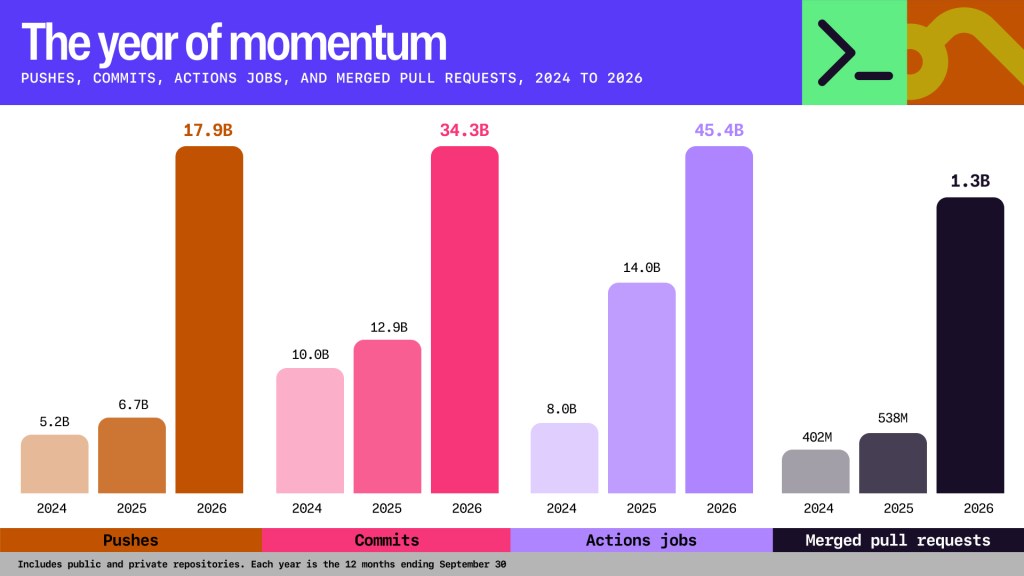
The global developer landscape experienced an unprecedented transformation over the past twelve months, defined by a surge in activity that defies historical precedent. According to the 2026 Octoverse report, developers pushed code to GitHub a staggering 17.9 billion times between October 2025 and September 2026. This figure is not merely a record; it represents a volume of activity that exceeds the combined totals of 2024 and 2025, signaling a profound shift in how software is conceptualized, built, and maintained in the era of artificial intelligence.
This historic momentum is anchored in the evolving relationship between human ingenuity and machine-assisted workflows. Behind the raw data are millions of individual stories—from developers in Nepal utilizing GitHub Pages and Actions to build real-time flood bulletins and disaster alerts like Gati, to engineers at NASA’s Jet Propulsion Laboratory crafting firmware for spacecraft. The narrative of 2026 is one of curiosity directed toward every conceivable field, as the barrier to building complex, impactful software has been fundamentally lowered.
The Year Developers Set a New Pace
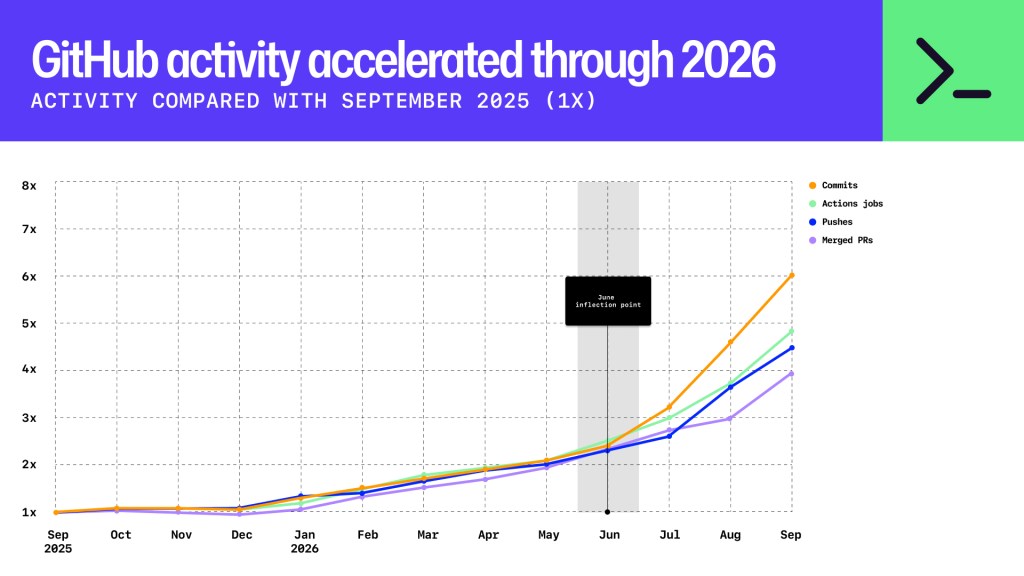
The acceleration observed in 2026 was not a gradual incline but a sharp, mid-year inflection point. By June, as AI agents transitioned from experimental novelties to essential, persistent collaborators, developer activity surged. This shift was marked by a move away from single-session interactions toward agents that can track progress across multiple days, orchestrate specialized sub-agents, and execute tasks across both local machines and cloud environments.

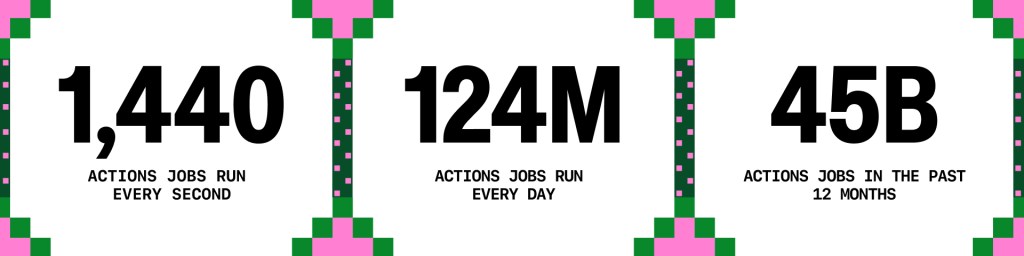
The quantitative evidence of this acceleration is striking. Total commits across public and private repositories reached 34.3 billion, more than triple the figures seen just two years prior. Even more significant is the velocity of collaboration: merged pull requests soared to 1.3 billion, averaging 3.5 million per day. GitHub Actions, the platform’s automation engine, mirrored this intensity, running 1,440 jobs every second—a daily total of 124 million jobs, representing a threefold increase over the previous year.
Perhaps the most telling metric of the new workflow is the adoption of agentic configurations. Repositories that incorporated agent configurations logged, on average, eight times as many commits as those that did not. This suggests that teams integrating agentic workflows from the inception of a project are operating at a fundamentally different speed than their peers. Automation is also increasingly used to maintain the health of these rapidly growing codebases; developers merged more than 30 million Dependabot pull requests this year, effectively doubling the pace of dependency management and vulnerability mitigation seen in 2025.
This momentum is not limited to new entrants. While roughly 55% of all commits since June originated from brand-new repositories, veteran developers are also leaning into these tools. The average developer on GitHub today works across 10% more repositories than they did a year ago, and the retention rate remains high, with 75% of those who opened a pull request in August returning to push code in September.
Global Expansion and the 2030 Projections
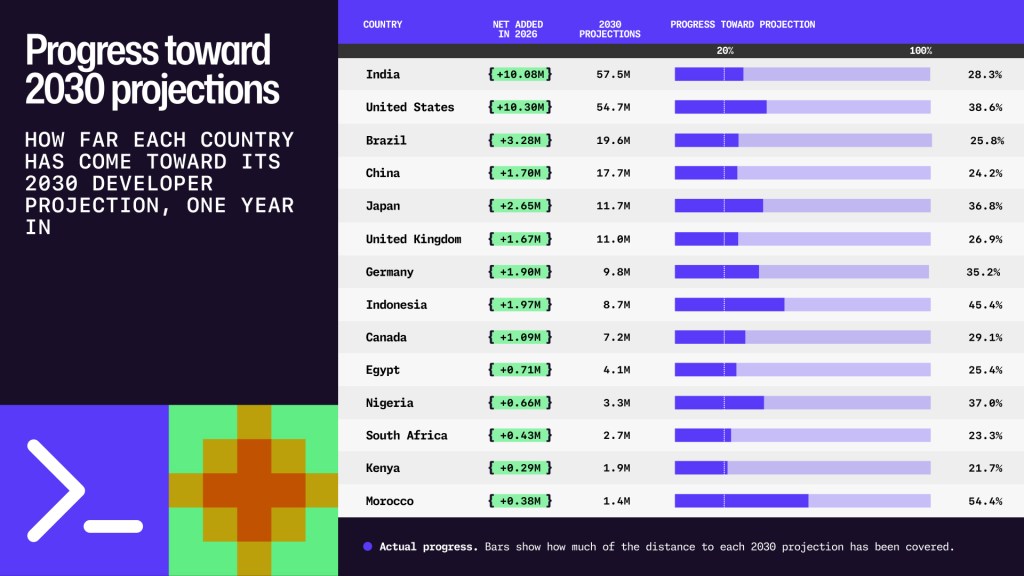
GitHub’s community has expanded to serve more than 225 million developers globally. The United States and India remain the largest hubs, with 38.3 million and 32 million developers respectively, each having added over 10 million new members in the past year alone. Brazil has emerged as a significant force, adding 3.28 million developers, ranking it third in terms of annual growth.
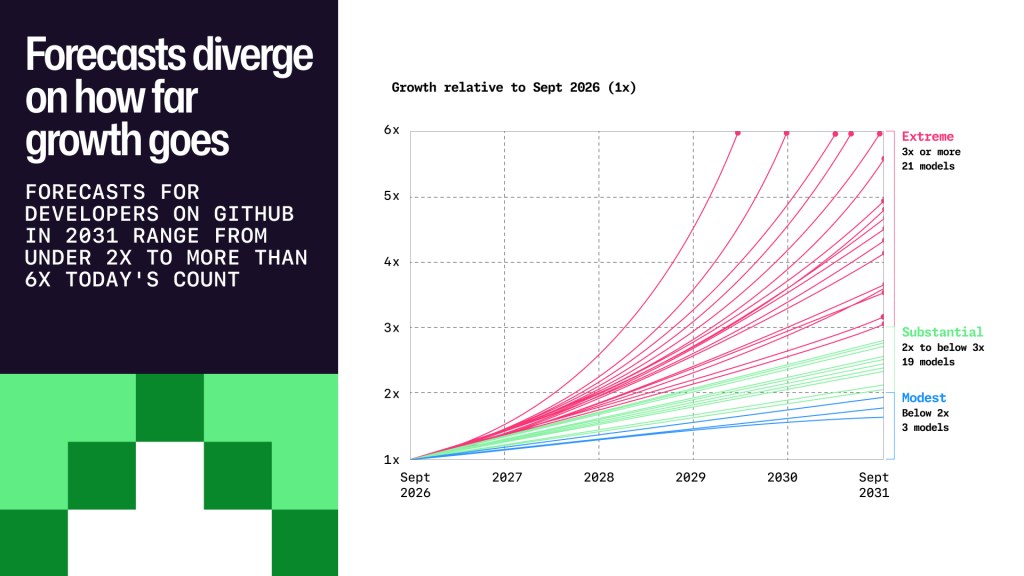
The scale of this growth has forced a recalibration of long-term forecasts. Just one year into a five-year projection window, nearly every country tracked has already closed at least 20% of the gap toward its 2030 target. The United States has already reached 38.6% of its projected 2030 developer population, while India has closed 28.3%. Given this pace, forecasting models are now yielding a wide spectrum of possibilities for 2031. While conservative models expect growth to double, nearly half of the 40+ forecasting models analyzed by GitHub suggest "extreme" growth, potentially tripling the total number of developers on the platform by the end of the decade.
This expansion is driven by diverse regional priorities. In the Americas, the focus remains on fintech and digital payments. In the EMEA region, AI adoption is accelerating in the industrial sectors of Germany and the startup ecosystems of France, Spain, and Morocco, while sub-Saharan Africa sees robust growth driven by agritech and coding bootcamps. In the APAC region, heavy government investment in AI infrastructure is fueling rapid digital transformation, particularly in Indonesia, Japan, and South Korea.
AI Reaches Every Industry
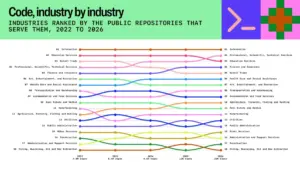
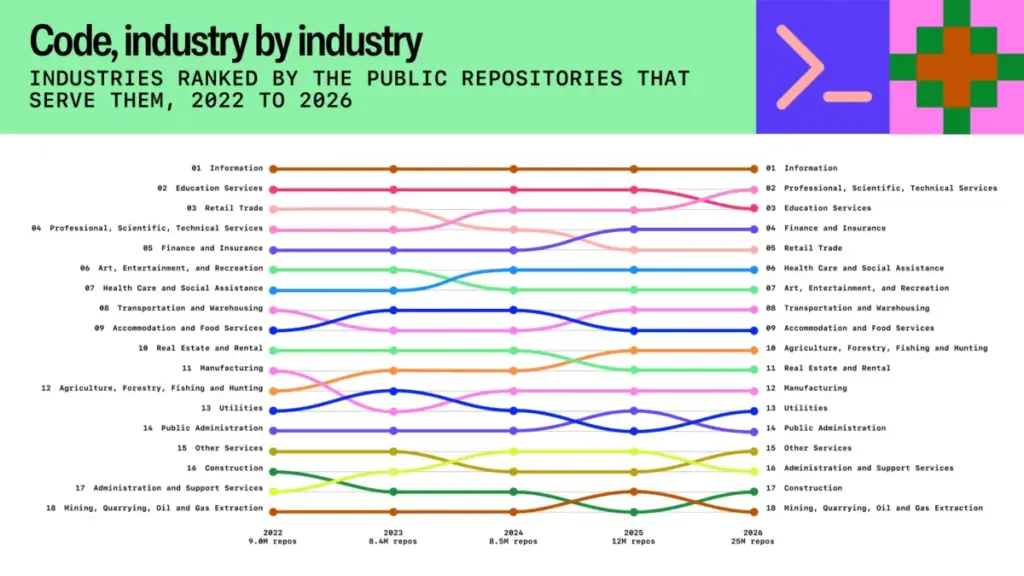
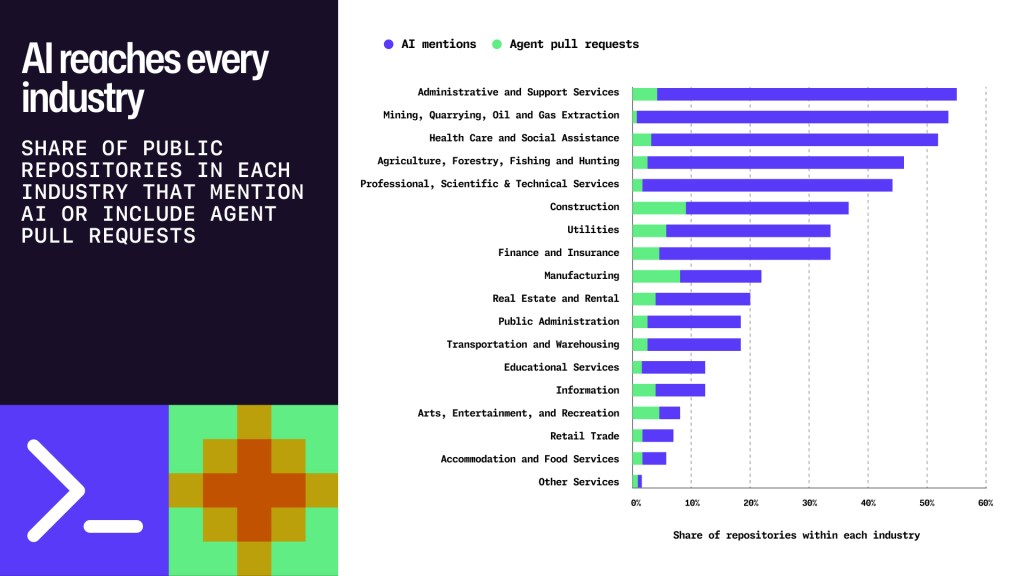
One of the most defining characteristics of 2026 is the democratization of code across industries that were previously considered outside the traditional "tech" sector. By applying the North American Industry Classification System (NAICS) to categorize public repositories, the report highlights a massive influx of software development in areas such as agriculture, health care, mining, and construction.
In sectors like mining, health care, and agriculture, over 40% of public repositories now explicitly mention AI, though these fields show lower rates of agent-led pull requests. Conversely, the construction industry is bucking this trend, with 9% of its repositories featuring agent-opened pull requests—the highest share of any sector. This signals that while many industries are still in the early stages of adopting AI, some are already deeply integrating autonomous agents into their core workflows.
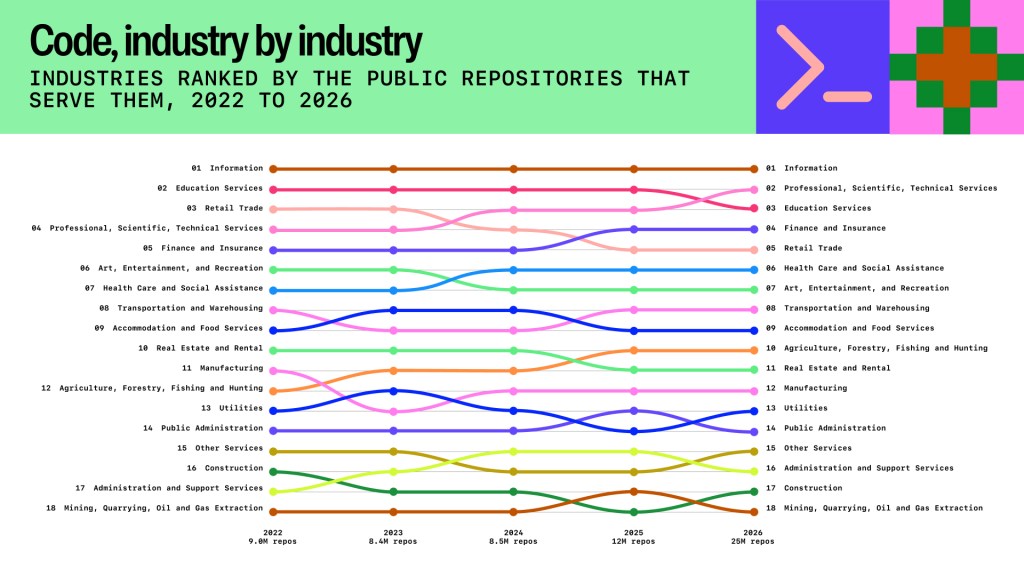
The impact of this shift is visible in tangible, real-world projects. From manufacturing teams using AI to create 3D-printable drawer organizers to university labs in Copenhagen classifying video of animal behavior, the common thread is that domain experts are using AI to solve the problems they know best. Professional and scientific services, which rose to the second-most prominent industry category, continue to utilize open source as the backbone of high-level research, with repositories now functioning as a critical component of the academic and scientific record, as seen in the development of tools like AlphaFold and the first reconstructions of black holes.
Reshaping the Workflow with Agents
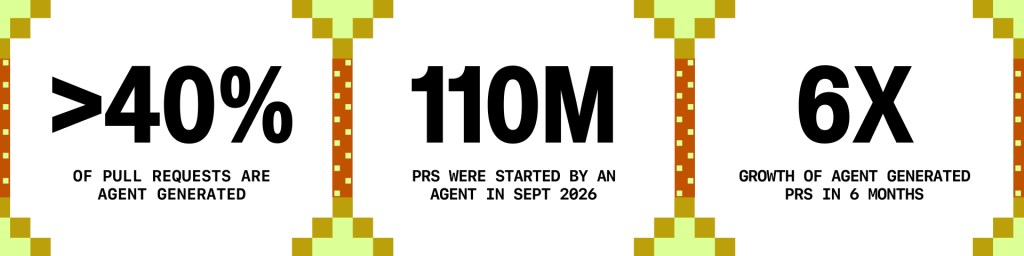
The workflow of the modern developer has fundamentally changed. By September 2026, more than 40% of all pull requests on GitHub were initiated by an agent’s draft—a massive increase from 17% just six months earlier. These agent-started pull requests are not only more frequent but also more complex, with 87% of them involving changes to multiple files compared to 79% for manual pull requests.
Efficiency gains are also measurable. By September, 90% of agent-involved pull requests were merged within two weeks, outperforming the 86% rate for those without agent involvement. This is supported by the rising adoption of agentic features within tools like GitHub Copilot, where 55% of active users are now leveraging agentic capabilities. Notably, the "cloud agent" mode, which allows developers to delegate entire tasks for independent execution, saw a 230% year-over-year growth, indicating a shift toward higher-level delegation.
The diversity of models available to developers has also exploded. In May, paid Copilot users utilized 29 distinct models; by September, that number reached 47. Developers are increasingly choosing models based on the specific requirements of the task—whether that be deep reasoning and planning, general-purpose assistance, or fast, lightweight execution. The industry is moving toward orchestration, where tools like GitHub Copilot Fusion automatically select the appropriate model for each step of the development process, balancing cost, speed, and accuracy.
The Evolving Language Landscape
TypeScript remains the most used language on GitHub by contributors, a title it defended against Python and JavaScript. However, the influence of AI on language choice is becoming a subject of intense interest. The languages with the highest community growth—TypeScript, Python, and Rust—also show the highest rates of AI involvement in merged pull requests, ranging from 40% to 44%.
Evidence suggests a correlation between language and agentic ease-of-use; when developers leave the choice of language to an agent, there is a clear preference for TypeScript. This indicates that as agents become more integrated into the development cycle, the ecosystem may naturally gravitate toward languages where agent output is easier to audit and integrate.
What Remains Constant
Despite the rapid shift toward automation and the unprecedented surge in code production, the core of the development experience remains human-centric. Whether it is an engineer building a new tool to assess earthquake risks or a novelist creating a custom app to streamline their writing process, the initial spark of creativity, the definition of the problem, and the final judgment of quality remain firmly in human hands.
The 2026 Octoverse report confirms that while the tools have become more powerful and the scope of the developer community has expanded to every corner of the globe and every sector of the economy, the fundamental purpose of building remains the same. As developers continue to navigate this period of rapid transformation, the rocket emoji—the most used emoji in repositories across all industries—remains a fitting, if simple, testament to the momentum driving the future of software development.