








CesiumAstro Inc., a recognized global leader in space and defense communications systems and satellites, has announced the successful closing of a massive $730 million Series D financing round, bringing the company’s total valuation to more than $4.5 billion. This latest injection of capital brings CesiumAstro’s total announced funding for the year 2026 to more than $1.2 billion, providing the financial runway necessary to accelerate its ambitious expansion into developing and operating its own proprietary satellite infrastructure.
Alongside the financing milestone, the company lifted the veil on Synchronicity, a planned 737-satellite, artificial intelligence-enabled constellation designed to serve commercial, sovereign, and defense missions across the globe. This major strategic rollout follows closely on the heels of the successful launch of CesiumAstro’s first satellite, Element-1, and the formal commencement of its on-orbit operations.
The rapid expansion builds upon a series of three strategic corporate acquisitions that have significantly strengthened CesiumAstro’s vertical integration capabilities. By bringing critical operations under one corporate umbrella—ranging from foundational semiconductors to comprehensive mission operations—the company has positioned itself to accelerate the development and deployment of the Synchronicity constellation. To support this massive scaling effort, CesiumAstro is simultaneously expanding its engineering and manufacturing operations worldwide, highlighted by a $500 million investment over five years to dramatically expand its Austin-area headquarters, including the acquisition of 270,000 square feet of advanced manufacturing space.
Series D Financing
The equity financing round was spearheaded by Janus Henderson, with substantial participation from a roster of prominent investors including Insight Partners, Sands Capital, Sumitomo Corporation of Americas, Woven Capital—Toyota’s Growth Fund, Incharge Capital, Magnetar, AV, and NewSpace Capital. In addition to the equity investment, the round was bolstered by $100 million in debt financing provided through a collaborative effort between the Export-Import Bank of the United States (EXIM) and JPMorgan.
This substantial influx of capital is earmarked for advancing core technologies, aggressively expanding U.S. manufacturing capacity, developing and producing next-generation spacecraft, facilitating the deployment of the Synchronicity constellation, and driving international market growth.
"For nearly a decade, we have invested in the engineering, intellectual property, manufacturing infrastructure, and the talented people required to build an enduring space technology company," said Shey Sabripour, Founder and CEO of CesiumAstro. "With our technology proven on orbit, on the ground and in the air, a significantly expanded set of capabilities, and more than $1.2 billion in new capital raised this year, we are positioned to take the next major step in our growth."
Aaron Schaechterle, Portfolio Manager at Janus Henderson, emphasized the transformative potential of the company’s technology within the broader aerospace landscape. "Shey Sabripour is an extraordinary entrepreneur, and CesiumAstro is poised to revolutionize the space communications industry. This industry is at an inflection point; legacy solutions are not equipped for the demands of today’s customers," Schaechterle said. He added that the investment originated through the Janus Henderson Ascent platform, which was specifically designed to provide private market capital to visionary companies redefining their industries and to support them on their journey from private markets to the public sphere.
Introducing Synchronicity: A 737-Satellite, AI-Enabled Constellation
The introduction of the Synchronicity constellation marks a pivotal evolution for CesiumAstro, moving the company beyond its traditional role as a supplier of advanced space technologies and complete spacecraft into the realm of operating its own fully integrated space infrastructure.
The constellation is engineered around a dynamically managed, multi-beam, and multi-frequency architecture. It is designed to support Ku-, Ka-, and V-band communications, advanced edge computing, and multi-orbit operations. This unified system aims to deliver vastly more flexible, resilient, and adaptable connectivity solutions across a diverse spectrum of commercial applications and national security missions.
Artificial intelligence is deeply embedded throughout the system architecture, enabling automated network optimization, the dynamic allocation of communications resources, and the ability to autonomously adapt to rapidly changing mission requirements and operating conditions. Furthermore, integrated edge processing capabilities are intended to bring computational power much closer to the point where data is generated. This reduces the system’s reliance on terrestrial infrastructure and efficiently supports increasingly time-sensitive operational applications.
Unlike conventional space architectures that are typically assembled from independently sourced components, Synchronicity will leverage CesiumAstro’s proprietary, vertically integrated technology portfolio. This ecosystem includes custom silicon, best-in-class active phased arrays, software-defined payloads, advanced processors, spacecraft platforms, mission software, and specialized terminals built for air, ground, mobility, and maritime deployment. This holistic approach allows for system-wide performance optimization that would otherwise be difficult to achieve.
"Synchronicity is the culmination of the technology stack we have methodically built since CesiumAstro was founded," noted Sabripour. "We designed the silicon, the active phased array, the payload, processors, the spacecraft, ground terminals, and the network as one system. That vertical integration gives us the ability to build capabilities in space that evolve as mission requirements, technology, and operating conditions change."

Three Strategic Acquisitions Expand CesiumAstro’s Capabilities
Over the preceding 12 months, CesiumAstro significantly expanded its technological foundation by absorbing critical semiconductor, mission software, and artificial intelligence capabilities through three targeted acquisitions: Jariet Technologies, 1Aardvark, and Vidrovr.
Jariet Technologies brings deep expertise as a leading millimeter-wave RF System-on-Chip (RF-SoC) semiconductor company specializing in advanced solutions tailored for satellite communications, electronic warfare, and radar systems. This acquisition fortifies CesiumAstro’s technology portfolio with advanced mixed-signal semiconductors, sophisticated digital signal processing, and digital beamforming capabilities, allowing for enhanced performance and precise control across its communications payloads, active phased arrays, and spacecraft.
The acquisition of 1Aardvark infuses the company with specialized mission software, algorithms, and systems engineering expertise geared toward national defense programs. This addition expands CesiumAstro’s autonomous mission capabilities, equipping spacecraft with the intelligence needed to dynamically respond to shifting operational conditions, maintain higher levels of resilience, and secure mission effectiveness even within contested or connectivity-constrained environments.
Rounding out the trio, Vidrovr contributes specialized artificial intelligence capabilities centered on real-time multimodal signal analysis. This acquisition accelerates the integration of AI into CesiumAstro’s broader space communications and sensing systems, empowering intelligent radio frequency optimization, autonomous satellite operations, and reconfigurable edge computing across its entire suite of space and defense platforms.
Element: A Decade of Engineering Proven on Orbit
The grand vision of the company is grounded in real-world validation, highlighted by the successful launch and subsequent on-orbit operations of Element-1 in October 2026.
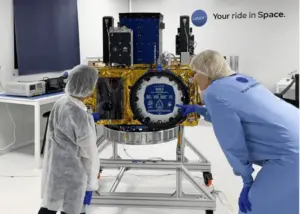
Element-1 successfully integrates CesiumAstro’s proprietary communications payloads, active phased array technology, internal compute systems, and comprehensive spacecraft engineering into a single, fully operational satellite. The mission serves as a critical validation of nearly a decade of sustained investment in proprietary intellectual property, specialized engineering talent, and robust in-house manufacturing capabilities.
As the first of eight planned spacecraft, Element-1 paves the way for seven additional launches that have already been secured for the upcoming deployment phase. The broader Element program also advances the company’s space-based edge processing and compute capabilities, allowing raw data to be processed much closer to its source and thereby supporting more intelligent, responsive, and autonomous space missions.
Expanding Global Operations and Manufacturing Capacity
To support these sweeping technological and operational initiatives, CesiumAstro is investing heavily in its physical footprint. In Texas, the company announced a major $500 million investment spanning five years to expand its global headquarters in Austin. This expansion includes the acquisition of 270,000 square feet of advanced manufacturing space dedicated to precision electronics and spacecraft manufacturing, engineering, system integration, and testing. The project is projected to create 550 new jobs, growing the local Austin workforce to more than 1,000 employees by 2030.
Across the United States, CesiumAstro is channeling hundreds of millions of dollars into expanding its engineering, manufacturing, and operational capabilities, supported by additional facilities located in Colorado, California, Alabama, Florida, and the Washington, D.C. area.
Internationally, the company is scaling its presence across Europe and Asia, maintaining established operations in the United Kingdom, Germany, Switzerland, Taiwan, Singapore, and Japan.
These comprehensive expansions will provide the necessary industrial foundation to support scaled production of the company’s advanced communications and sensing systems, high-performance computing technologies, and next-generation spacecraft, while directly fueling the deployment of the newly announced Synchronicity space infrastructure.