










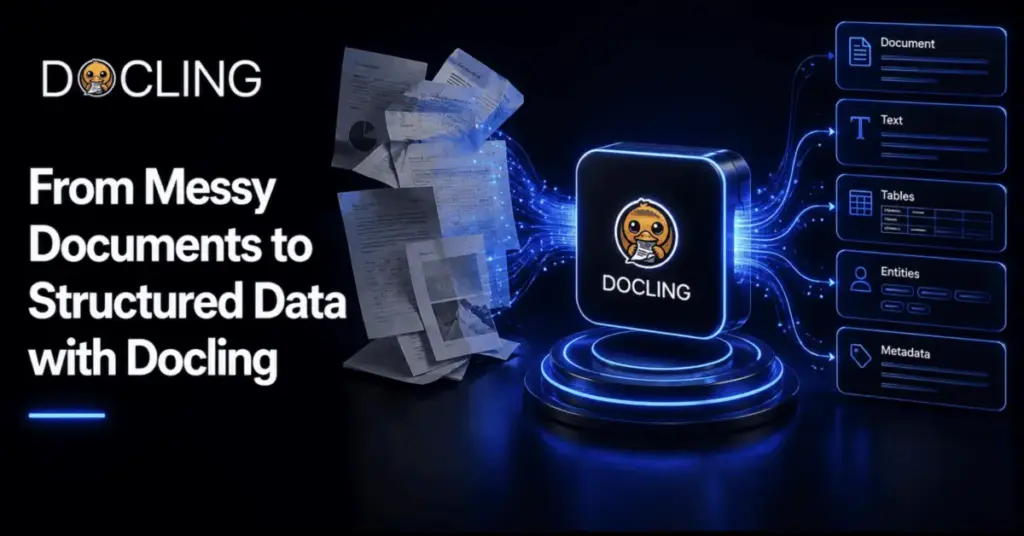
Somewhere on a shared corporate drive right now, an employee is staring down a hundred-page PDF report, desperately hunting for three critical figures buried deep within its pages. They open the file, locate the required table, and attempt to copy and paste it into a spreadsheet. Instantly, every row collapses into a single, unreadable cell. Faced with digital gridlock, they abandon automation entirely and resort to manual data entry, transcribing a forty-row table by hand because writing a custom, single-use script simply does not justify the time investment.
This exact brand of recurring, small-scale frustration is the primary target of Docling, an increasingly popular open-source document processing toolkit. Rather than expecting messy, real-world documents to miraculously conform to tidy standards, Docling provides developers and data teams with a reliable framework to convert chaotic inputs—ranging from scanned invoices and multi-column academic papers to PowerPoint presentations—into structured, programmatically trustworthy data.
What Docling Actually Is
Docling originated within the AI for Knowledge team at IBM Research Zurich and has since matured into a robust, actively maintained ecosystem hosted under the LF AI & Data Foundation under an MIT license. Boasting tens of thousands of GitHub stars and extensive community adoption, the project relies on formal technical research papers rather than mere marketing claims, establishing credibility for organizations looking to build production-grade workflows upon its infrastructure.

At its core, Docling ingests documents across an inconsistent array of file formats and normalizes them into a unified, structured representation. This allows both human users and advanced artificial intelligence systems to work with enterprise data reliably, eliminating the ambiguity typically associated with raw, unparsed text extraction.
Why Messy Documents Are a Genuinely Hard Problem
Understanding why document processing fails requires moving past the casual observation that PDFs can be annoying. Standard PDF documents possess no inherent understanding of structural elements like tables, paragraphs, or headings. Instead, they store text as isolated character strings positioned at specific coordinate points across a page.
When a basic text extractor processes a file sequentially from top to bottom, multi-column layouts like academic research papers immediately descend into a scrambled narrative where fragments of text from separate columns blend together. Tables suffer an identical fate; without genuine structural detection algorithms, cell boundaries vanish, leaving behind an indistinguishable block of numbers devoid of row or column context.
Scanned documents introduce an entirely separate layer of complexity. Because no underlying text layer exists, optical character recognition must interpret pixels and attempt to reconstruct characters. Headers and footers repeat across pages, injecting noise into the actual content, while mathematical formulas, code blocks, and figure captions either vanish entirely or merge directly into the body text. These obstacles represent standard operating conditions for data workflows, rather than rare edge cases, making specialized extraction pipelines essential.
A Comprehensive Look at Document Capabilities
Docling’s operational scope extends far beyond basic text conversion. The platform handles a diverse array of import formats, including standard portable document formats, word processor files, presentation decks, markup languages, web formats, spreadsheet files, comma-separated values, and various image and audio files.
When exporting processed information, the toolkit supports JSON, Doctags, Markdown, HTML, and plain text. More importantly, its extraction engine captures structural metadata such as page images, sequence numbers, headers, footers, paragraphs, list items, code blocks, formulas, reading order, pre-formatted chunks, table cell boundaries, and picture classifications complete with bounding boxes for every component.
This granular classification separates comprehensive parsing engines from simple text scrapers. By identifying the functional role of each content fragment—distinguishing a figure caption from a data cell and preserving their hierarchical relationship—the platform creates the foundation necessary for advanced data extraction and machine learning applications. Furthermore, Docling executes its core models locally by default. Organizations can process sensitive contracts, medical records, and internal financial reports without requiring external API keys or transmitting confidential data across the internet.
Standardizing the Document Structure
The unifying mechanism behind Docling is the DoclingDocument object, which normalizes disparate input formats into a single, predictable schema. This unified structure organizes information into explicit content items—categorized as text blocks, tables, pictures, and key-value pairs—and content structure hierarchies.
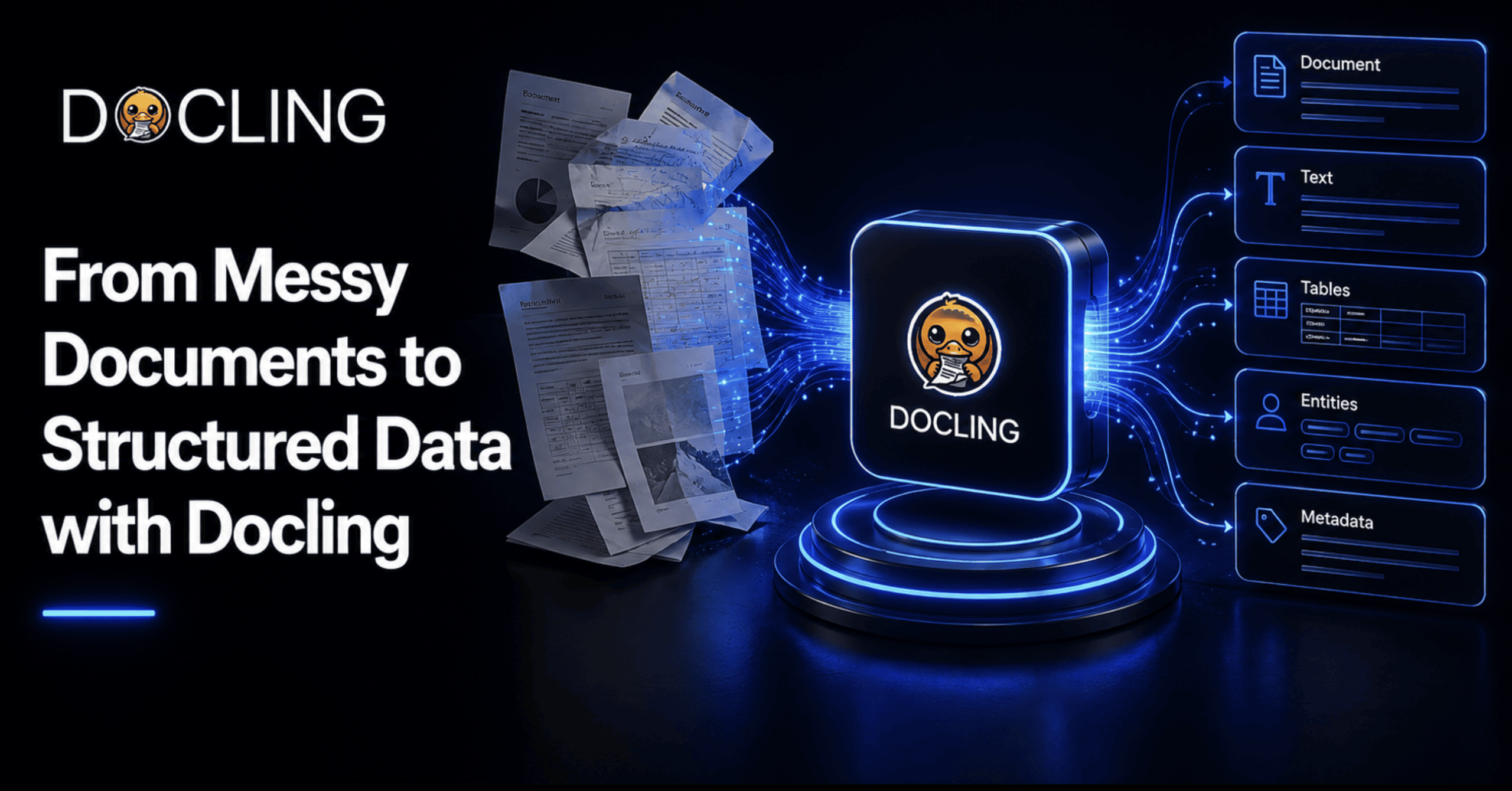
The structural hierarchy organizes data into distinct trees: the main body content arranged in logical reading order, a separate container for non-content elements like headers and footers, and structural groupings for items like lists or chapters. This structural tree solves the reading-order dilemma by nesting every content item beneath its corresponding section node. Consequently, a title node maintains direct child relationships with all subsequent paragraphs, tables, and images in the exact sequence a human reader would consume them.
Exporting to Downstream Pipelines
Once a document is converted into the unified structure, exporting it to fit the requirements of downstream applications requires minimal effort. Markdown exports serve as an efficient choice for feeding content into large language models and retrieval-augmented generation pipelines due to their compact footprint and strong model training familiarity.
Conversely, JSON exports provide lossless, structured data representation when programmatic systems need to query specific elements without re-parsing raw files. HTML outputs remain valuable when human reviewers require browser-based rendering that preserves visual styling otherwise flattened by plain text conversions.
Resolving Complex Layouts and Scanned Media
Handling scanned documentation requires activating optical character recognition as part of the conversion pipeline. By configuring processing parameters to enable text recognition and table structure detection, users can process non-searchable PDFs, faxes, and photographs of receipts seamlessly.
The table structure detection module goes beyond merely locating tables on a page, actively reconstructing complex rows, columns, multi-level headers, and nested cell contents rather than flattening intricate data grids into unstructured text blocks.
Optimizing Content for Retrieval-Augmented Generation
Feeding documents into retrieval-augmented generation systems often exposes the limitations of naive text splitters, which frequently cut sentences in half or separate table headers from their corresponding data rows. Docling addresses this through a hybrid chunking mechanism that operates directly on the document’s structural tree rather than relying on arbitrary character counts.
The chunking process applies tokenizer-aware refinements, splitting content only when fragments exceed target token limits while merging adjacent undersized chunks that share common headings. Furthermore, context-enrichment features ensure that individual text chunks retain their parent section headings, preserving vital semantic context for embedding models during vector retrieval.
Schema-Based Structured Extraction
Beyond general document conversion, Docling provides schema-based extraction capabilities that allow developers to define precise data templates using standard data validation models. By supplying a schema—either as a basic dictionary or through structured Python data classes—applications can extract validated, typed data directly from documents rather than parsing unstructured text streams manually.
This extraction mechanism supports nested object definitions, enabling developers to map complex relationships, such as contact details embedded within larger corporate invoices. Once extracted, the data can be validated and loaded directly into strongly typed objects, providing IDE autocompletion and type safety for subsequent database storage or API integrations.
Production Integration and Enterprise Ecosystems
For enterprise production environments, Docling integrates natively with major artificial intelligence orchestration frameworks, allowing developers to utilize the toolkit as a standard document loader. Agent-based workflows can also leverage a dedicated Model Context Protocol server to execute conversion and extraction tasks autonomously.
Teams preferring centralized infrastructure can deploy self-hosted REST API services to handle conversions across internal applications, while managed cloud offerings provide scalable processing alternatives for large enterprises. As the project roadmap continues to evolve—with upcoming expansions for automated metadata extraction and complex chemical structure parsing—Docling remains positioned as a critical bridge between unstructured enterprise documents and reliable, machine-readable data pipelines.