








Artificial intelligence coding assistants have transformed software development by making the process of fixing broken code nearly instantaneous. Developers can paste an error message into an automated tool and receive a corrected implementation within seconds. While this efficiency is undeniably useful when the primary goal is simply to get a program running, a more fundamental question arises for those learning how to program: did the artificial intelligence actively help the user understand the underlying problem, or did it simply remove the obstacle entirely?
This distinction sits at the heart of modern programming education. Debugging is not merely an administrative chore aimed at arriving at working code; it is an analytical process. It requires developers to understand why a routine failed, identify incorrect assumptions, implement a deliberate change, and verify that the modification successfully resolved the issue.
Recent hands-on evaluations of interactive learning platforms highlight this ongoing pedagogical tension. By examining environments that pair traditional coding exercises with test feedback, debugging tools, progressive hints, and integrated artificial intelligence tutors, observers are beginning to ask a critical question for the industry: how much assistance should an automated coding tutor provide before it crosses the line from helpful guidance into simply giving away the answer?
Debugging Is More Than Producing Correct Code
To understand the difference between code generation and genuine comprehension, consider a basic Python function designed to calculate the mathematical average of a list of numbers. A routine might sum the elements correctly in a loop but commit a subtle error in the return statement by dividing the accumulated total by the length of the list minus one.
When executed, this program runs without throwing any syntax errors or runtime exceptions, yet the returned value is mathematically incorrect. An unconstrained artificial intelligence assistant might immediately rewrite the return statement with the correct divisor. While the immediate problem is solved, the automated tool has performed the core reasoning on behalf of the developer.
A different pedagogical approach involves an assistant that acknowledges the successful calculation of the total while prompting the programmer to re-examine the divisor and verify the exact number of elements present in the dataset. This subtle shift transforms a passive copy-and-paste transaction into an active investigation, illustrating two fundamentally different philosophies of automated assistance.
How Developers Actually Debug
When software engineers debug manually, they follow a methodical loop of isolation, reasoning, fixing, and verification. If a specific test assertion fails against an expected output, the engineer inspects the actual result, checks whether intermediate variables hold expected values, and verifies individual logic gates. This rigorous mental mapping builds deep technical understanding.
When an artificial intelligence assistant bypasses this loop by instantly rewriting the code, the program becomes valid, but the vital reasoning steps disappear. This structural flaw suggests that coding assistants engineered specifically for education require more than raw code-generation capabilities. They need a deliberate strategy for calibrating the volume of help they deliver.
A Framework for AI-Assisted Debugging
Experts examining educational technology propose a five-stage framework for artificial intelligence assistance: context, diagnosis, hint, verification, and explanation. Each stage serves a distinct purpose in preserving the cognitive load necessary for effective learning.
Before suggesting any remedy, an assistant must first grasp the broader context of what the developer is trying to accomplish. Code in isolation can be ambiguous. For example, a boundary condition check that determines whether a user’s age qualifies them as an adult might look correct on the surface, but it could fail to meet specific business requirements regarding exact age thresholds. Without the underlying requirements, technically valid advice can easily miss the mark.
Once context is established, the assistant can move to diagnosis, identifying the likely source of the problem without immediately supplying the replacement code. If diagnosis proves insufficient, the system can introduce a graduated hint, establishing a hint ladder that moves from general observation toward stronger direction.
Following a fix, verification becomes paramount. Real-world software engineering demonstrates that fixing one failing test case can inadvertently expose another vulnerability, such as a division-by-zero error when processing empty inputs. A comprehensive educational assistant encourages developers to anticipate edge cases rather than merely chasing a single passing test. Finally, once the solution is reached, an explanation can reinforce the underlying concepts without replacing the developer’s initial reasoning.
Practical Experiments in Interactive Learning Environments
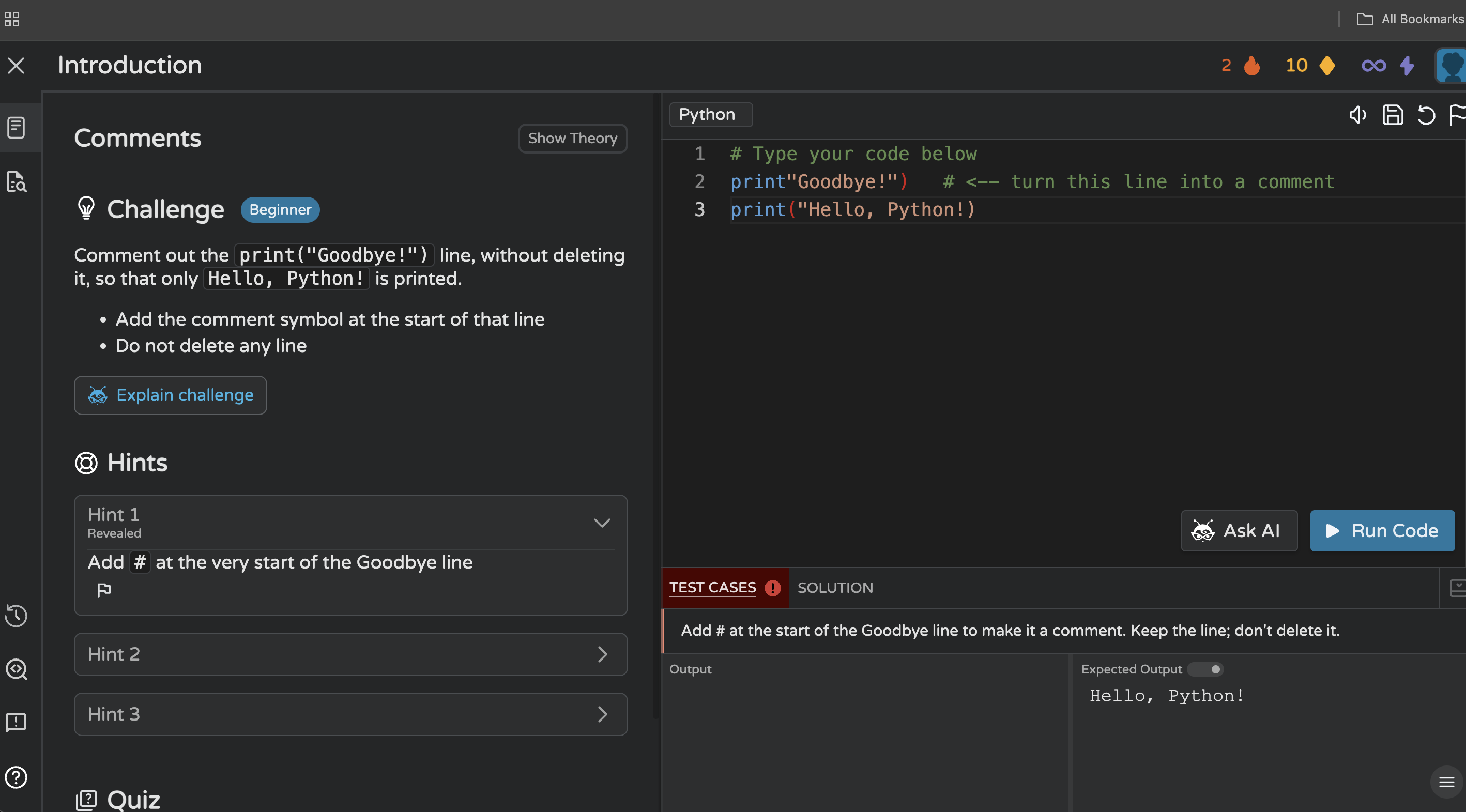
Exploring these concepts within interactive platforms such as Coddy.tech reveals how progressive feedback loops operate in practice. Beginners tackling straightforward challenges—such as inserting a line comment to disable a print statement without deleting code—encounter multiple layers of feedback before ever invoking an artificial intelligence tutor.
In these environments, browser-based editors are surrounded by comprehensive support systems, including explicit exercise requirements, test results, expected outputs, progressive hints, and integrated artificial intelligence tutors like Bugsy. When a user introduces faulty code, the platform often provides immediate test feedback that connects failures directly to the underlying rules of the exercise. This design ensures learners evaluate whether their implementation satisfies required behavioral standards, rather than simply checking if a script executes successfully.
Progressive hint systems further reinforce this structure. Instead of jumping from failure to a complete solution, learners can step through increasingly specific hints. When artificial intelligence is introduced into this mix, advanced tutors demonstrate the ability to analyze both the broader educational objective and the specific syntax errors present in the user’s workspace, addressing issues that extend beyond the immediate scope of the current lesson.
The Trade-Offs of Automated Assistance
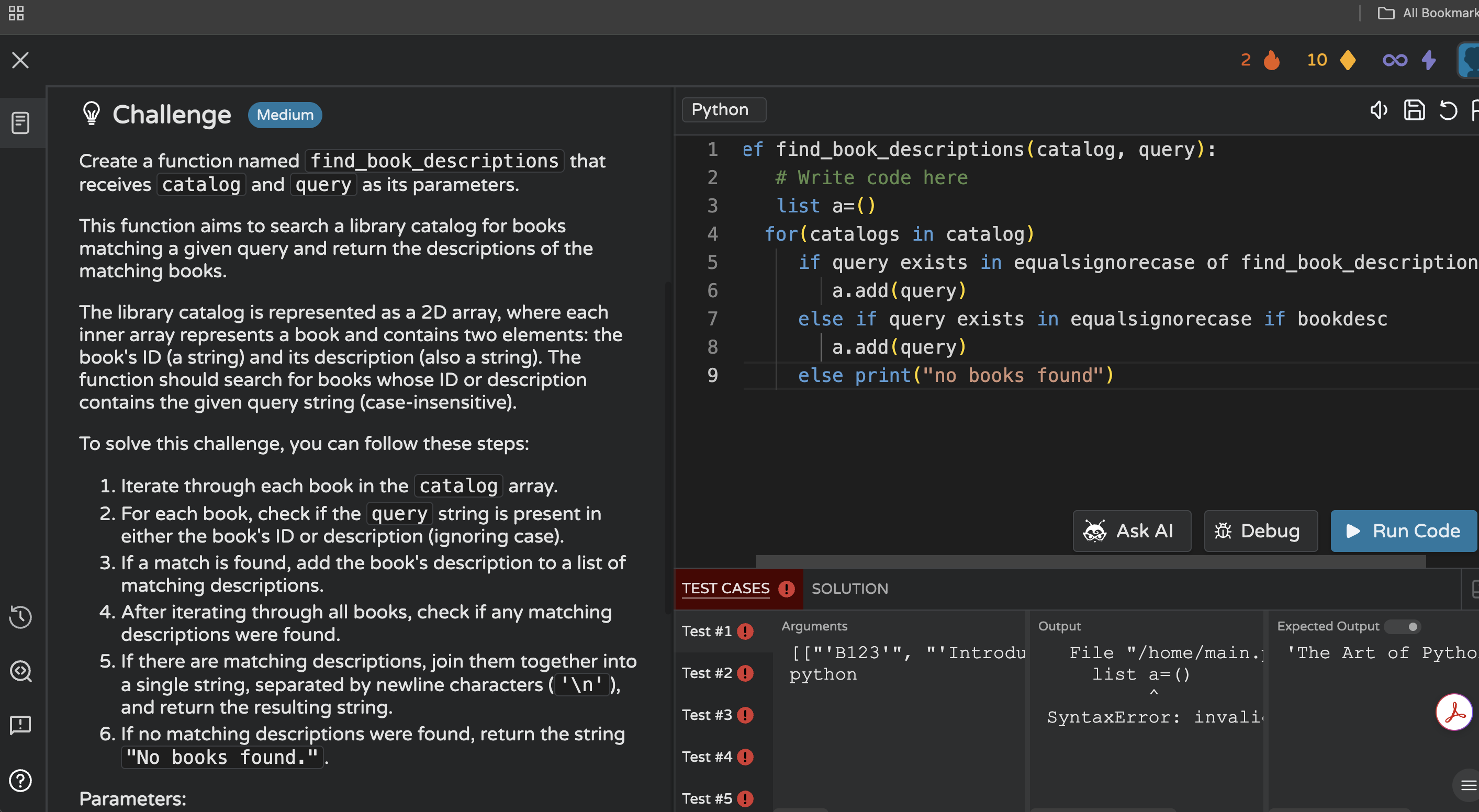
As challenges grow more complex, such as implementing search routines across multi-dimensional data catalogs, the limitations of unconstrained artificial intelligence become apparent. In more advanced scenarios, automated tutors often transition from offering conceptual guidance to laying out detailed implementation structures.
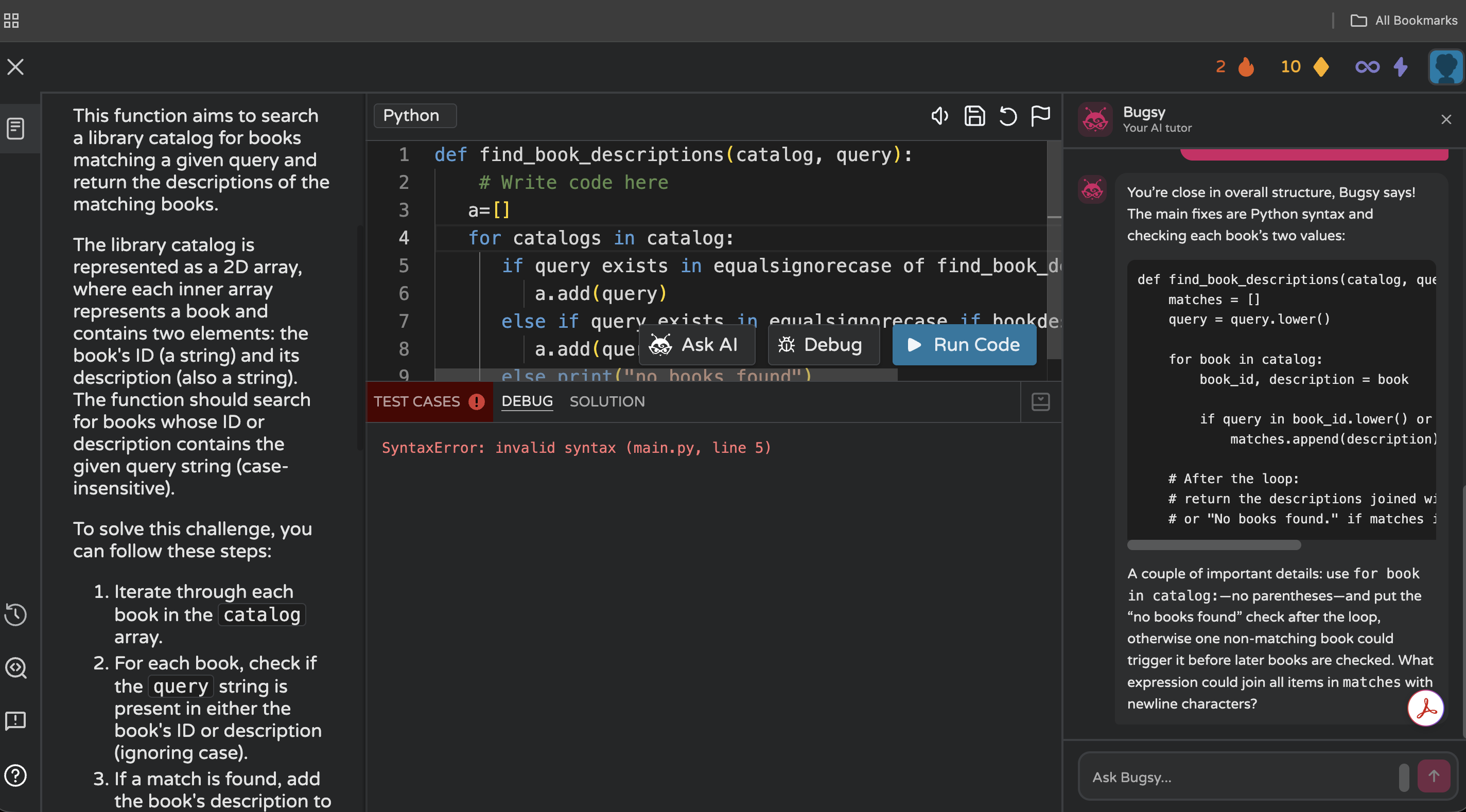
For experienced software engineers working under tight deadlines, rapid code generation is a welcome productivity multiplier. However, for students mastering fundamental concepts, excessive information can undermine the learning process. This creates a core conflict for artificial intelligence developers: balancing the desire to help the learner succeed with the pedagogical necessity of preserving enough difficulty to stimulate critical thinking.
Because different users require different levels of support, the ideal interaction model should not default to a one-size-fits-all correction. Asking developers whether they prefer a hint, an explanation, or a direct code solution shifts the dynamic, transforming the artificial intelligence from an oracle into a collaborative mentor.
Evaluating Coding Assistants Beyond Correctness
Traditional evaluations of coding software focus heavily on whether a tool generates correct code. However, assessing systems intended for education demands a broader set of test cases, including how they handle syntax errors, runtime failures, subtle logic flaws, boundary conditions, and alternative valid implementations.
A sophisticated learning assistant must also recognize correct code when it sees it. If a developer asks for help on an implementation that already satisfies the requirements, a poorly designed assistant might suggest unnecessary changes simply to produce output. A robust system, by contrast, recognizes that no intervention is required and validates the developer’s work.
Similarly, programming problems rarely have a single correct solution. Different developers may implement the exact same logic using distinct, equally valid syntactic structures. An effective educational assistant must distinguish between code that is genuinely incorrect and code that simply differs from a reference solution. Furthermore, when faced with repeated failures from the same user, the assistant must adapt its responses, offering increasingly specific guidance rather than repeating identical explanations or instantly revealing the answer.
Ultimately, the most valuable artificial intelligence coding assistants are those that recognize when withholding code is more beneficial than generating it. By fostering an environment centered on context, diagnosis, progressive hints, verification, and explanation, educational technology can help developers transition from feeling frustrated that their code does not work to understanding precisely why it failed.