The global notebook computer market is bracing for a challenging year ahead. According to the latest industry research published this week by the market intelligence firm TrendForce, global notebook shipments are projected to face a decline in 2027. While the initial forecast suggests a modest contraction in the low-single-digit percentage range, the ultimate performance of the sector will be heavily contingent on how manufacturers navigate a complex landscape of rising component costs and shifting consumer demand.
Brands Face Difficult Trade-offs
For years, the notebook industry has been defined by a constant balancing act between innovation, performance, and pricing. However, as we look toward 2027, the primary risk profile for the market is undergoing a significant transformation. The industry is pivoting away from the supply chain constraints that dominated the post-pandemic era, shifting its focus toward the macroeconomic pressures of rising component costs.
TrendForce’s comprehensive analysis suggests that manufacturers are now entering a period where they must make difficult strategic decisions. The core of this issue lies in the bill of materials (BOM). In the third quarter of 2026, research indicated that approximately 68% of the total component cost for a typical, mainstream notebook—specifically those with a manufacturer’s suggested retail price (MSRP) of around $900—was comprised entirely of three key pillars: the Central Processing Unit (CPU), DRAM, and SSD storage.


With these three critical components occupying such a dominant share of the manufacturing cost, any upward movement in their pricing creates a direct ripple effect through the entire supply chain. As lower-cost inventories that were accumulated during previous quarters are gradually depleted, brands will find themselves with less room to maneuver. They will effectively be forced to choose between three suboptimal paths: passing the increased costs onto the consumer through higher retail prices, absorbing the financial hit at the expense of their gross profit margins, or potentially downgrading component specifications to keep price points stable—a move that could undermine their competitive standing in a demanding market.
The Impact of Elevated Component Costs
The potential for a high-single-digit shipment decline in 2027 is directly tied to the pricing trajectory of key hardware components. If DRAM and CPU prices remain persistently elevated, manufacturers will find it increasingly difficult to avoid passing those costs down to the retail level.
The economic theory here is straightforward but perilous for the industry: higher retail prices typically act as a deterrent to consumer spending, particularly in a market that has already seen a significant influx of new hardware. When prices rise, consumers tend to extend their replacement cycles, holding onto their existing machines for longer rather than opting for a timely upgrade. This behavioral shift is exactly what leads analysts to project a more significant, high-single-digit decline in shipments should cost pressures continue to mount.
The situation is further complicated by the current state of component availability. TrendForce notes that the DRAM market is likely to remain tight throughout the coming year. This sustained pressure is largely driven by the insatiable, AI-related demand for high-performance memory. As artificial intelligence integration becomes a standard feature across the PC landscape, the competition for DRAM resources is intense, and the PC sector specifically faces the risk of limited supply growth.
Conversely, there is a glimmer of optimism regarding NAND Flash technology. Analysts expect the supply constraints currently plaguing the NAND market to begin easing by the second half of 2027, as new production capacity finally comes online. While this may provide some relief for the SSD portion of the BOM, it may not be enough to offset the broader, more systemic cost pressures facing the industry in the first half of the year.
Evaluating the 2026 Context
To understand the outlook for 2027, one must first look at the foundation laid in 2026. Last year, the notebook market benefited from a confluence of favorable factors that helped buoy shipment numbers. The year was characterized by significantly improved CPU availability, which allowed manufacturers to meet orders that had been backlogged for months. Additionally, there was a strategic push toward early purchasing by major brands, combined with a wave of replacement demand that had been held over from earlier, more constrained periods.

This surge of activity in 2026, however, has effectively "borrowed" from the future. Because many of the purchases that would have naturally occurred in the latter half of 2026 and the beginning of 2027 were pulled forward into earlier cycles, the natural replacement momentum for the coming year is expected to be weaker. The market is currently dealing with the after-effects of that artificial acceleration, leaving manufacturers in a position where they must contend with both reduced demand and higher cost structures simultaneously.
As TrendForce explicitly notes in its research, it is highly unlikely that brands will be able to maintain their current trifecta of pricing, specifications, and profitability throughout 2027. The extent to which they choose to prioritize one over the others will be the defining factor for the industry’s health over the next twelve months.
Shifting Production Geographies
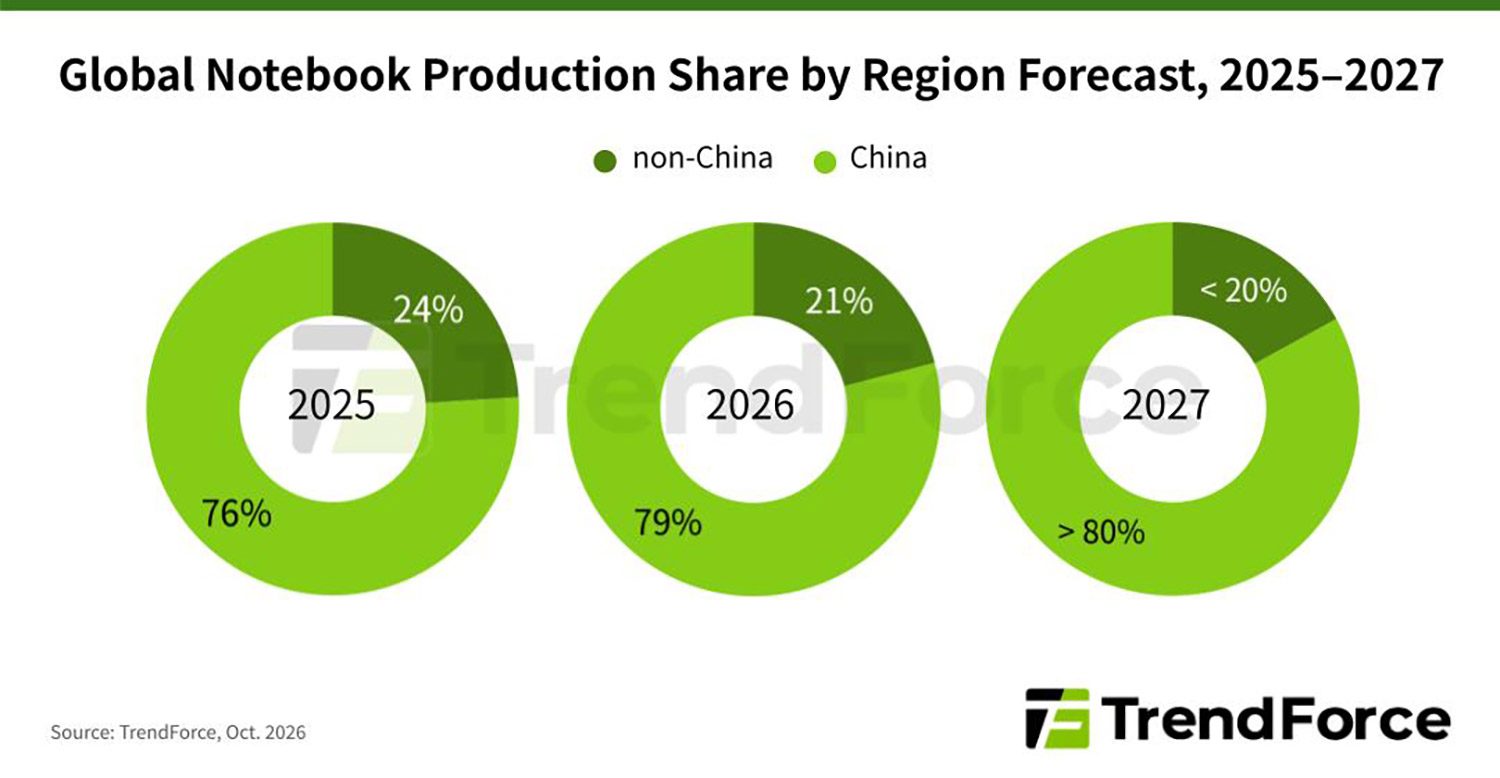
Amidst these financial and logistical challenges, the industry is also navigating the complex waters of global trade and production. The geographical distribution of notebook manufacturing is showing signs of consolidation. TrendForce estimates that China’s share of global notebook production, which sat at 76% in 2025, rose to 79% in 2026. Projections suggest this trend could continue, potentially pushing that figure past the 80% threshold in 2027.

This shift back toward Chinese production hubs is largely viewed as a tactical maneuver to mitigate rising costs. By centralizing production in regions with established, high-efficiency manufacturing ecosystems, brands are attempting to claw back some of the margins lost to the rising costs of CPUs and DRAM. However, this strategy is entirely dependent on the global political climate. The report notes that this trajectory assumes no significant escalation in tariff pressures. Should trade policies shift or new international tariffs be introduced, the cost-saving benefits of moving production could be negated, forcing brands to re-evaluate their global footprint once again.
As the industry moves deeper into the year, the interplay between AI-driven memory demand, CPU pricing, and consumer price sensitivity will serve as the primary barometer for the health of the notebook market. For now, manufacturers are playing a defensive game, carefully managing their inventory and pricing strategies to survive what promises to be a year defined by tough choices and a cooling market. Investors and industry observers alike will be watching closely to see which brands prove most resilient in the face of these tightening margins.