




Knowledge transfer has formed the bedrock of human progress since long before the invention of writing in ancient Mesopotamia. Long before historical records, laws, myths, and scientific observations were committed to paper or stone, human societies relied entirely on oral traditions. Information was passed down through generations via storytelling, folktales, and direct instruction. As civilization evolved, this transfer of knowledge became more formalized through the timeless relationship between teacher and student. History is replete with such intellectual lineages: Jesus mentoring his twelve disciples, Socrates instructing Plato, and Plato establishing an academy in Athens where he spent two decades teaching Aristotle, who in turn revolutionized science, logic, and politics.
In the twenty-first century, this lineage of mentorship finds a parallel in the development of deep learning artificial intelligence. Even during the twentieth-century periods known as AI winters—when widespread skepticism led many researchers to dismiss neural networks as a historical dead end—this teacher-student lineage sustained momentum within the field. Geoffrey Hinton, widely regarded as a foundational figure in modern artificial intelligence, operated a laboratory that nurtured pioneering researchers such as Yann LeCun, who later invented the convolutional neural network, and Ilya Sutskever, who went on to co-found OpenAI before launching Safe Superintelligence Inc.
While human-to-human knowledge transfer remains universally understood, the artificial intelligence community has increasingly turned its focus toward an analogous paradigm operating entirely between machines: model distillation.

Model distillation, frequently referred to as knowledge distillation, is an advanced compression technique designed to transfer the learned behaviors, predictive capabilities, and generalizable intelligence of a large, highly accurate artificial intelligence model into a smaller, computationally efficient model. This smaller network, traditionally designated as the student, learns to closely mimic the outputs and behaviors of a larger, vastly more complex network known as the teacher. The overarching objective is for the student model to achieve a level of predictive performance that rivals the teacher while operating with a significantly reduced parameter count, thereby making the model vastly more practical and cost-effective for real-world deployment.
The Growing Necessity of Model Distillation
The economic and computational pressures driving modern artificial intelligence development have made model distillation an indispensable tool for engineers and researchers alike. Contemporary frontier models, spanning both closed-source and open-source ecosystems, are routinely trained on datasets comprising trillions of parameters. These internal configuration variables are adjusted automatically during training to recognize complex patterns, but their sheer volume creates immense operational hurdles.
Deploying and running these massive models requires substantial financial investment, specialized hardware infrastructure, and tremendous energy consumption. For organizations operating outside the tech sector or lacking massive venture capital funding, running these multi-billion-parameter systems locally or at scale is often economically unfeasible. Model distillation addresses this challenge directly by compressing the accumulated wisdom of massive frontier models into compact, agile architectures. By leveraging distillation, organizations can capture much of the performance of a heavyweight model within a footprint small enough to run on edge devices, mobile phones, and consumer-grade hardware.
Core Techniques in Knowledge Distillation
The specific distillation methodology deployed by a developer depends heavily on the precise nature of the knowledge being transferred from the teacher to the student. While some approaches focus exclusively on the final predictive outputs of the larger model, others seek to replicate internal representations, attention mechanisms, or the broader behavioral dynamics of the network.
Response-based distillation represents the classic teacher-student paradigm originally popularized by Geoffrey Hinton. To understand this approach, developers must distinguish between hard labels and soft labels. Hard labels enforce strict, binary categorical targets. When an image of a dog is fed into a classifier using hard labels, the correct answer is designated definitively as a dog with a value of one, while cats and horses receive values of zero. The model receives no indication regarding the degree of similarity between the target class and alternative classes.
In contrast, soft labels incorporate probabilistic nuance. When evaluated against soft labels, the same image might yield a prediction indicating an eighty-five percent probability of being a dog, a ten percent probability of resembling a cat, and a five percent probability of sharing features with a horse. This surplus of probabilistic information is frequently termed dark knowledge. In response-based distillation, the student model is trained not merely on the correct ground-truth labels, but on these rich probability distributions generated by the teacher. Consequently, the smaller network learns to absorb subtle relational patterns between classes, allowing it to punch significantly above its weight class in terms of accuracy.
While response-based distillation is computationally stable and straightforward to implement—particularly for image classification tasks—it possesses notable limitations. Chief among these is its black-box nature. Because the student model only examines the final output layer of the teacher, it learns what conclusions the teacher reached, but it remains entirely blind to the internal reasoning processes and intermediate features that led to those conclusions.
To address these limitations, researchers developed feature-based distillation. This technique focuses on transferring the internal feature representations and hidden layer activations of the larger model rather than restricting the transfer to final outputs. Using mathematical frameworks such as mean squared error, the student model is penalized during training if its internal feature maps diverge from those of the teacher network. While this forces the student to adopt the precise cognitive pathways and feature extraction mechanics of its tutor, it introduces significant computational overhead, as the student must continuously process and store internal activation maps across every training iteration.
Attention distillation offers a specialized variation tailored for transformer architectures. Rather than attempting to replicate every neuron or internal activation map, the student model observes where the larger network allocates its computational focus. In transformer models, attention maps highlight which specific input tokens or contextual regions carry the greatest weight when generating predictions. By training the student to reproduce these attention distributions, engineers teach the smaller model precisely where to look when resolving complex queries. However, calculating the divergence metrics required to match massive attention tensors across models can consume substantial hardware resources and extend training durations.
Self-distillation represents another viable strategy, wherein a single network transfers knowledge internally from earlier architectural layers or previous training checkpoints to later iterations. This allows a model to refine its own performance progressively without incurring the heavy hardware costs associated with maintaining a separate, massive teacher network.
Practical Implementation and Experimental Evaluation
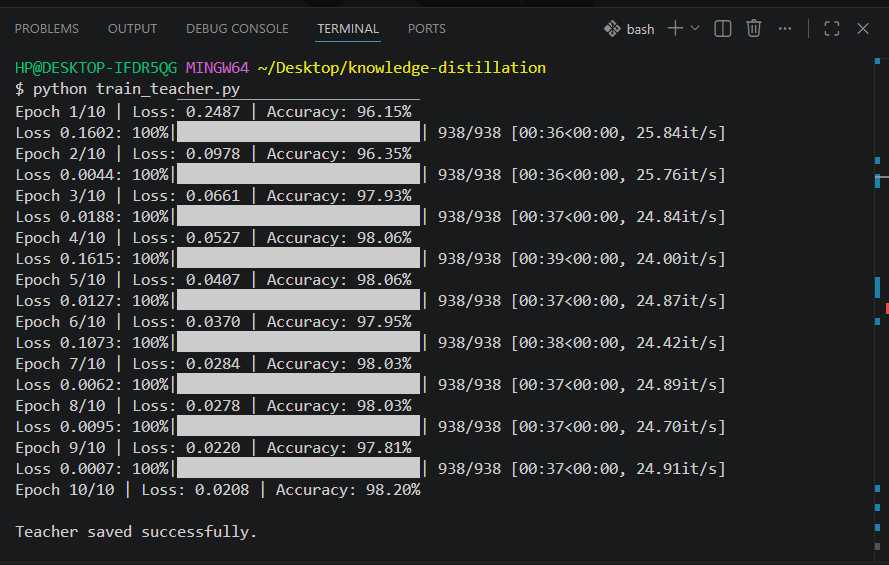
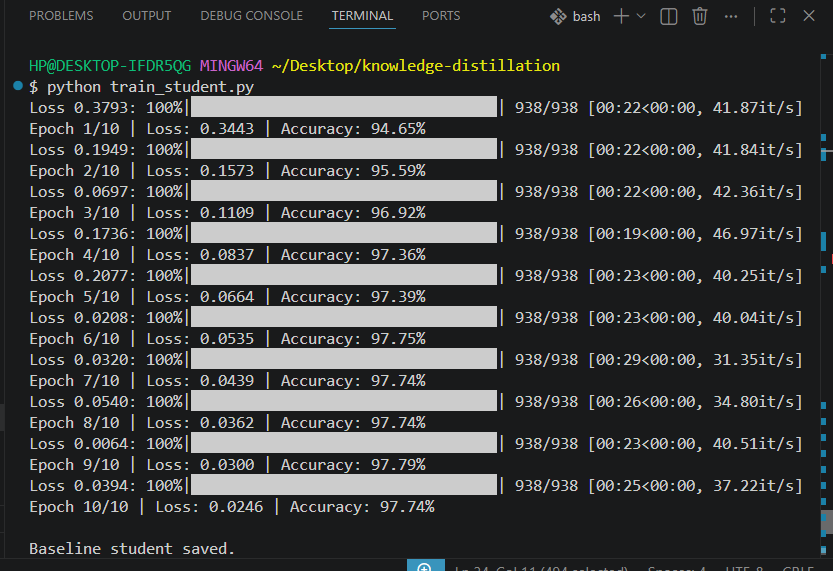
To demonstrate the efficacy of knowledge distillation in a practical environment, developers frequently turn to standardized benchmarks such as the MNIST dataset of handwritten digits, which contains seventy thousand grayscale images. In a typical experimental workflow, engineers first train a high-capacity teacher network—such as a multi-layer perceptron featuring over a thousand hidden units per layer—using standard cross-entropy loss against the dataset. Once training is complete, the weights of the teacher network are frozen.
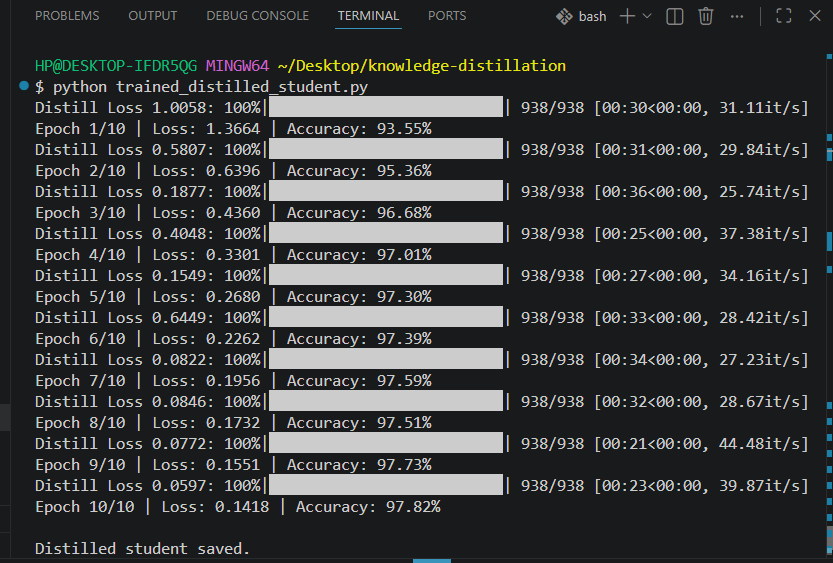
A separate, significantly smaller student network—featuring a fraction of the parameters found in the teacher—is then trained using a combined loss function that integrates both traditional hard labels and soft targets derived from the frozen teacher via temperature-scaled softmax distributions. When evaluated on identical test sets, baseline student models trained without teacher guidance typically achieve strong performance, but distilled student models consistently bridge the performance gap, closely tracking or matching the accuracy of the much larger teacher network while utilizing drastically fewer computational resources.
Alternative Approaches to Model Size Reduction
Model distillation is just one of several methodologies utilized by modern developers seeking to mitigate the latency, memory footprints, and computational costs associated with large-scale deep learning models.
Quantization achieves efficiency by reducing the numerical precision—measured in bit-width—used to store the weights and activations of a neural network. By converting standard thirty-two-bit floating-point numbers into lower-bit formats, quantization can reduce a model’s file size by up to seventy-five percent while targeting memory bandwidth bottlenecks rather than altering the underlying network architecture. To use a publishing analogy, if distillation functions by summarizing a textbook into a concise guide, quantization functions by printing the exact same text using a compressed, highly efficient layout to save paper and ink.
Pruning operates on the premise that large artificial intelligence models often contain redundant, low-impact parameters that contribute minimally to overall performance. By systematically identifying and removing these weak connections, engineers can produce smaller, faster models. Continuing the publishing analogy, pruning is equivalent to going through a textbook and removing chapters or pages deemed non-essential to the core subject matter.
Low-rank factorization utilizes linear algebra to simplify the complex matrix multiplications that dominate deep learning architectures, effectively rewriting complex operations into streamlined mathematical equivalents.
Ultimately, the choice of optimization technique depends heavily on the specific engineering bottleneck at hand. Quantization is generally favored for resolving strict memory constraints, whereas pruning and knowledge distillation are engineered specifically to accelerate computation times and enhance deployment feasibility on resource-constrained hardware.