








For data professionals, the modern web browser functions as an immersive digital workspace. Over the course of a single afternoon, a practitioner might pivot seamlessly from technical documentation and academic research papers to model cards, GitHub repositories, and sprawling industry reports. In recent years, artificial intelligence assistants have integrated themselves firmly into this daily rhythm, offering rapid summaries and real-time coding support. Yet, this productivity boost has quietly carried a hidden privacy tax.
Popular tools like Chrome paired with Gemini, standalone platforms like Perplexity, or ChatGPT accessed via pinned browser tabs offer immense utility, but their underlying data handling policies often conflict with the rigorous security demands of enterprise and research environments. Consumer-facing implementations of Gemini may utilize conversational inputs to refine Google services, with select interactions subject to human review. Perplexity routes active queries and page content directly through cloud-based servers for processing. Meanwhile, ChatGPT standardly incorporates user prompts into its model training pipelines unless users manually opt out.
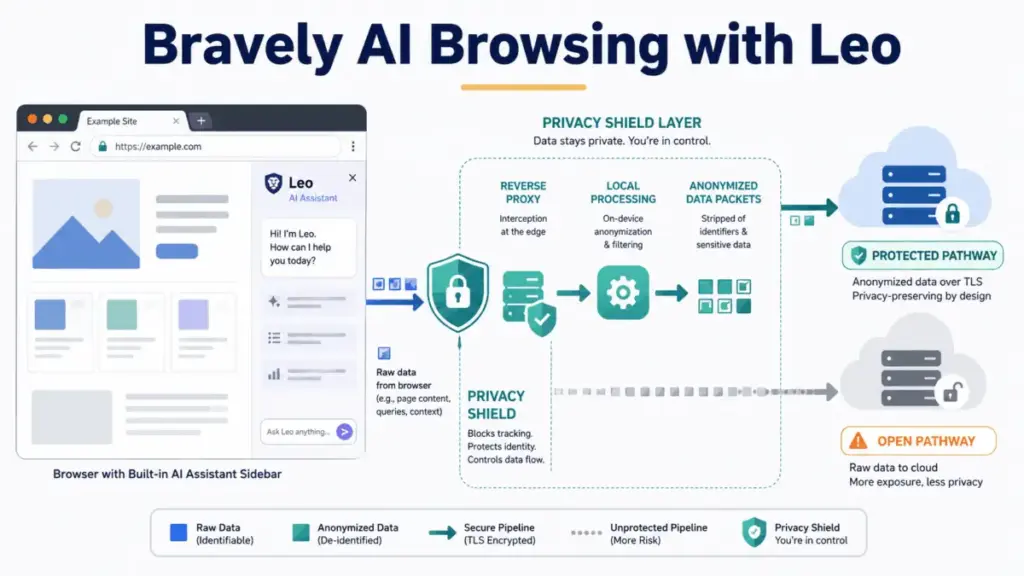
While these tradeoffs remain acceptable for casual browsing or public-domain inquiries, they pose significant risks for data professionals handling proprietary corporate datasets, confidential client research, unreleased model architectures, or sensitive business intelligence. Enter Brave Leo, an alternative privacy-first AI assistant embedded natively within the Brave browser architecture. Rather than operating as a fragmented third-party extension or a separate tab, Leo functions as an integrated sidebar capable of analyzing active web content in real time, all without storing, logging, or utilizing user inputs for machine learning training.

Understanding the Privacy Architecture of Browser AI
To appreciate why privacy-centric browsing tools are gaining traction among technical workers, it is necessary to examine the structural differences in how mainstream AI tools process information. When utilizing Chrome’s Gemini integration, Google’s documentation explicitly advises users to withhold sensitive information that they would not want human reviewers to inspect. Furthermore, foundational local models like Gemini Nano are frequently downloaded automatically to local devices in the background, sometimes without explicit consent, while consumer-tier inputs remain vulnerable to default model improvement practices.
Similarly, platforms like Perplexity offer robust research capabilities backed by precise citations, making them a favorite for exploratory academic work. However, they rely fundamentally on a cloud-first infrastructure where user queries and visited page content leave the local machine entirely. While Apple’s Intelligence suite within Safari offers strong on-device privacy protections, its hardware-locked ecosystem excludes the substantial portion of data professionals operating on Windows or Linux environments.
Brave Leo approaches this architectural challenge through a fundamentally different model. All user queries are routed through a specialized reverse proxy that strips identifying IP addresses before requests ever reach the underlying large language models. Furthermore, conversation logs are discarded immediately once a response is generated, ensuring that no data persists on Brave’s corporate servers. No user account is required to access the free tier, and no inputs are leveraged for training purposes. This uncompromising privacy posture applies universally to both free and paid accounts, allowing professionals to inspect proprietary documentation, analyze internal schema definitions, or dissect unpublished research without leaving a digital footprint.
Integration and Capabilities Across Free and Paid Tiers
Built directly into the Chromium-based Brave browser available across Windows, macOS, Linux, Android, and iOS, Leo offers a low-friction transition for users migrating from other browsers, with bookmarks and extensions importing seamlessly within clicks. Activation is instantaneous via the browser sidebar or toolbar icon, requiring no login credentials for baseline usage.
The free tier of Leo incorporates a competent lineup of open-weight models capable of handling routine daily tasks such as summarizing technical papers, explaining documentation, and answering inquiries regarding open-source codebases. For more advanced professional demands, Brave offers Leo Premium, which unlocks frontier models including Claude Sonnet and DeepSeek R1, alongside elevated rate limits during periods of peak network congestion.
Crucially, upgrading to a paid subscription does not compromise the underlying privacy framework. Brave employs a credential-based tokenization system that deliberately decouples payment details from active chat sessions, ensuring that even paying subscribers remain anonymous to their usage metrics. While premium users are given the option to enable persistent chat history, this feature remains strictly opt-in, preserving maximum privacy by default. Furthermore, the introduction of features like Brave Ocelot—a local-first summarization model that executes inference entirely on local hardware—ensures that sensitive document processing never requires external data transmission.
Core Workflows for Technical Professionals
Leo’s most defining characteristic is its native page-awareness. Unlike standalone conversational chatbots that necessitate manual copying and pasting of text, Leo reads active browser tabs dynamically in real time. This capability streamlines the consumption of dense technical literature, such as arXiv preprints or complex model cards, allowing users to extract evaluation metrics, identify training methodologies, or query known limitations simply by addressing the sidebar directly.
This contextual awareness extends smoothly to PDF documents, Google Docs, and Google Sheets opened natively within the browser environment. Data professionals can interrogate unfamiliar data dictionaries, review proposed research methodologies, or examine dataset schemas without manual extraction. Additionally, Leo can parse the transcripts of web-based video content, enabling practitioners to bypass lengthy technical talks and isolate core experimental setups or conclusions efficiently.
Advanced features introduced across recent development cycles have further expanded these workflows. Multi-tab context allows Leo to synthesize information across several open documents simultaneously, eliminating the need to constantly switch tabs when cross-referencing API documentation against implementation tutorials. Meanwhile, saved prompt chains known as Skills enable users to automate repetitive analytical tasks, transforming the assistant into a customized tool for standardized document review.
Defining the Boundaries of Privacy-First AI
Despite its robust feature set, professional adoption requires a clear-eyed assessment of Leo’s limitations. Unlike cloud-centric research agents designed to crawl the broader web autonomously for real-time developments, Leo operates primarily within the constraints of active tabs and its static training data, making it less suited for rapidly evolving current events. Additionally, Leo does not natively support image generation, features limited voice input options, and lacks cross-session memory unless explicitly configured.
Ultimately, privacy-first AI tools like Brave Leo represent a shifting philosophy in how technical workers manage security in an AI-saturated landscape. By demonstrating that advanced model capabilities can be accessed without sacrificing data confidentiality, tools of this nature provide data professionals with a viable path toward secure, frictionless workflow integration.