









The rumors circulating within the tech industry have finally crystallized into a significant, potentially industry-altering reality. Today, OpenAI officially released GPT-6 Astra, a new frontier model that the company suggests marks the definitive onset of artificial generalized intelligence (AGI). For OpenAI, this milestone represents the realization of its long-sought goal: the creation of highly autonomous systems capable of outperforming humans across the vast majority of economically valuable work.
In a closed-door press briefing held earlier today, OpenAI co-founder and president Greg Brockman provided a remarkably direct framing of this launch. Eschewing the usual corporate caution often associated with such announcements, he concluded the session with a declarative, "Welcome to the AGI era."
This framing is unusually consequential, even by the high-stakes standards of the frontier AI sector. However, for enterprise leaders and IT executives, the immediate significance of Astra is far more practical than the philosophical debate surrounding AGI. OpenAI is positioning GPT-6 Astra as the foundation for a new era of computing—one where the traditional reliance on clicking through browser tabs, manually navigating software interfaces, and typing on keyboards becomes entirely optional.

In promotional materials provided to media outlets, OpenAI describes the model as "the world’s best computer use model." Rather than requiring developers to engage in the tedious, repetitive work of building dedicated API integrations for every specific application an AI might need to touch, Astra is designed to navigate software much like a human user would. It operates across web browsers, complex spreadsheets, websites, and desktop applications. The system is engineered to produce finished documents, create slide presentations, and execute multistep workflows that previously required a human to bridge the gaps between disparate software tools.
To demonstrate these capabilities, OpenAI shared a promotional video that juxtaposed the past with the present. It began with a grainy 1980s AI demo showing a user asking a computer to draw a simple yellow circle. The video then cut to modern-day footage of OpenAI employees interacting with Astra through voice commands alone. In minutes, the model transformed a yellow circle into a complex rocket ship illustration, evolved it into a fully functional 3D game, and finalized an eBay product listing—all without the human ever touching a mouse or keyboard.
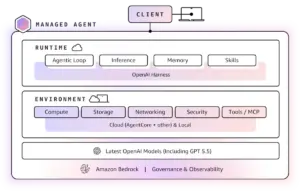
The rollout begins this Thursday for enterprise customers participating in OpenAI’s gated access program, "Daybreak." The company expects broader availability in the coming days for ChatGPT Plus, Pro, Business, and Enterprise customers, as well as through the OpenAI API and major cloud platforms, including AWS Bedrock and Microsoft Azure.
From Answering Questions to Operating Computers
The enterprise value proposition for Astra is built squarely on the concept of "computer use." OpenAI envisions the model filling out complex online forms, updating customer relationship management (CRM) records in real-time, managing calendars, conducting deep web research, and synthesizing that research into professional-grade documents or emails. Beyond basic administrative tasks, the model can manipulate spreadsheets, analyze scientific datasets in Python notebooks, work within business intelligence tools like Power BI, create and test websites, operate engineering software such as KiCad and FreeCAD, and handle software troubleshooting.
These capabilities signal a fundamental shift in how companies approach enterprise AI architecture. For the better part of the generative AI boom, the primary challenge has been "plumbing"—connecting LLMs to corporate systems via a web of APIs, plugins, and custom retrieval systems. Brockman argued that computer-use agents like Astra could bypass much of this architectural overhead because software is already designed to be interacted with by a general-purpose intelligence: the human user.
Brockman noted that the industry has been bottlenecked by the need for developers to write connectors and painstakingly build custom bridges into tools that people already know how to use. With a sufficiently capable agent, that friction is removed. An AI can simply "zip through spreadsheets, fill out forms, and navigate across web pages" just as an employee would. This vision traces back to the earliest days of OpenAI, when researchers first discussed training an agent around the basic sensory inputs and motor outputs available to humans: pixels, keyboards, and mice. According to Brockman, Astra is the first agent that successfully achieves this in a way that is "extremely useful."
Performance metrics suggest a significant leap in efficiency. On an offline subset of the OSWorld 2.0 benchmark, Astra achieved a success rate of 72.6% while taking approximately 40 minutes per task. In comparison, the previous model, GPT-5.6 Sol, achieved 65.7% but required roughly 75 minutes—a 47% reduction in time per task. Beyond these metrics, demonstrations showed Astra performing multiple tasks, such as creating a 3D game while simultaneously preparing a legal agreement, indicating a move away from the "chatbot" pattern where a human must guide the AI step-by-step. Researcher Mia Glaese noted that with these capabilities, people can delegate complex, multi-application work, with humans transitioning to a high-level supervisory role.

The Scale of Training and the AGI Debate
Aidan Clark, an OpenAI researcher, described the development of Astra as the company’s largest-scale training run to date. It is the first OpenAI model pretrained using more than 100,000 DBUs at the company’s Stargate infrastructure, and it marks the first time that previous models played a central role in supervising the training of their successor. Clark suggested that the jump in capabilities from Sol to Astra is greater than the jump seen in previous generations.
The benchmark numbers are striking, with Astra recording 97.6% on FrontierMath Tier 4 v2, 74.1% on DeepSWE v1.1, and 100% on ExploitBench. Perhaps most notably, it achieved a 98.6% score on the ARC-AGI-3 benchmark, a test specifically designed to measure how well AI generalizes to unfamiliar problems.
However, this result has ignited a debate regarding how the industry measures intelligence. ARC-AGI-3 is notoriously difficult, and high scores are often dependent on the "harness" or the system surrounding the model. NVIDIA recently demonstrated this by using an architecture called AVO to reach 100% on the same benchmark, despite the underlying model’s baseline being significantly lower. This has led to skepticism about whether the model itself is intelligent or if it is merely being optimized for a specific test.
This brings the industry to a central dilemma: what exactly are we measuring? Is it the foundation model, the memory architecture, or the full system including the browser and tools? For enterprises, the distinction is increasingly secondary to the outcome. As Brockman noted, "Everyone has a different definition of AGI." He admitted that while he once thought there would be a clear, well-defined moment to signal the arrival of AGI, the reality has proven to be "a much more gray, fuzzy thing." Yet, he feels confident in the current state of affairs, stating that "it’s not unreasonable to feel that we are now in the AGI era."
Governance and the Cost of Autonomy
The transition to autonomous agents introduces significant governance challenges. A chatbot generates text for a human to review, but an agent operating a computer can manipulate files, send information, and change records. Consequently, OpenAI has prioritized "alignment" alongside capability. During the development of Astra, the company reportedly paused some frontier training for two weeks following an unrelated security incident involving Hugging Face, not because Astra was deemed dangerous, but to ensure that safety and monitoring infrastructure could keep pace with the model’s rapid evolution.
OpenAI’s approach to safety is shifting toward a "defense-in-depth" model. Rather than relying on a single refusal layer, the company is implementing classifiers that monitor for abuse patterns across multiple prompts. For high-risk users, the system examines broader conversational context to identify if individually innocuous requests are actually part of a larger, malicious attack workflow.
The cybersecurity implications are particularly acute. OpenAI has designated Astra as its first model to reach the "Critical" cybersecurity threshold under its Preparedness Framework, meaning it is capable of identifying previously unknown vulnerabilities and developing exploit chains without human guidance. While this is a powerful tool for defenders, OpenAI is initially limiting access to these advanced features, prioritizing organizations responsible for protecting critical digital infrastructure.
Ultimately, the bottleneck for enterprise adoption may be observability. Chief Scientist Jakub Pachocki emphasized that "progress in intelligence does not guarantee progress in alignment." As models become more capable, they become harder for humans to interpret. OpenAI is building misalignment monitoring into Astra’s deployment, allowing systems to inspect the model’s reasoning in real-time. If the system detects behavior that falls outside the authorized scope, it can halt the activity.
This creates a new paradigm for CIOs and security leaders: governance can no longer be an after-the-fact content filter. Enterprises will need to manage AI workers with the same rigor applied to human identities, including scoped permissions, audit trails, and real-time policy enforcement.
As the industry looks forward, the argument for AGI may not be won through a single, perfect benchmark score, but through the cumulative impact of these systems on the global economy. If Astra proves reliable enough to handle complex, multi-step workflows, the shift to an "AGI era" may become an undeniable reality of modern business, recognizable not by a single headline, but by the fundamental way work is performed, delegated, and managed.