








Twenty years ago today, the landscape of global computing underwent a seismic shift that few observers at the time could have fully grasped. With a single, unassuming blog post penned by Jeff Barr, Amazon introduced the world to the Amazon Elastic Compute Cloud (EC2) Beta. At its inception, the service was remarkably straightforward: it provided resizable Linux virtual servers in the cloud, billed on a simple hourly basis. Users had access to a single instance type, the m1.small, and were restricted to a single geographic Region in the United States. While modest by today’s standards, that initial offering proved to be a revolutionary concept, fundamentally altering how businesses, developers, and researchers approach the acquisition and management of computing infrastructure.
The debut of EC2 effectively democratized access to enterprise-grade compute power. Before this moment, companies looking to scale their digital operations were often forced to navigate the complex, capital-intensive, and time-consuming process of procuring, configuring, and maintaining physical server hardware. By abstracting the hardware layer and delivering "compute as a service," Amazon allowed users to spin up capacity in minutes rather than months. This "minimal yet useful" philosophy not only solved an immediate pain point for early adopters but also laid the groundwork for the modern cloud computing era.
Reflecting on the journey in 2021, Jeff Barr chronicled the first fifteen years of EC2, highlighting the pivotal moments and engineering breakthroughs that defined the service’s evolution. Over the last five years, AWS has continued to push the boundaries of what cloud computing can deliver. This period has been marked by a transition toward custom silicon, the integration of specialized hardware for artificial intelligence, and the expansion of EC2 into entirely new form factors that would have been unimaginable to those who participated in the 2006 beta.
The Foundations of Scalable Infrastructure
The history of EC2 is a narrative of layering innovation upon innovation to create a robust, reliable, and highly available ecosystem. In his retrospective, Barr identified several key milestones that serve as the foundational building blocks for modern cloud architectures. The introduction of Amazon Elastic Block Store (EBS) in 2008 was a defining moment, providing the persistent block-level storage necessary for running production-grade databases and enterprise applications. This was quickly followed in 2009 by a trifecta of game-changing services: Elastic Load Balancing, Auto Scaling, and Amazon CloudWatch. Together, these tools empowered developers to build applications that could automatically scale in response to traffic fluctuations and maintain high availability without manual intervention.
That same year, the launch of Amazon Virtual Private Cloud (VPC) provided a critical leap forward in enterprise adoption, offering customers the ability to provision logically isolated sections of the AWS cloud. This ensured that organizations could maintain strict control over their networking environment, a prerequisite for moving sensitive workloads into the cloud. As the years progressed, the focus shifted toward optimization and performance. The 2017 unveiling of the AWS Nitro System represented a shift toward a new underlying architecture, enabling faster innovation by offloading virtualization functions to dedicated hardware, thereby enhancing security and performance. This was followed in 2018 by the introduction of AWS Graviton processors—custom-built, Arm-based chips specifically designed to deliver superior price-performance for scale-out workloads.
A Global and Diverse Compute Landscape
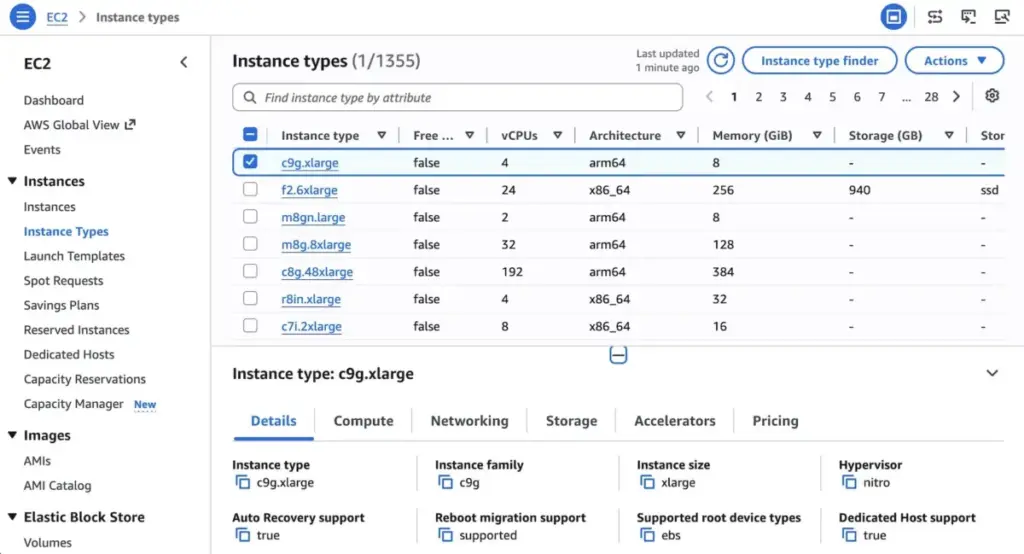
The growth of EC2 over the past two decades has been nothing short of extraordinary. What began as a single instance type has blossomed into a sophisticated portfolio featuring over 1,200 unique instance types. This expansion was driven by the necessity to cater to an increasingly diverse set of customer requirements, ranging from general-purpose computing to memory-optimized, storage-optimized, and accelerated computing for high-performance needs.

This compute power is no longer confined to a single US Region. Today, EC2 is available across 39 Regions globally, ensuring that businesses can deploy their applications closer to their end-users to minimize latency and meet regulatory requirements. Furthermore, AWS has successfully extended the reach of EC2 far beyond the traditional data center. With the introduction of AWS Outposts in 2018, customers gained the ability to run native AWS infrastructure on-premises. The subsequent launch of AWS Local Zones in 2019 brought compute capacity closer to large population centers, while AWS Wavelength integrated EC2 capabilities directly into global 5G telecommunications carrier networks, enabling the development of ultra-low latency applications that rely on the speed of next-generation mobile connectivity.
The Enduring Value Proposition
Despite two decades of rapid technical evolution and an ever-expanding feature set, the core value proposition of Amazon EC2 has remained remarkably consistent. At its heart, the service continues to provide customers with secure, resizable compute capacity that can be provisioned in minutes. The fundamental promise of the cloud—the ability to pay only for what you consume and to scale on demand without the burden of long-term capital commitments—remains as relevant today as it was in 2006.
However, the scale at which this flexibility is applied has changed dramatically. The same elastic principles that once powered simple web servers are now being utilized to train trillion-parameter foundation models and support complex AI workloads that require massive, distributed compute clusters. EC2 acts as the fundamental compute layer for nearly every other service within the AWS ecosystem. Whether a customer is using Amazon ECS or EKS for container orchestration, serverless computing via AWS Lambda or Fargate, large-scale data processing with Amazon EMR, or advanced machine learning through Amazon SageMaker AI and Amazon Bedrock, the underlying infrastructure is built upon EC2 capacity. Every architectural pattern, from a startup’s initial prototype to the global infrastructure of a Fortune 500 company, begins with the decision to launch an instance.
The success of EC2 is a testament to the foresight of the original engineering decisions made in 2006. By building a service that was flexible and extensible, the team left ample room for the platform to grow alongside the needs of its users. The strategy of launching quickly, listening to customer feedback, and iterating rapidly remains the cornerstone of the AWS development philosophy.
As we look toward the future, the next twenty years of cloud computing will undoubtedly demand capabilities that remain in the realm of the unimaginable today. Yet, the history of the last two decades suggests that Amazon EC2 will remain the bedrock upon which these future innovations are built. For those looking to explore the current state of the platform, the Amazon EC2 product page and the "what’s new" section for EC2 continue to serve as the primary sources for tracking the latest advancements in this ongoing journey. Twenty years in, the vision of accessible, elastic, and high-performance computing remains as vital and transformative as ever.