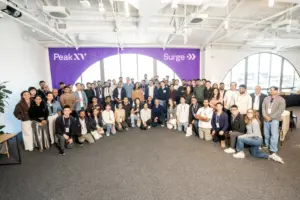












Greek Prime Minister Kyriakos Mitsotakis arrived in San Francisco on Monday night with a mission that transcended the typical parameters of a diplomatic trade visit. While heads of state often arrive in global business capitals with carefully scripted talking points and firm policy declarations, Mitsotakis adopted a strikingly different approach. Standing before an audience of approximately 250 startup founders, venture capitalists, and tech operators at an event hosted by Endeavor Greece—the local chapter of the international nonprofit dedicated to supporting entrepreneurs—the Prime Minister offered a candid admission: he does not have all the answers to the complex, high-stakes questions surrounding artificial intelligence that currently dominate private debates among global leaders.
The Bay Area visit, described by the Prime Minister as a "homecoming" given his own academic roots at Stanford University, served as a multifaceted platform. Beyond the networking and pitch sessions, the trip functioned as a fact-finding mission. Earlier in the day, Mitsotakis had engaged in high-level tours of corporate giants and investment powerhouses, including Tesla and Sequoia Capital. These meetings were designed to build bridges between the Hellenic Republic and the titans of the American technology sector, with the ultimate goal of persuading global companies to establish a presence in Greece.
A Turning Point for the Greek Economy
The timing of this pitch is no coincidence. Greece is currently poised to regain "developed market" status next year according to MSCI, the prominent index provider, a milestone that signals a definitive end to the country’s long-standing reputation as a volatile, high-risk economy. "I think it’s another indication that the economy is doing well and that Greece is no longer treated as a special case," Mitsotakis remarked during his conversation with the event’s moderator.

Mitsotakis leaned heavily into the economic narrative, painting a picture of a nation that has undergone a profound transformation since its harrowing debt crisis. He noted that Greece is currently paying down its sovereign debt at a record pace. In a moment of lighthearted candor that drew smiles from the crowd, he noted that Greece now borrows at a lower cost than the United States. While acknowledging that comparing the two economies is not an apples-to-apples exercise—given the structural influence of the eurozone and differing interest rate environments—the Prime Minister used the comparison to highlight the dramatic shift in market confidence.
As of this week, Greece’s 10-year bond yield hovered around 4.3%, compared to roughly 5% for U.S. Treasuries. This stability stands in stark contrast to the dark days of 2012, when the country’s yields soared past 40%, leaving it on the brink of economic collapse.
Digital Infrastructure and Policy Reform
Beyond debt metrics, the Prime Minister was eager to outline exactly how Greece has deployed its capital to foster a modern, digital-first economy. He highlighted that a significant portion of the roughly €36 billion in funds received from the European Union’s post-COVID recovery package has been funneled into digital infrastructure. This investment has already yielded tangible results, including a streamlined online government portal that allows citizens to manage administrative paperwork without enduring the traditional, time-consuming bureaucracy.

Furthermore, Mitsotakis highlighted a major technological project in the port town of Lavrio. With technical assistance from Hewlett Packard Enterprise, Greece has assembled a new supercomputer slated to come online within the next few months. The machine is intended to act as a catalyst for local scientific research and provide the computational backbone for burgeoning artificial intelligence efforts within the country.
To attract foreign tech investment, the government has enacted a series of policy reforms designed to make Greece a more welcoming environment for business. These include significant adjustments to the taxation of stock options, a relaxation of rigid labor laws to provide companies with more operational flexibility, and the introduction of favorable tax incentives for Greeks returning to the country after living abroad—incentives that remain in place for up to seven years.
The Prime Minister also touched upon the country’s evolving landscape of visa programs, though he was transparent about the limitations of the current system. When pressed on how he measures the efficacy of these programs, he conceded that the government "still has work to do," particularly regarding the processing speed of applications. He also noted a cultural shift in the nation’s public universities, which he argued have historically leaned toward a "radical leftist approach" that viewed corporate engagement with skepticism. He expressed optimism that this mindset is fading as universities increasingly act as incubators for new, high-growth startups.
Navigating the AI Frontier
The conversation shifted to a more somber and reflective tone when the topic turned to the societal impact of artificial intelligence. It was here that Mitsotakis’s lack of a "finished plan" was most apparent, offering a refreshing departure from the standard political rhetoric that usually surrounds emerging technology.
The Prime Minister expressed significant concern regarding the pace of AI development and its influence on future generations. He highlighted Greece’s planned ban on social media for children under 15, set to take effect this coming January. While noting that many other nations are exploring similar legislation, he questioned whether such measures are already insufficient, given the rapid emergence of highly addictive AI-powered chatbots.
"Sometimes I feel that we’re already fighting yesterday’s battle," he remarked. "What does it mean for our kids to grow up with digital companions or boyfriends or girlfriends?"

This caution extended to the classroom. While Greece has experimented with an educational pilot program in partnership with OpenAI—aimed at automating administrative tasks for teachers and potentially offering AI-driven personalized tutoring—the Prime Minister remained wary of the long-term consequences. He stressed that the benefits of such technology are contingent upon ensuring that AI does not replace the fundamental rigor of learning basic skills. He acknowledged the reality that students are already using generative AI to complete their homework, warning that "complacency is a human trait" that could erode the intellectual foundation of the next generation.
Regarding the physical infrastructure of the AI boom, Mitsotakis positioned Greece as a rare outlier. While many nations face significant pushback against the construction of massive data centers due to their voracious appetite for electricity and water, Greece has encountered little public resistance. He pointed to major projects, such as Microsoft’s cluster of data centers near Athens and an AWS initiative to build the country’s largest data center in a former coal-producing region, as evidence that these developments are viewed as vital economic opportunities rather than environmental threats.
Perhaps most notably, the Prime Minister rejected the temptation to act as a prognosticator. He acknowledged that widespread job displacement is inevitable and that no government or society is currently prepared for the velocity of that transition. When asked about the growing movement among tech leaders to pause or slow down the development of frontier models, he expressed agreement with those calling for restraint. "If the people who are building the models are telling us, ‘We’re not really sure exactly what’s happening with these models,’ especially in how they improve themselves," he said, "we need to listen to them."
He concluded by suggesting that while some form of "smart regulation" is an inevitability, and while the United States will ultimately dictate the global framework for that regulation, Greece would be a willing and capable partner in hosting the necessary international dialogue. Reflecting on the nature of humanity in the age of synthetic intelligence—a technology he described as a "form of intelligence that is very quickly exceeding the capacity of the most advanced organ that evolution has ever created"—he argued that the conversation requires more than just technologists. It needs philosophers, historians, and social scientists.
In closing, the Prime Minister gestured toward the philosophical weight of his own nation. Athens, he noted, was the original forum where Socrates once challenged his fellow citizens in the agora to define the characteristics of a just society and a good life. Whether the modern questions currently vexing Silicon Valley will eventually find their answers in the shadow of the Acropolis remains to be seen, but Mitsotakis made it clear that Greece is ready to host the debate.