










Replacing a cumbersome block of JavaScript with a sleek, native CSS feature is one of the most satisfying experiences in modern frontend development. Swapping out a JavaScript ResizeObserver for a modern container query can slash dozens of lines of code from a pull request, leaving a sea of red deletions that easily wins approval before lunch.
However, developer Gabriel Shoyombo has raised a critical concern regarding this trend: while a modern CSS feature can drastically simplify a localized piece of code, it can simultaneously make the wider application significantly harder to reason about. When logic is quietly split between CSS and JavaScript, unforeseen bugs often emerge elsewhere in the system. Shoyombo explored these implications in a follow-up to his previous work on the evolution of intelligent CSS, examining what happens when conditional styles interact with existing codebases without clear coordination.
The core issue is not that modern CSS is inherently problematic, but rather that a native feature only truly reduces complexity when it completely replaces what was there before without disrupting the surrounding ecosystem. Developers frequently fall into the trap of measuring local simplicity while ignoring system complexity. A new CSS rule does not exist in a vacuum; it must coexist with JavaScript, existing component layouts, the CSS Cascade, and the browser’s underlying rendering engine.


This architectural tension mirrors broader industry debates. Recent discussions within the developer community on platforms like Reddit have highlighted a growing philosophical divide regarding frontend complexity. Some engineers argue that modern native features allow developers to achieve outcomes with far less tooling and overhead, cutting through the accidental complexity introduced by heavy frontend frameworks. Others caution that writing less code on paper does not automatically translate to a less complex system in practice, especially when features interact in unexpected ways.
The complications typically manifest in specific scenarios, the first of which involves shared ownership of component behavior. During a migration from JavaScript-driven layout adjustments to CSS container queries, old scripts or helper classes are frequently left behind. For instance, a component might be updated to use a container query for its layout while an old ResizeObserver script or legacy class name survives in a completely different file. When requirements shift—such as updating a breakpoint—developers often modify only the CSS rule they are aware of, leaving orphaned JavaScript logic to create unintended intermediate states that no one explicitly designed.
A second major challenge arises when layout changes cascade unexpectedly. Adopting features like container-type: inline-size communicates to the browser that an element’s children should be allowed to query its width. However, the browser interprets this declaration much more broadly, applying style and inline-size containment. This automatically establishes a new block formatting context, which can drastically alter surrounding layout behaviors. Margins that previously collapsed through the top of a card may suddenly become trapped, floats that once allowed text to wrap may push elements aside entirely, and content-sized components may suddenly collapse to zero width if they lack an explicit contextual size.

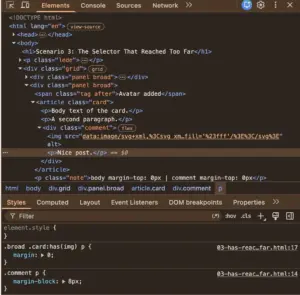
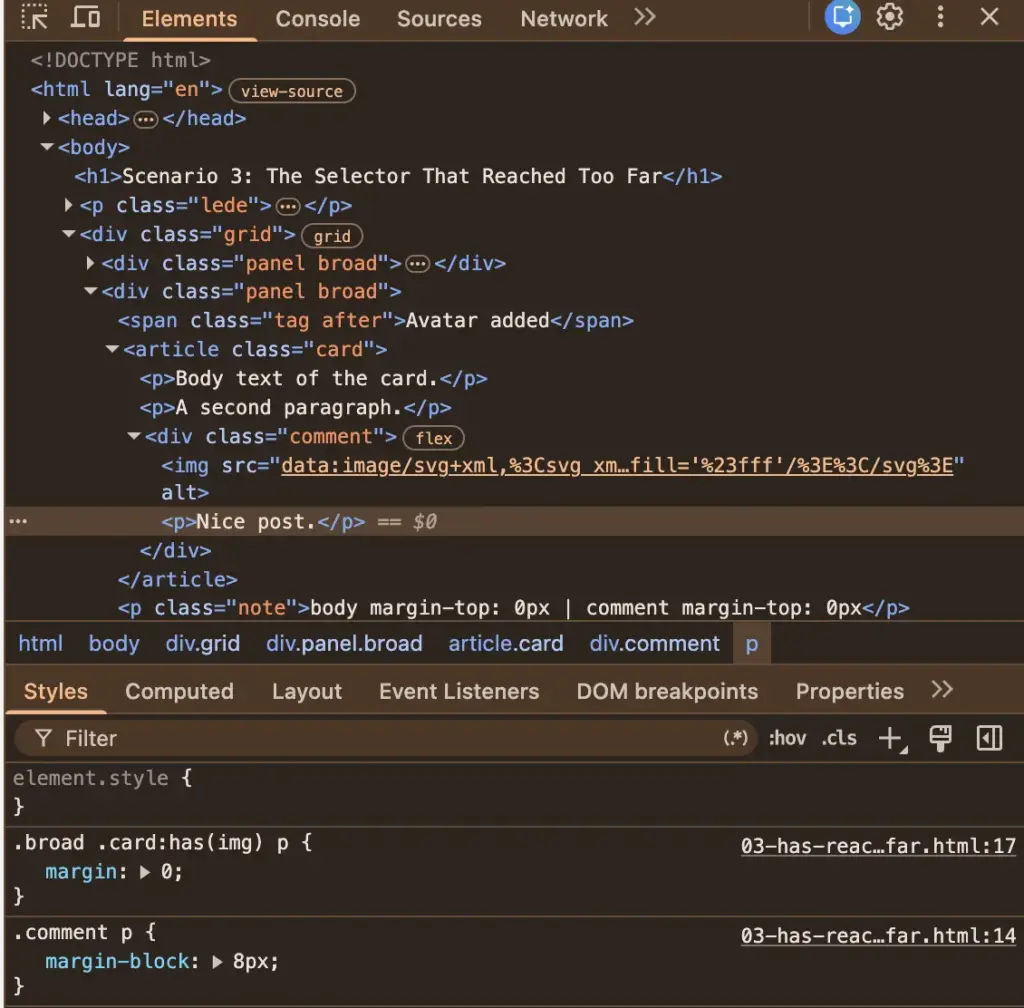
The CSS Cascade introduces a third layer of complexity. Modern additions like the :has() selector and native CSS nesting allow for concise, powerful selectors, but they can easily reach further into a document than intended. A short selector designed to modify a specific card layout can unintentionally override styles deep within unrelated child components if it lacks precise combinator constraints. Similarly, native nesting adopts the highest specificity of its associated selector list, frequently triggering unintended specificity wars that force developers to write increasingly complex overrides or resort to scoping tools like :where(). Furthermore, mixing layered and unlayered stylesheets can produce counterintuitive cascade outcomes that defy standard specificity rules unless every part of the codebase is migrated uniformly.
Performance implications represent the final hurdle in these migrations. It is a common assumption in code reviews that moving a behavior from JavaScript to CSS will automatically yield performance improvements. While browser engines handle layout calculations efficiently, complex queries can still introduce hidden costs. Extensive use of anchor-based selectors like body:has(...) can significantly increase the number of elements the browser must restyle during layout updates. When multiple broad rules interact, the rendering engine may be forced to restyle thousands of elements for a single minor state change, neutralizing the performance gains developers expected to achieve.
Ultimately, these challenges illustrate that the primary friction in modern frontend development rarely stems from greenfield projects, where new features can be applied cleanly from the ground up. Instead, the real test lies in complex codebases undergoing gradual migrations. Shoyombo emphasizes that successfully adopting modern CSS requires rigorous evaluation before merging code—asking critical questions about behavioral ownership, layout containment, cascade specificity, and rendering performance. By treating native CSS features with the same architectural scrutiny given to JavaScript logic, development teams can harness the power of modern styling tools without introducing hidden system complexity.