








As artificial intelligence systems continue to evolve from passive conversational interfaces into active, autonomous agents, the industry has gravitated toward a single acronym: MCP. Constantly mentioned alongside modern coding assistants, specialized agents, and dynamic tool use, the Model Context Protocol has quickly become a cornerstone of modern software development. Yet, while software engineers and data scientists widely recognize the abbreviation, far fewer fully grasp its underlying mechanics or how to deploy it effectively in production environments.
At its core, the Model Context Protocol provides AI applications with a standardized method for connecting with external data sources and execution tools. Historically, developers faced the arduous task of building bespoke, custom integrations for every single application programming interface, database, code repository, or browser environment an AI needed to touch. MCP radically streamlines this workflow by allowing an AI application to connect directly to a standardized server and automatically discover the capabilities it provides, eliminating architectural fragmentation.
While the concept itself is straightforward, the terminology surrounding it can initially create friction. Architectural components such as hosts, clients, servers, tools, resources, and underlying transports can easily make the framework feel more convoluted than it actually is. However, once developers grasp the fundamental operational flow—moving seamlessly from model reasoning to protocol communication, tool execution, and result ingestion—the entire ecosystem becomes significantly easier to architect and reason about.
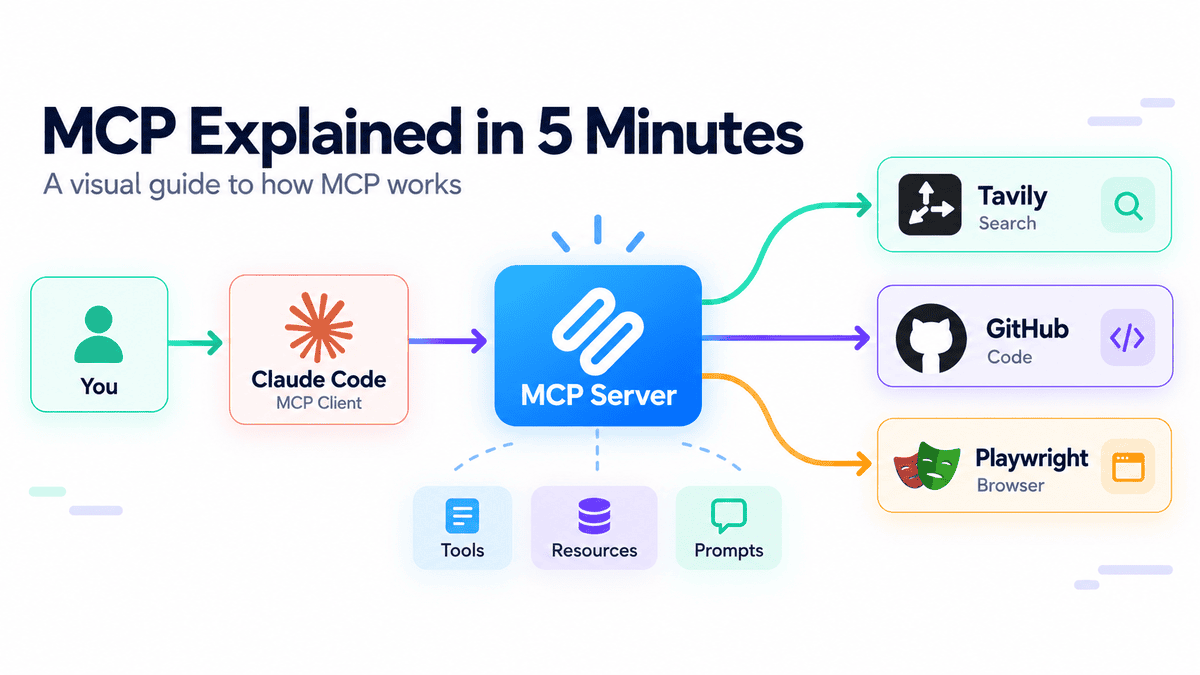
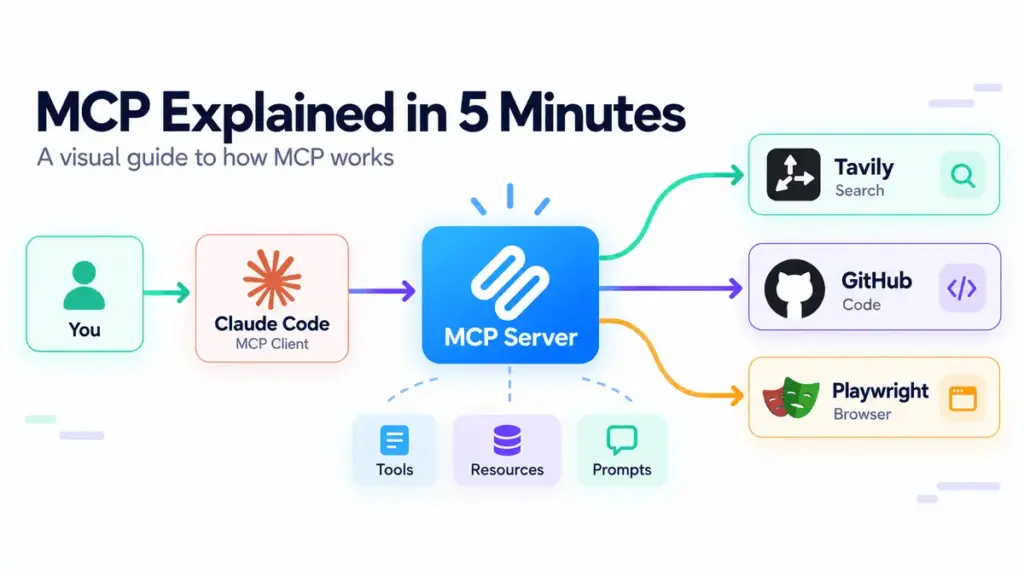
To understand its practical application, consider how advanced development environments like Claude Code leverage MCP. By establishing standardized communication pathways, systems can bridge the gap between static language models and dynamic external environments, ranging from live web search providers and software repositories to full browser automation suites.
What Is the Model Context Protocol?
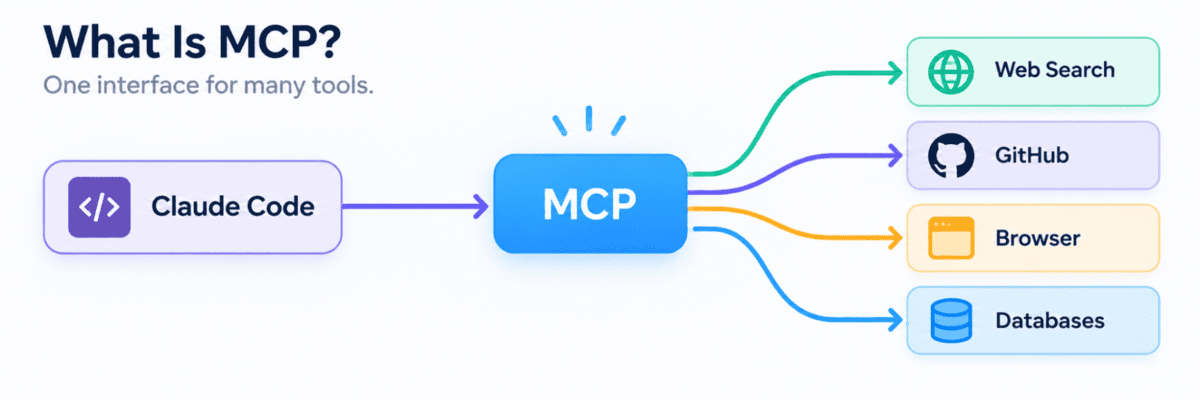
The simplest way to conceptualize the Model Context Protocol is as a universal common language established between an artificial intelligence application and the external tools it aims to utilize. Without a unified protocol, every external service demands a separate, custom integration layer tailored to its specific syntax and security schema. With MCP in place, the AI application communicates with disparate servers through a single, consistent interface.
Crucially, the protocol does not replace existing application programming interfaces. An MCP server typically acts as an intermediary, communicating directly with the underlying API or legacy service on behalf of the AI application. What the protocol successfully standardizes is the way those capabilities are presented, discovered, and invoked by the model.
For the vast majority of autonomous agent workflows, tools represent the most critical dimension of MCP. By exposing executable functions rather than static text, the protocol enables models to transcend simple text generation and actively interact with complex external systems, databases, and continuous integration pipelines.
Architectural Mechanics and Operational Flow
The Model Context Protocol operates on a distinct client-server architecture, though the operational sequence becomes intuitive when viewed as an integrated pipeline. The host environment functions as the primary AI application, such as Claude Code. Within this host, an internal client establishes secure communication channels with one or more servers. These external servers expose specific tools, data resources, or prompt templates tied to external services.
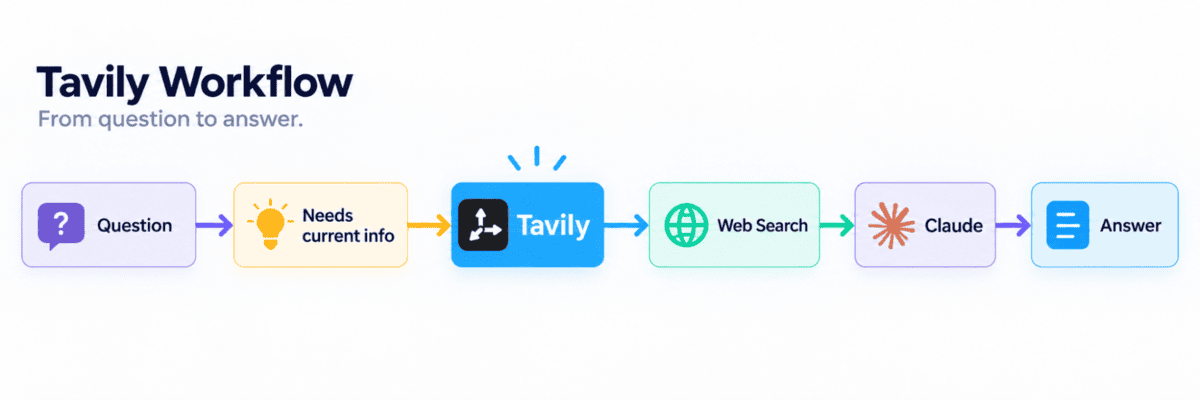
Consider a practical query issued by a developer: searching for the latest software release and summarizing major infrastructure changes. The AI model first evaluates the prompt and determines that the task requires real-time information beyond its static training data. It then inspects the available MCP tools, selects an appropriate web-search function, routes the execution request through the corresponding server, and ingests the returned results.
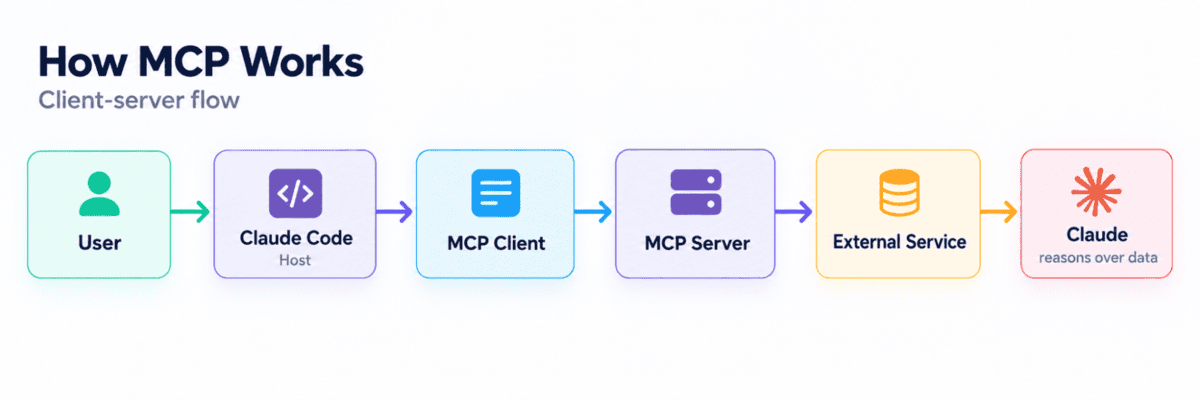
A vital distinction in this architecture is that the protocol itself does not perform any underlying reasoning. The language model retains full responsibility for deciding when a tool is genuinely required and how to process the returned data, while the protocol merely supplies the standardized conduit that makes the tool accessible and discoverable.
Practical Implementations in Development Environments
Modern development environments have begun integrating robust management layers to handle these server connections effortlessly. Engineers can inspect active configurations, add new protocol endpoints, and manage server states directly through integrated command-line interfaces and interactive prompts within their development workspaces.
To cover the most common and powerful agent workflows, developers typically integrate servers dedicated to web research, repository management, and browser automation. For web search and live data retrieval, platforms like Tavily provide AI agents with real-time access to crawling, mapping, and extraction tools. Rather than requiring the model to understand the granular details of a specific search API, the integration allows the application to discover and deploy search tools dynamically based on conversational context.
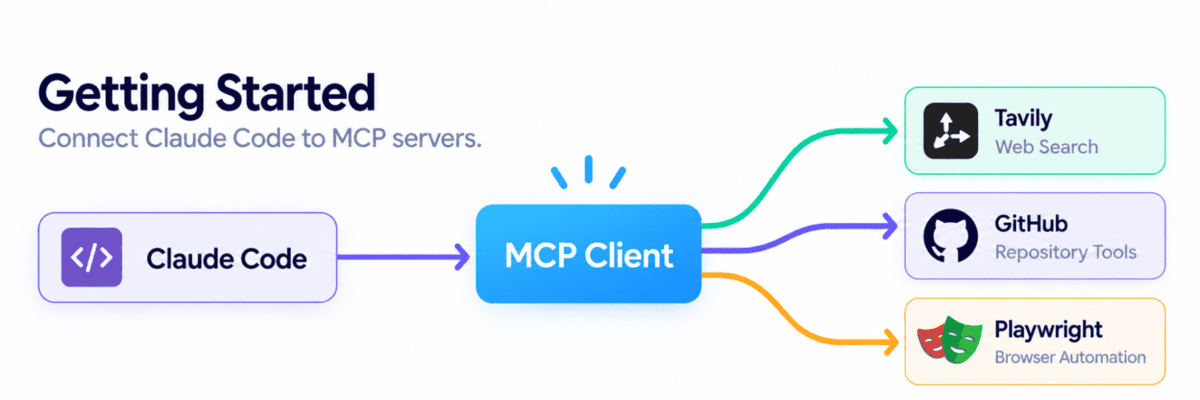
Repository workflows represent another major pillar of protocol adoption. Official server integrations transform platforms like GitHub into direct operational tools for AI assistants. Depending on configured security permissions, an agent can read source code repositories, search through codebases, inspect commit histories, manage issues and pull requests, and analyze continuous integration workflows. Instead of requiring developers to manually copy and paste code snippets, error logs, and issue descriptions into a chat window, the assistant retrieves necessary context autonomously through the protocol when authorized.
For tasks that demand more than traditional API calls, browser automation servers provide critical capabilities. Utilizing engines like Playwright, an AI agent can open web applications, click user interface elements, fill out input forms, navigate complex multi-page workflows, and execute end-to-end testing procedures. These automation servers typically operate using structured accessibility snapshots of web pages, providing the model with a clean, programmatic representation of the interface rather than raw, unstructured HTML.
Recent Architectural Evolutions
Since its initial introduction, the Model Context Protocol has undergone rapid iteration to meet the demands of enterprise-grade deployments. Recent protocol specifications have introduced profound architectural shifts, most notably transitioning the core protocol design to be entirely stateless.
Rather than forcing systems to maintain a persistent, resource-heavy session with a specific server, modern protocol specifications ensure that every individual request contains all the necessary contextual information required to process it independently. This stateless design drastically simplifies the deployment of remote servers across distributed cloud infrastructures and elastic container environments, making horizontal scaling significantly more straightforward.
Furthermore, recent protocol updates have enhanced security controls, streamlined authentication flows, and improved error handling mechanisms. These refinements collectively position the architecture as a mature, enterprise-ready standard for building reliable, production-grade AI agents that can safely interact with corporate systems and external infrastructure.
Conclusion
While the terminology surrounding the Model Context Protocol can initially appear daunting, its fundamental premise remains elegantly simple: providing artificial intelligence applications with a standardized, reliable method for connecting to external tools and data sources. By understanding the core operational flow that links models, protocol clients, servers, and execution tools, developers can construct sophisticated, highly capable AI agents without the burden of building bespoke integrations for every service they encounter. As the ecosystem continues to mature and standardize across the industry, protocol-driven development is poised to become the default standard for human-AI collaboration and automated software engineering.