








Abacus.AI has officially introduced the Smaug series, a new family of three open-weight models specifically fine-tuned for complex, agentic workloads. Publicly available on Hugging Face, the lineup includes Smaug Flash, Smaug Mini, and Smaug Agentic. Each model is built on a distinct open-weight base architecture chosen to cover a different point on the capability-efficiency curve. According to the developers, the primary objective of the release is to address a critical bottleneck in modern artificial intelligence: the tendency of general language models to falter, drift, or exhaust context during extended, multi-step workflows.
The significance of AI agent performance has become a pressing issue for development teams across the technology sector. While a standard conversational chatbot typically provides a response to a single isolated request, an autonomous agent must retain deep contextual awareness and execute decisions based on a continuous chain of related actions. In real-world scenarios, an agent must successfully comprehend a user query, identify and deploy an appropriate tool, analyze the resulting output, and take subsequent corrective or progressive actions.
However, after a number of execution cycles, models frequently veer away from their initial goal, thereby compromising the reliability and credibility of the final output. Abacus.AI encountered these exact operational shortcomings internally, noting that complex agentic tasks often took several hours to complete, maintained massive amounts of context from stage to stage, and frequently required invoking external tools across disparate documents, application programming interfaces, and databases. These operations routinely ran out of steam or failed to complete successfully altogether.


Addressing these challenges led the research team to conclude that making a state-of-the-art model function effectively as a robust agent is fundamentally a training challenge rather than a prompting challenge. General language models, despite their raw capabilities, are rarely optimized for extended operational usage, as prompt caching eventually loses effectiveness and context windows expand. Rather than attempting to compensate for these inherent shortcomings through temporary prompting tricks or external weight adjustments, Abacus.AI pursued a strategy of improving the underlying models directly, culminating in the development of the Smaug model family.
The Smaug Line and Shared Methodology
The Smaug lineup consists of three distinct models built on separate foundational architectures. Smaug Flash is constructed on DeepSeek V4 Flash 0731 and is optimized for always-on enterprise agents prioritizing speed and cost at a scale of 304 billion parameters. Smaug Mini is built on Qwen3.8-27B, standing as a compact, 28-billion-parameter multimodal model designed for efficient, one-off tasks. Smaug Agentic represents the frontier scale of the series, built upon Kimi K3, a massive mixture-of-experts model boasting 2.8 trillion parameters tailored for long-horizon coding and complex operations.
Despite their differing architectures and parameter counts, all three models were subjected to a unified fine-tuning methodology. This shared recipe utilized a combination of human-curated actual agentic operational trails and artificially generated synthetic data grounded in exceptionally challenging examples. The training data was rigorously filtered to remove instances that merely exploited the formal scoring criteria of a benchmark rather than genuinely solving the underlying problem. Consequently, this methodology prioritized authentic problem-solving and reasoning fidelity over superficial format compliance.
Applying a uniform fine-tuning recipe across three vastly different base architectures serves as a broader research claim: that the underlying methodology is robust and general enough to produce consistent, measurable performance improvements regardless of scale or structural design. An examination of the results across the individual models reveals where this claim holds strongest, as well as where notable trade-offs emerge.
Smaug Flash and the Focus on Enterprise Workloads
Smaug Flash delivers the most dramatic benchmark score jumps within the entire Smaug line. As an agentic fine-tune of DeepSeek V4 Flash, the model acts as the operational workhorse designed for continuous enterprise self-improving agents. While the base DeepSeek V4 Flash model is recognized for its speed and cost-effectiveness, it has historically been susceptible to confusion and cyclical errors during long-context tool utilization. The fine-tuning process was specifically targeted at mitigating this failure mode.
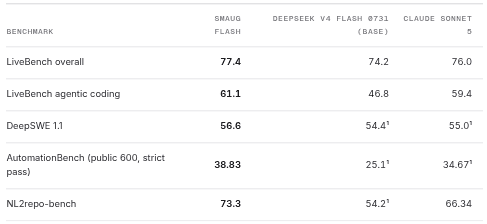
The results on LiveBench highlight the precision of this intervention. Smaug Flash achieved a notable 14.3-point gain in agentic coding, moving from 46.8 up to 61.1, marking the single largest category delta across the entire Smaug series. Furthermore, its score on AutomationBench improved by 13.7 points, rising from 25.1 to 38.83, while its performance on NL2Repo-Bench saw a 19-point increase, climbing from 54.2 to 73.3. These substantial jumps reflect the model closing a genuine capability gap precisely within the automated workflows for which it was engineered.
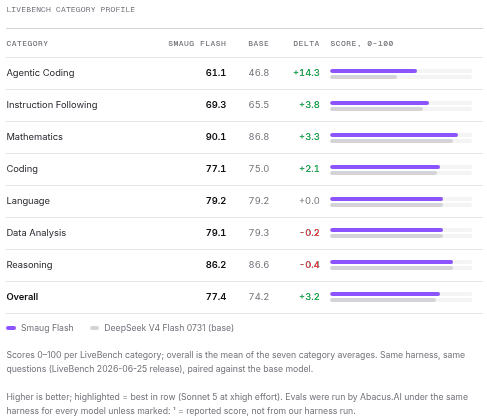
A closer look at the category breakdown reveals modest reductions in Data Analysis and Reasoning, dropping by 0.2 and 0.4 points, respectively. Developers behind the project suggest these minor dips represent an acceptable trade-off, given that honing production-critical skills—such as accurate tool execution and long-context processing—carries far more operational weight than preserving unadjusted general reasoning scores. Across benchmark evaluations measuring these targeted production capabilities, Smaug Flash outperforms competing proprietary systems such as Claude Sonnet 5.
Smaug Mini and the Nuances of Smaller-Scale Multimodal Tasks
Smaug Mini represents an advanced iteration of the Qwen3.8-27B model, serving as the smaller-scale option in the series. Tailored for multimodal applications including image and video interpretation, complex instruction following, and tool utilization, its 28-billion-parameter footprint allows for significantly easier deployment across varied hardware and inference configurations. Notably, Smaug Mini frequently achieves performance levels that surpass several advanced closed-source frontier models in benchmarks where those proprietary systems traditionally excel.
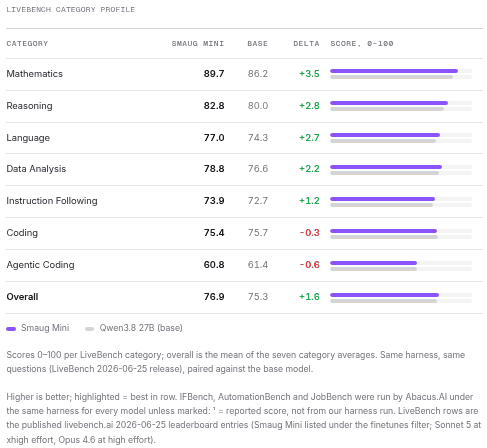
Because the underlying Qwen base model was already proficient at coding-style tasks, Smaug Mini’s largest performance gains manifested in Mathematics, which improved by 3.5 points, and Reasoning, which rose by 2.8 points. Additionally, the model recorded a 13.5-point gain over its base on NL2Repo-Bench, moving from 42.3 to 55.8. An interesting dynamic emerges in its agentic coding score, which experienced a slight decrease of 0.6 points compared to the base model.

Despite this minor regression in one specific subcategory, Smaug Mini outperforms prominent proprietary systems including Claude Sonnet 5, Claude Opus 4.6, and GPT-5.6 Luna on evaluations such as IFBench for instruction following, AutomationBench, and JobBench. JobBench in particular demonstrated a substantial 17.1-point gain over the base model, moving from 33.4 to 50.5. This divergence underscores the distinction between what a narrow benchmark category measures and what a model can achieve in practical, real-world execution.
Smaug Agentic and Behavioral Reliability at Scale
As the largest model in the lineup, Smaug Agentic is built upon Kimi K3, a state-of-the-art mixture-of-experts model from Moonshot AI featuring 2.8 trillion parameters. Interestingly, Smaug Agentic exhibited the smallest numerical benchmark deltas over its base model among the three Smaug variants. As the research documentation notes, the behavioral change achieved by the fine-tuning process was significantly more substantial than the movement in benchmark scores.
Honest evaluation of the official data indicates a small number of benchmarks where the base model outperformed the fine-tuned version, including Terminal-Bench 2.1, where the base scored 88.3 compared to the fine-tuned model’s 86.5, and MMMU-Pro, where scores shifted from 81.6 down to 81.0. However, quantitative benchmarks fail to capture the primary behavioral enhancement introduced by the fine-tuning: the successful suppression of runaway reasoning loops while preserving normal operational deliberation.
During rigorous testing involving 113 agentic coding tasks spanning more than seven hours of continuous operation, Smaug Agentic executed a median of 78 agent steps per task with zero infrastructure errors and zero timeouts. At this frontier scale, the fine-tuning process did not focus on generating headline score increases, but rather on producing a resilient model capable of operating reliably within extended execution loops without breaking down.
Implications for Practical Deployment
Evaluating the Smaug model family requires matching each variant to the specific operational workload it was designed to manage. For applications demanding sustained, long-context tool utilization, extensive document processing, or repeated API calls spanning multi-hour workflows, the pronounced gains seen in Smaug Flash offer the most direct utility. For scenarios requiring efficient multimodality and instruction following within a compact 28-billion-parameter size that fits on a single graphics processing unit, Smaug Mini provides competitive advantages over established closed-source alternatives. Meanwhile, for applications requiring high endurance across hundreds of execution steps without infrastructural failure, the behavioral stability demonstrated by Smaug Agentic serves as a critical performance indicator.
Ultimately, developers seeking to integrate open-weight models into agent-based applications must look beyond standardized benchmark metrics. While benchmark results provide an initial roadmap for identifying which architectures are worth evaluating, factors such as hardware configuration, context length, task difficulty, task completion ratios, production latency, and cost per thousand agent steps remain paramount. The Smaug series demonstrates that targeted fine-tuning can successfully resolve distinct operational bottlenecks, but practical validation against real-world workloads remains essential for successful enterprise deployment.