










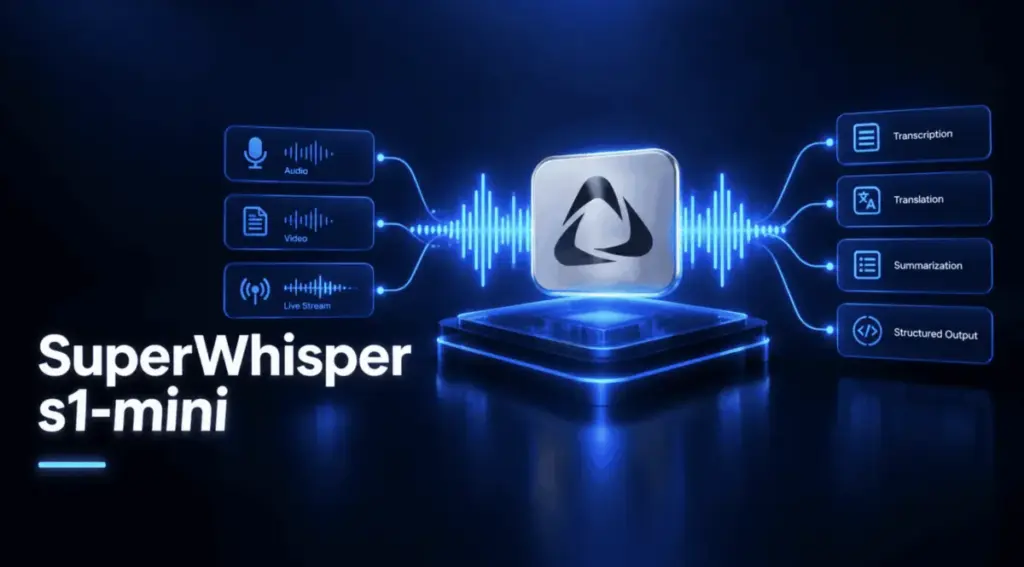
SuperWhisper officially launched its S1 family of proprietary audio models, introducing a three-pronged approach to voice-to-text processing built around a central premise: that transcription and cleanup tools can achieve higher speeds and greater accuracy without requiring user data for training. Released on August 19, 2026, the lineup consists of three distinct models—S1-Voice, S1-Language, and S1-mini—each tailored for specific stages of the audio processing pipeline. While two of these models are hosted in the cloud, the third model, S1-mini, stands out as an open-weights release designed to operate entirely locally on standard laptop hardware.
The introduction of the S1 family arrives as developers and enterprises increasingly seek alternatives to routing sensitive audio transcripts through general-purpose cloud infrastructure. By offering a mix of cloud-based power and local efficiency, SuperWhisper aims to address the varied demands of dictation applications, meeting-transcription software, and accessibility tools.
What’s New in the S1 Family

The newly unveiled S1 family divides responsibilities across specialized architectures rather than relying on a single, monolithic engine. S1-Voice serves as SuperWhisper’s proprietary cloud speech-to-text model, engineered to replace standard Automatic Speech Recognition (ASR) engines. According to the company’s benchmark evaluations across eight different datasets—including complex meeting audio and financial earnings calls—S1-Voice achieved a 6.8 percent average word error rate, marking the lowest error rate among fifteen models tested by SuperWhisper, alongside a 2.2 percent error rate specifically on LibriSpeech benchmarks.
Positioned downstream from transcription, S1-Language functions as a cloud instruction-following model designed for advanced text cleanup, custom formatting rules, and meeting-note structuring. It targets complex formatting needs that extend far beyond basic punctuation and capitalization normalization.
In contrast, S1-mini occupies a unique position in the family. It is the only model in the S1 release with open weights, published directly on Hugging Face, and built specifically to run completely offline without generating external network requests.
Engineering Focus and Performance Metrics
The defining characteristic of S1-mini is not merely its compact parameter count, but the specific design constraints enforced during its development. Model documentation describes the system as engineered for strict obedience. Rather than attempting to act as a broad conversational assistant, the model is trained exclusively to transform raw, lowercase, unpunctuated ASR transcripts into polished written text without adding outside content, correcting factual errors, altering dialects, or softening profanity.
Performance evaluations on a held-out evaluation set comprising 7,519 English cases across 104 previously unseen transcripts demonstrate the effectiveness of this narrow focus. The model achieves a 94.8 percent token accuracy and an 11.6 percent text-edit error rate. When processing email-formatted outputs, S1-mini correctly identifies introductory greetings 99.3 percent of the time and sign-offs in 97.9 percent of instances. Furthermore, the model exhibits high reliability in edge cases, with fewer than one percent of generations displaying degenerative behaviors such as looping or text truncation. When presented exclusively with filler noise or silence, the model returns an empty string 98.6 percent of the time rather than hallucinating text to fill the gap.
User control over the output is managed through a structured control line prepended to every input. This control mechanism relies on three independent axes: styling, which ranges from casual to formal and governs capitalization and contractions; structure, which dictates whether output appears as prose or bulleted lists while strictly requiring at least three genuine items before applying bullet points; and context, which switches between general usage and email formatting to trigger greeting and sign-off conventions. Because these three axes were trained independently, combinations function reliably across varied use cases.
Technical Implementation and Compatibility
Developers working with S1-mini must account for its architectural lineage. Because the model is fine-tuned from Qwen3-0.6B, it inherits the underlying chat template, which natively activates a reasoning or "thinking mode" by default. However, because S1-mini was trained without reasoning traces in its training data, failing to explicitly disable this feature results in the model emitting an empty thinking block and halting execution without producing visible error messages. Consequently, proper implementation requires explicitly setting generation parameters to bypass this mode to secure standard output.
Furthermore, S1-mini relies on greedy decoding by default. Because text normalization is treated as a deterministic transformation rather than a creative generation task, deterministic decoding prevents the introduction of unwanted variance during post-processing.
Differentiation from General-Purpose and Cloud Models
Traditional text cleanup workflows typically rely on one of two paradigms: routing raw ASR outputs through large, general-purpose chat models paired with complex prompt engineering, or deploying oversized local models that lack specialized training for transcription formatting. S1-mini challenges this approach by demonstrating that a narrow, highly optimized model can outperform larger alternatives on specific tasks while consuming a fraction of the computational resources.
With 596 million unique parameters, S1-mini operates comfortably on local laptop central processing units without requiring dedicated graphics hardware. This resource efficiency delivers lower latency and reduced infrastructure overhead compared to general chat models ranging from seven to eight billion parameters.
Within SuperWhisper’s own ecosystem, S1-mini and S1-Language serve complementary roles based on deployment preferences. Offline users can pair S1-mini with a local ASR engine to maintain complete data privacy, while cloud-dependent deployments can utilize S1-Language alongside S1-Voice for heavier administrative workloads.
Practical Deployment and Licensing Considerations
For developers looking to integrate S1-mini into dictation software, voice assistants, or enterprise transcription tools, quantized builds compatible with frameworks such as llama.cpp, Ollama, and LM Studio offer reduced memory footprints with negligible impact on overall accuracy.
Deployment teams must also review the specific licensing terms governing the model. S1-mini is distributed under an Apache 2.0 license modified with an attribution clause requiring downstream applications to retain the precise name "S1-mini" and reference "SuperWhisper" wherever the model is implemented.
As voice interfaces become more prevalent in software development, the release of specialized, open-weights models like S1-mini highlights a growing industry shift toward lightweight, task-specific artificial intelligence designed for efficient on-device execution.