








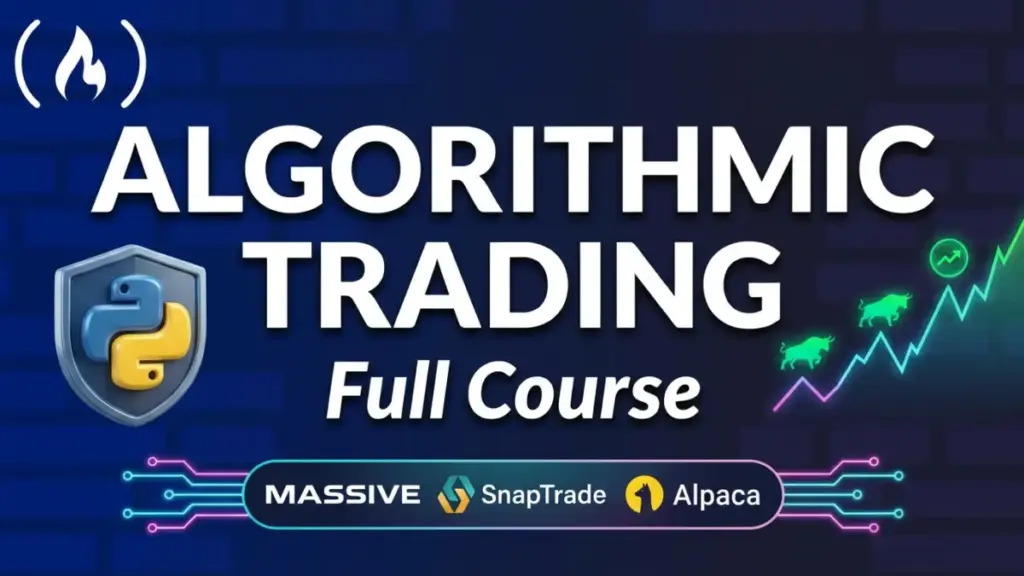
freeCodeCamp.org has announced the release of a comprehensive, hands-on video course on its official YouTube channel, designed to teach developers how to build an automated, end-to-end algorithmic trading system from scratch utilizing Python and Django.
The newly launched two-hour tutorial guides learners through the complete process of engineering a functional, production-style web application called Momentum Trader. This software project is built to evaluate a vast universe of equities, calculate quantitative momentum scores across a structured 12-month lookback period—while carefully excluding the most recent month to mitigate the impact of short-term price reversals—generate accurate buy and sell trading signals, and ultimately execute orders automatically into a live brokerage account without manual intervention.
The release addresses a growing demand among software engineers and finance enthusiasts who wish to bridge the gap between traditional web development and quantitative finance. By breaking down both the underlying quantitative logic and the broader system architecture, the course demonstrates how robust backend frameworks like Django can be integrated with financial APIs to handle complex, data-driven tasks.
Algorithmic trading has traditionally been confined to elite institutional trading desks, quantitative hedge funds, and proprietary trading firms equipped with expensive, low-latency infrastructure. However, the proliferation of modern brokerages offering developer-friendly application programming interfaces, alongside powerful open-source programming languages like Python, has significantly democratized access to automated market strategies. Through this new educational offering, freeCodeCamp aims to provide developers with the practical skills required to design, test, and deploy their own automated trading mechanisms in a controlled environment.
At the core of the Momentum Trader application featured in the tutorial is a momentum-based investment strategy. Momentum investing is a well-documented financial anomaly and strategy wherein investors buy securities that have shown high past returns and sell securities that have exhibited poor recent performance. By implementing a 12-month lookback period that intentionally skips the most immediate prior month, the strategy guards against the well-known short-term momentum reversal effect, ensuring that trades are based on sustained medium-term trends rather than transient market noise.
The application serves as a full-stack engineering challenge. On the backend, Python handles the heavy computational lifting, data ingestion, indicator calculations, and communication with external financial services. Django acts as the robust web framework orchestrating the application logic, database management, and administrative oversight. The course walks viewers through how these distinct components interact seamlessly to create a cohesive, automated system capable of running scheduled background tasks and interacting securely with brokerage accounts.
The release of this educational content aligns with freeCodeCamp’s broader mission to provide accessible, high-quality technical education to a global audience. Operating as an open-source community and learning platform, freeCodeCamp has historically focused on foundational web development, data science, and computer science fundamentals. Its curriculum and supplementary video resources have collectively helped tens of thousands of individuals worldwide transition into professional careers as software developers and engineers.
By expanding its video catalog to include sophisticated financial technology topics like algorithmic trading with Python and Django, the organization continues to cater to intermediate and advanced developers seeking to apply their programming expertise to specialized domains. The complete two-hour video course is currently available for public viewing on the freeCodeCamp.org YouTube channel, offering developers an in-depth look at building modern, automated financial web applications from the ground up.